Abreha Bereket Berhe, Fisseha Girmatsion, Tsadik Mache, Legesse Awol Yemane, Teka Hale, Abraha Hiluf Ebuy, Hadush Martha Yemane, Gebrekurstos Gebrehaweria, Ayele Brhane, Hailu Abraha Gebreegziabher, Tsegay Haile, Ebrahim Mohamedawel Mohamedniguss, Godefay Hagos, Gebremariam Tsega, Hagos Tigist, Muoze Kibrom, Mulugeta Afewerk, Gebremeskel Tesfit
Mekelle University, College of health sciences, school of Medicine, Mekelle, Ethiopia.
Mekelle University, College of Health science, School of Public Health, Mekelle, Ethiopia.
Confl Health. 2024 Aug 31;18(1):55. doi: 10.1186/s13031-024-00614-4.
Child mortality is one of the key indicators of the Sustainable development goals. The Ethiopian healthcare system in general and Tigray's healthcare system in particular has shown a remarkable progress in terms of reducing maternal, neonatal, and under-five mortality in the last couple of decades. However, the war erupted in November 2020 caused the healthcare system to collapse and little is known about the status of child mortality in Tigray. Thus, this study aimed to examine the magnitude and causes of under-five child mortality in the embattled Tigray region was conducted from October 2020 - May 2022.
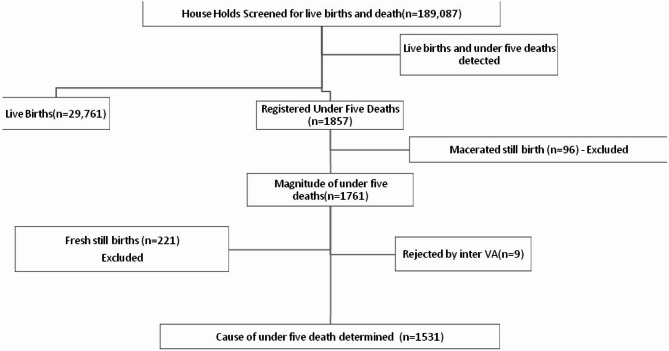
A cross-sectional community-based survey was employed. The study included all zones except the western zone and some areas of eastern and north western Tigray bordering Eritrea. These areas were skipped for security reasons. Based on multistage cluster sampling, 121 tabiyas in districts were selected. Census was conducted to survey 189,087 households in the 121 Tabiyas. A locally developed household screening tool and the latest world health organization verbal autopsy instrument were used. The Verbal Autopsy data was processed using the Inter-VA-5.1 (probabilistic modeling) to assign the cause of death. Under-five mortality rate (U5MR) was calculated per 1000 live births with a 95% confidence interval (CI).
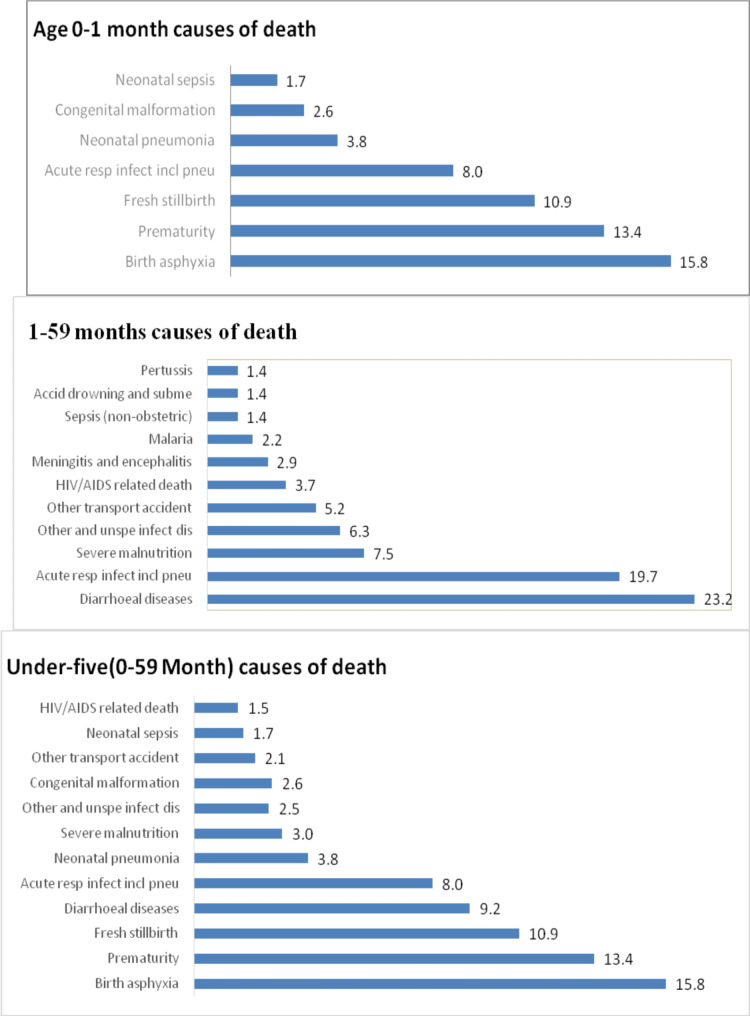
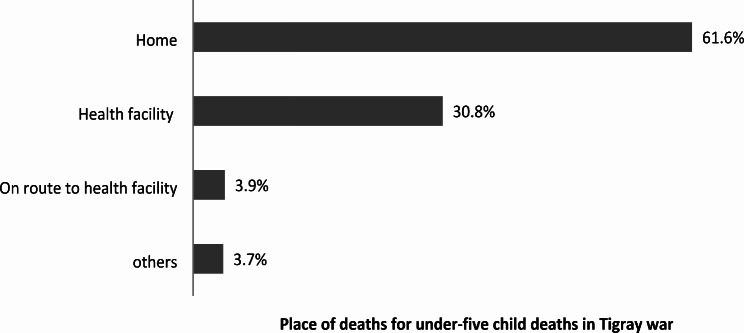
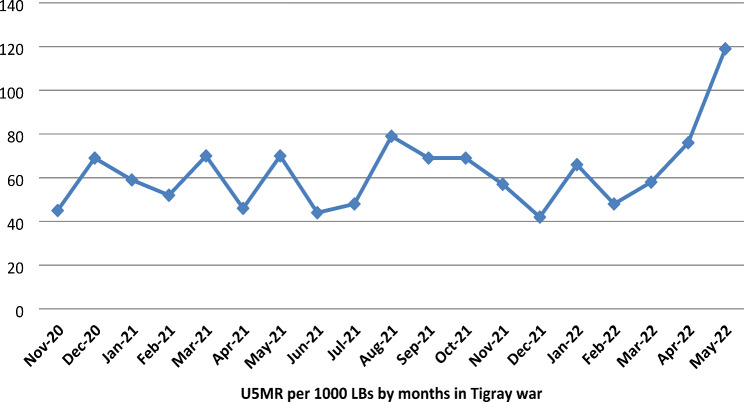
In the present study, out of 29,761 live births, 1761 under-five children died giving an under-five mortality rate of 59(95% CI, 57-62) per 1000 live births. Deaths in the neonatal period and post-neonatal period accounted for 60% and 19.9% of the deaths respectively. Overall, the top 3 causes of under-five child mortality in the present study were: Perinatal asphyxia (n = 277,18%,) prematurity (n = 235,16%) and diarrheal diseases (n = 162, 12.5%). In those who died after first month of life, diarrheal diseases, lower respiratory tract infection, sever acute malnutrition and HIV were the main causes of death. Concerning the place of death, 61.6% of the children died at home.
The present study revealed the doubling of under-five mortality in Tigray from where the figure stood in the pre-war period. The leading causes of death in under-five mortality are potentially preventable in situation where the healthcare system is functioning. Restoring the healthcare system and its apparatus, improving access to skilled institutional delivery, smooth perinatal transition, improving nutrition status of children, access to full course of vaccines could ameliorate the staggering under-five mortality rate in the war in Tigray.
儿童死亡率是可持续发展目标的关键指标之一。在过去几十年里,埃塞俄比亚的医疗体系,尤其是提格雷地区的医疗体系,在降低孕产妇、新生儿和五岁以下儿童死亡率方面取得了显著进展。然而,2020年11月爆发的战争导致医疗体系崩溃,人们对提格雷地区儿童死亡率的状况知之甚少。因此,本研究旨在调查2020年10月至2022年5月期间,饱受战乱的提格雷地区五岁以下儿童死亡率的规模和原因。
采用基于社区的横断面调查。该研究涵盖了除西区以及提格雷东部和西北部与厄立特里亚接壤的一些地区之外的所有区域。出于安全考虑,这些地区被排除在外。基于多阶段整群抽样,在各地区选取了121个塔比耶(tabiyas)。进行人口普查以调查这121个塔比耶中的189,087户家庭。使用了当地开发的家庭筛查工具和世界卫生组织最新的死因推断工具。死因推断数据通过Inter-VA-5.1(概率模型)进行处理,以确定死亡原因。计算每1000例活产的五岁以下儿童死亡率(U5MR)及其95%置信区间(CI)。
在本研究中,29,761例活产中,有1761名五岁以下儿童死亡,每1000例活产的五岁以下儿童死亡率为59(95%CI,57 - 62)。新生儿期和新生儿后期死亡分别占死亡总数的60%和19.9%。总体而言,本研究中五岁以下儿童死亡的前三大原因是:围产期窒息(n = 277,18%)、早产(n = 235,16%)和腹泻病(n = 162,12.5%)。在出生后第一个月后死亡的儿童中,腹泻病、下呼吸道感染、重度急性营养不良和艾滋病毒是主要死因。关于死亡地点,61.6%的儿童在家中死亡。
本研究显示,提格雷地区五岁以下儿童死亡率较战前水平翻了一番。在医疗体系正常运作的情况下,五岁以下儿童死亡的主要原因有可能得到预防。恢复医疗体系及其设施,改善获得熟练的机构分娩服务的机会,实现平稳的围产期过渡,改善儿童营养状况,确保获得全程疫苗接种,可能会改善提格雷战争中惊人的五岁以下儿童死亡率。