Department of Pharmacology and Therapeutics, School of Medicine, Trinity College Dublin, Dublin D02 PN40, Ireland.
Wellcome-HRB Clinical Research Facility, St James's Hospital, Dublin D08 NHY1, Ireland.
Eur Heart J. 2024 Oct 7;45(38):4124-4134. doi: 10.1093/eurheartj/ehae564.
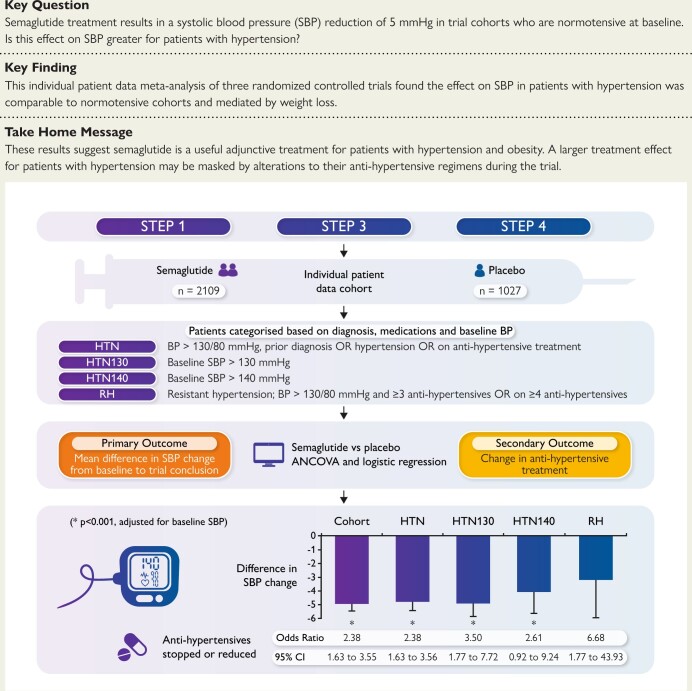
Randomized clinical trials (RCTs) assessing semaglutide reported reductions of systolic blood pressure (SBP) in trial populations with baseline blood pressure in the normotensive range. This study aimed to determine whether this SBP reduction is greater in hypertensive groups.
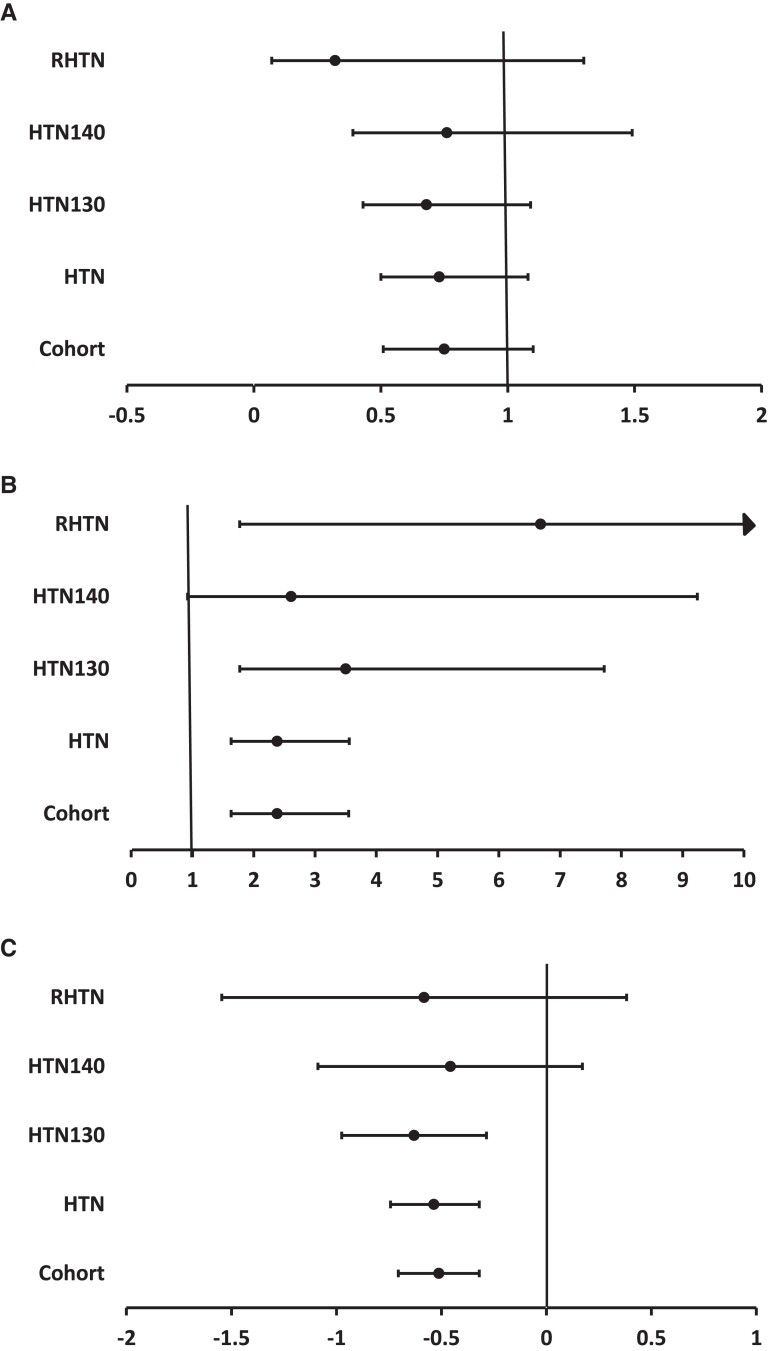
Individual patient data (IPD) from three RCTs examining the effect of semaglutide 2.4 mg on body weight over 68 weeks were included. Trial participants were categorized according to a hypertension diagnosis, treatment or baseline measurement (HTN), baseline SBP > 130 mmHg (HTN130) or >140 mmHg (HTN140), and those with apparent resistant hypertension (RH). The primary analysis compared the in-trial change in SBP in the semaglutide and placebo arms. Alterations of anti-hypertensive medications were quantified by treatment intensity score and compared between arms. These analyses were performed using analysis of covariance.
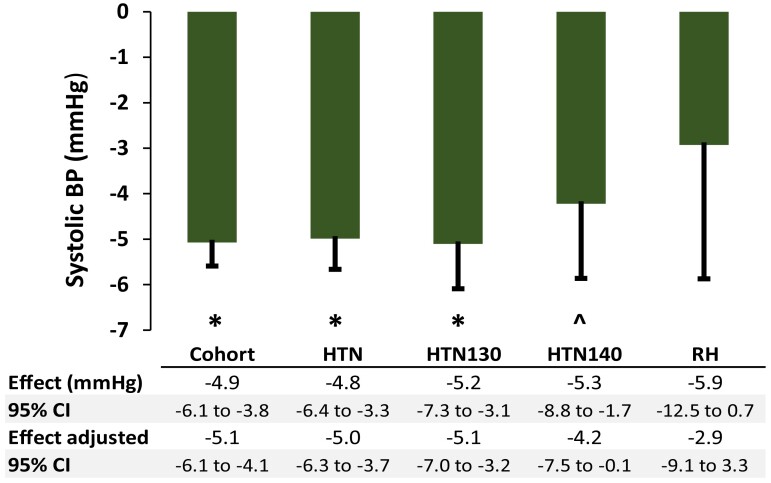
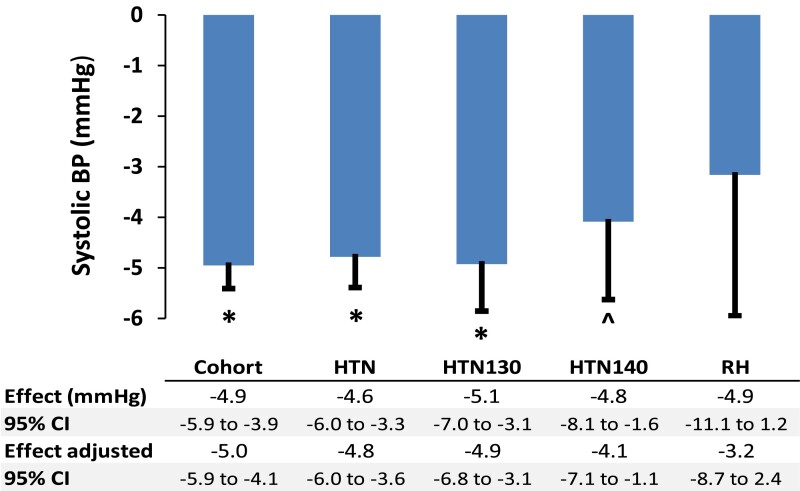
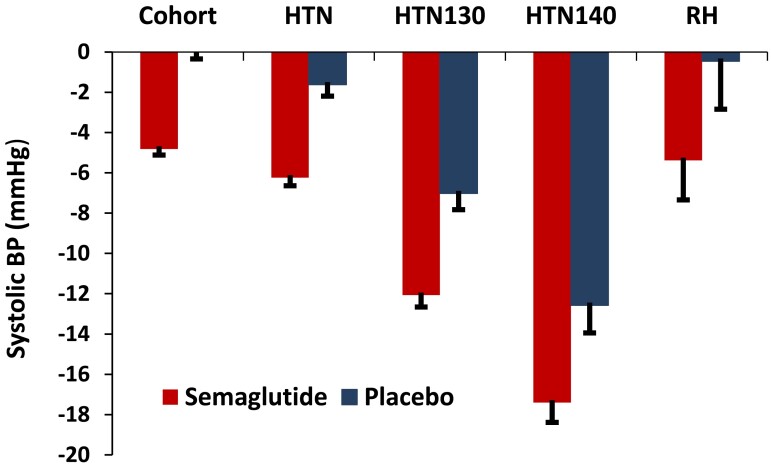
Overall, 3136 participants were included. The difference in SBP change between the treatment (n = 2109) and placebo (n = 1027) groups was -4.95 mmHg [95% confidence interval (CI) -5.86 to -4.05] overall. This difference was -4.78 mmHg (95% CI -5.97 to -3.59) for HTN, -4.93 mmHg (95% CI -6.75 to -3.11) for HTN130, -4.09 mmHg (95% CI -7.12 to -1.06) for HTN140, and -3.16 mmHg (95% CI -8.69-2.37) for RH. Reduction in SBP was mediated substantially by weight loss. The anti-hypertensive treatment intensity score decreased for those on semaglutide compared to placebo (-0.51; 95% CI -0.71 to -0.32).
This IPD analysis of three large RCTs found blood pressure reductions with semaglutide in participants with hypertension that were similar to those seen in all trial participants. This finding may in part be due to concurrent reductions to anti-hypertensive medications. These results suggest that semaglutide is a useful adjunctive treatment for patients with hypertension and obesity.
评估司美格鲁肽的随机临床试验(RCT)报告称,在基线血压处于正常范围内的试验人群中,收缩压(SBP)有所下降。本研究旨在确定在高血压组中,这种 SBP 降低是否更大。
纳入了三项评估司美格鲁肽 2.4mg 对体重影响的 RCT 的个体患者数据(IPD),共 68 周。根据高血压诊断、治疗或基线测量(HTN)、基线 SBP>130mmHg(HTN130)或>140mmHg(HTN140)以及明显的难治性高血压(RH)对试验参与者进行分类。主要分析比较了司美格鲁肽组和安慰剂组的 SBP 试验内变化。通过治疗强度评分来量化抗高血压药物的变化,并比较各组之间的差异。这些分析使用协方差分析进行。
共有 3136 名参与者被纳入。治疗组(n=2109)和安慰剂组(n=1027)之间 SBP 变化的差异为-4.95mmHg[95%置信区间(CI)-5.86 至-4.05]。HTN 组为-4.78mmHg(95%CI-5.97 至-3.59),HTN130 组为-4.93mmHg(95%CI-6.75 至-3.11),HTN140 组为-4.09mmHg(95%CI-7.12 至-1.06),RH 组为-3.16mmHg(95%CI-8.69-2.37)。体重减轻在 SBP 降低中起了主要作用。与安慰剂相比,接受司美格鲁肽治疗的患者的抗高血压治疗强度评分降低(-0.51;95%CI-0.71 至-0.32)。
本项对三项大型 RCT 的 IPD 分析发现,高血压患者使用司美格鲁肽后血压下降与所有试验参与者相似。这一发现可能部分归因于同时减少了抗高血压药物的使用。这些结果表明,司美格鲁肽是高血压和肥胖患者的一种有用的辅助治疗方法。