Shi Quan, Huang Yang, Huo Na, Jiang Yi, Zhang Tong, Wang Juncheng
Department of Stomatology, The First Medical Center, Chinese PLA General Hospital, Beijing, China.
J Adv Prosthodont. 2024 Aug;16(4):212-220. doi: 10.4047/jap.2024.16.4.212. Epub 2024 Aug 20.
This cone-beam computed tomography (CBCT) study aimed to analyze the anatomical characteristics of alveolar bone at mandibular first molar (MFM) and their implications for immediate implant placement surgery.
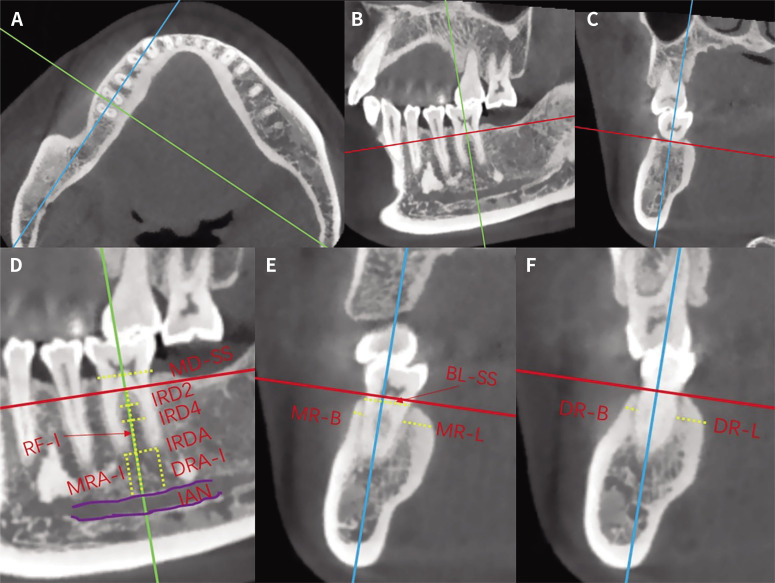
100 patients with 140 MFMs were reviewed retrospectively. We first performed a 3D reconstruction of the patient's CBCT data to determine a reference plane with ideal implant placement and orientation. The following parameters of MFM region were analyzed: mesial-distal socket size (MD-SS), buccal-lingual socket size (BL-SS), root furcation fornix to inferior alveolar nerve (IAN) distance (RF-I), interradicular bone thickness (IRB), mesial/distal root apex to the IAN distance (MRA-I/DRA-I), thickness of the buccal/lingual bone of the mesial root (MR-B/MR-L), thickness of the buccal/lingual bone of the distal root (DR-B/DR-L).
The MD-SS of MFM was 8.74 ± 0.76 mm, and the BL-SS was 8.26 ± 0.72 mm. The MR-B, DR-B was 1.01 ± 0.40 mm and 1.14 ± 0.50 mm, and the difference was statistically significant ( = .001). The values of the MR-L, DR-L were 2.71 ± 0.78 mm and 3.09 ± 0.73 mm, and the difference was also statistically significant ( < .001). The mean distance of RF-I was 15.68 ± 2.13 mm, and the MRA-I was 7.06 ± 2.22 mm, which was greater than that of DRA-I (6.48 ± 2.30 mm, < .001). The IRB at 2 mm, 4 mm apical from the furcation fornix, and at apex level was 2.81 ± 0.50 mm, 3.30 ± 0.62 mm, and 4.44 ± 1.02 mm, respectively.
There is relatively sufficient bone mass in interradicular bone in height, but an adequate width is lacking for the bone between the mesial and distal root after the extraction of the MFM for immediate implantation. The thickness of the MFM buccal bone is relative thin, especially for the mesial root.
本锥形束计算机断层扫描(CBCT)研究旨在分析下颌第一磨牙(MFM)牙槽骨的解剖特征及其对即刻种植手术的影响。
回顾性分析100例患者的140颗MFM。首先对患者的CBCT数据进行三维重建,以确定理想种植体植入的参考平面和方向。分析MFM区域的以下参数:近远中牙槽窝尺寸(MD-SS)、颊舌向牙槽窝尺寸(BL-SS)、根分叉穹窿至下牙槽神经(IAN)的距离(RF-I)、根间骨厚度(IRB)、近中/远中根尖至IAN的距离(MRA-I/DRA-I)、近中牙根颊侧/舌侧骨厚度(MR-B/MR-L)、远中牙根颊侧/舌侧骨厚度(DR-B/DR-L)。
MFM的MD-SS为8.74±0.76mm,BL-SS为8.26±0.72mm。MR-B、DR-B分别为1.01±0.40mm和1.14±0.50mm,差异有统计学意义(P = 0.001)。MR-L、DR-L的值分别为2.71±0.78mm和3.09±0.73mm,差异也有统计学意义(P < 0.001)。RF-I的平均距离为15.68±2.13mm,MRA-I为7.06±2.22mm,大于DRA-I(6.48±2.30mm,P < 0.001)。根分叉穹窿根尖2mm、4mm及根尖水平处的IRB分别为2.81±0.50mm、3.30±0.62mm和4.44±1.02mm。
MFM拔除后即刻种植时,根间骨高度骨质相对充足,但近远中牙根间骨宽度不足。MFM颊侧骨厚度相对较薄,尤其是近中牙根。