Nugent Killian, Das Prantik, Ford Dan, Sabharwal Ami, Perna Carla, Dallas Nicola, Lester Jason, Camilleri Philip
GenesisCare UK, Oxford, United Kingdom.
Department of Oncology, Oxford University Hospitals National Health Service Foundation Trust, Oxford, United Kingdom.
Adv Radiat Oncol. 2024 Jul 18;9(9):101574. doi: 10.1016/j.adro.2024.101574. eCollection 2024 Sep.
To report acute and late bowel, urinary, and sexual dysfunction patient-reported outcome measures, among patients with localized prostate cancer who underwent stereotactic magnetic resonance-guided daily adaptive radiation therapy (SMART).
All patients who completed a baseline 12-item Patient-Reported Outcomes Version of the Common Terminology Criteria for Adverse Events questionnaire, before undergoing SMART with 36.25 Gy in 5 fractions, were subsequently followed up with the same graded questionnaire at set time points. Latest prostate-specific antigen levels were recorded. The percentage of patients who reported no change from their baseline adverse event (AE) or reported a new ≥ "frequent or almost constant" or "severe grade or higher" AE grade during follow-up was calculated. The maximum 12-item Patient-Reported Outcomes Version of the Common Terminology Criteria for Adverse Events grade for each item was recorded for each patient. The percentage of toxicity levels for each separate AE item at set time points was calculated.
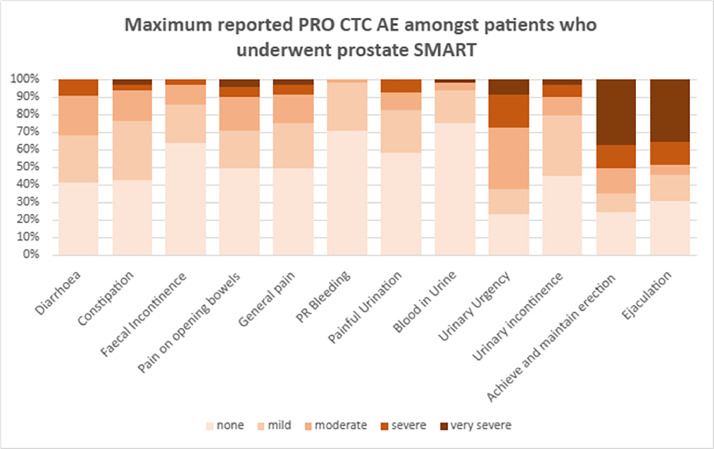
The total number of patients was 69 with a median follow-up of 27 months. Median age of the cohort was 73 years (range, 54-85 years). The median pretreatment prostate-specific antigen level, T stage, and Gleason score were 7.5 mmol/L (range, 4.5-32 mmol/L), T2b (range, T2-T3b), and 7 (3 + 4; range, 6-9), respectively. No patient had biochemical failure during follow-up. Regarding bowel symptoms, >80% of men reported no change from baseline toxicity during follow-up. New ≥ frequent or almost constant diarrhea was reported in 9% of patients. "Almost constant" diarrhea peaked at 1 month but was absent at >33 months. Regarding urinary symptoms, increased urinary urgency was the most common complaint (39%). Twenty percent of men reported new ≥ frequent or almost constant urinary urgency incidence peaking at 1 month but absent at >33 months. New "severe" sexual dysfunction was seen in 26% of patients and was persistent at >33 months.
Our study is one the largest patient-reported outcomes study after prostate SMART. It shows acceptable levels of toxicity even up to 2 years after treatment.
报告接受立体定向磁共振引导下每日适应性放射治疗(SMART)的局限性前列腺癌患者的急性和晚期肠道、泌尿及性功能障碍的患者报告结局指标。
所有患者在接受5次分割、总剂量36.25 Gy的SMART治疗前,均完成了一份包含12项内容的患者报告的不良事件通用术语标准问卷(Patient-Reported Outcomes Version of the Common Terminology Criteria for Adverse Events questionnaire),随后在设定的时间点用相同的分级问卷进行随访。记录最新的前列腺特异性抗原水平。计算报告随访期间不良事件(AE)与基线相比无变化或报告出现新的≥“频繁或几乎持续”或“严重程度及以上”AE分级的患者百分比。记录每位患者12项患者报告的不良事件通用术语标准问卷中各项目的最高分级。计算在设定时间点每个单独AE项目的毒性水平百分比。
患者总数为69例,中位随访时间为27个月。该队列的中位年龄为73岁(范围54 - 85岁)。治疗前前列腺特异性抗原水平、T分期和 Gleason评分的中位数分别为7.5 mmol/L(范围4.5 - 32 mmol/L)、T2b(范围T2 - T3b)和7(3 + 4;范围6 - 9)。随访期间无患者出现生化复发。关于肠道症状,超过80%的男性报告随访期间与基线毒性相比无变化。9%的患者报告出现新的≥频繁或几乎持续的腹泻。“几乎持续”的腹泻在1个月时达到峰值,但在>33个月时消失。关于泌尿症状,尿急增加是最常见的主诉(39%)。20%的男性报告出现新的≥频繁或几乎持续的尿急,发病率在1个月时达到峰值,但在>33个月时消失。26%的患者出现新的“严重”性功能障碍,且在>33个月时仍持续存在。
我们的研究是前列腺SMART治疗后最大规模的患者报告结局研究之一。它表明即使在治疗后长达2年,毒性水平也是可接受的。