Figueiredo Fernanda de Azevedo, Esteves William Antonio M, Hung Judy, Gomes Nayana Flamini Arantes, Taconeli Cesar Augusto, Pantaleão Alexandre Negrão, de Oliveira Matheus Assunção Rabello, de Magalhães Silvio Mendes, Chavez Luz Marina Tacuri, Tan Timothy C, Bhat Aditya, Levine Robert A, Nunes Maria Carmo Pereira
Postgraduate Program of Infectious Diseases and Tropical Medicine, School of Medicine, Universidade Federal de Minas Gerais, Av. Professor Alfredo Balena, 190, Santa Efigênia, Belo Horizonte, MG 30130 100, Brazil.
Hospital das Clínicas, School of Medicine,Universidade Federal de Minas Gerais, Av. Professor Alfredo Balena, 190, Santa Efigênia, Belo Horizonte, MG 30130 100, Brazil.
Eur Heart J Imaging Methods Pract. 2024 Jul 12;2(2):qyae067. doi: 10.1093/ehjimp/qyae067. eCollection 2024 Apr.
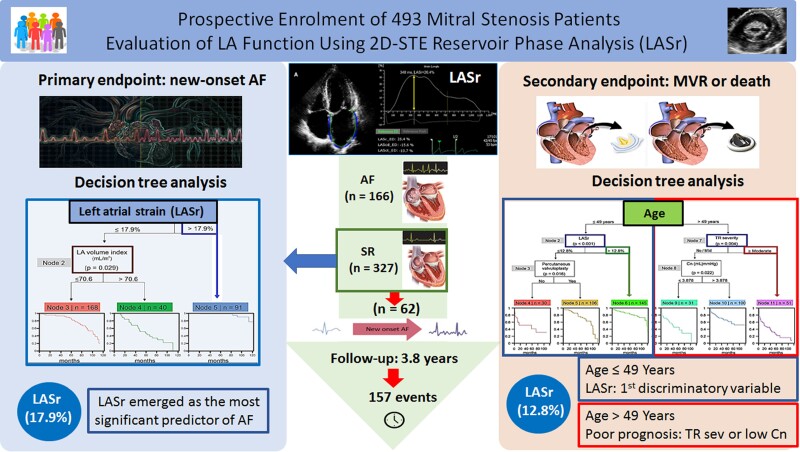
Rheumatic mitral stenosis (MS) frequently leads to impaired left atrial (LA) function because of pressure overload, highlighting the underlying atrial pathology. Two-dimensional speckle tracking echocardiography (2D-STE) offers early detection of LA dysfunction, potentially improving risk assessment in patients with MS. This study aims to evaluate the predictive value of LA function assessed by 2D-STE for clinical outcomes in patients with MS.
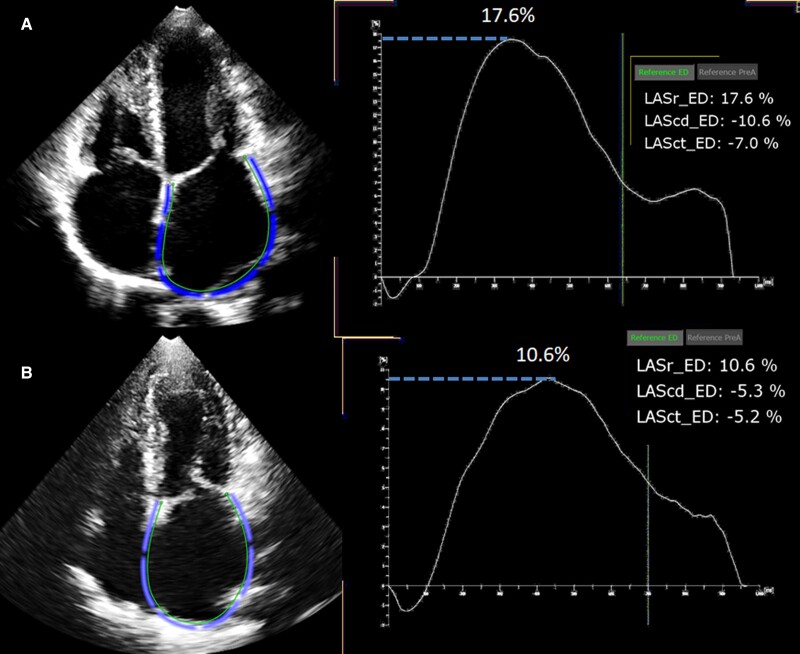
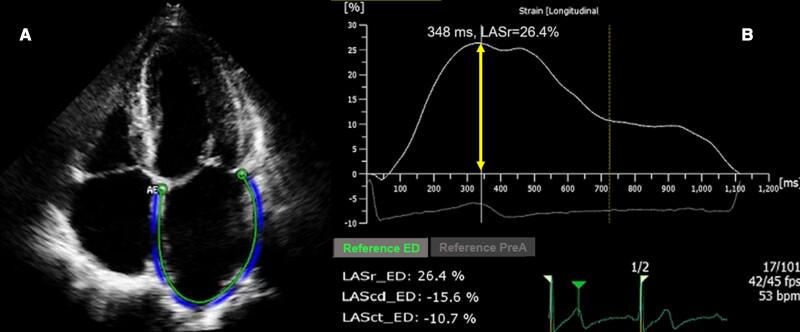
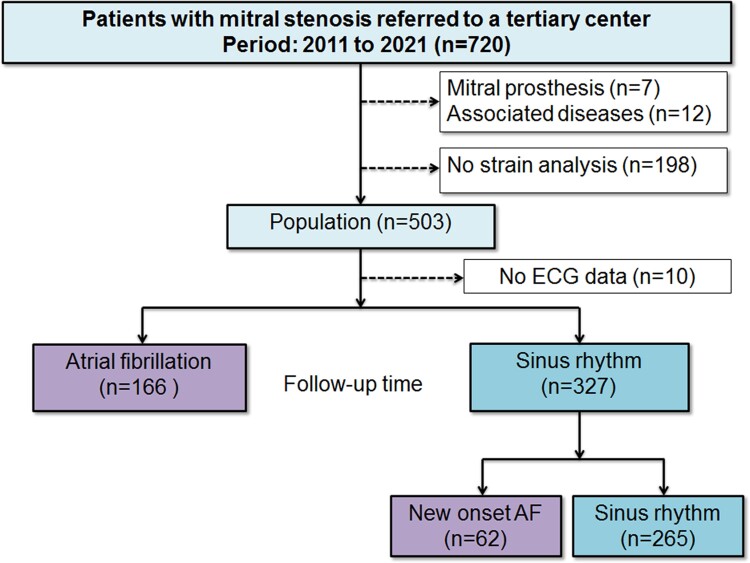
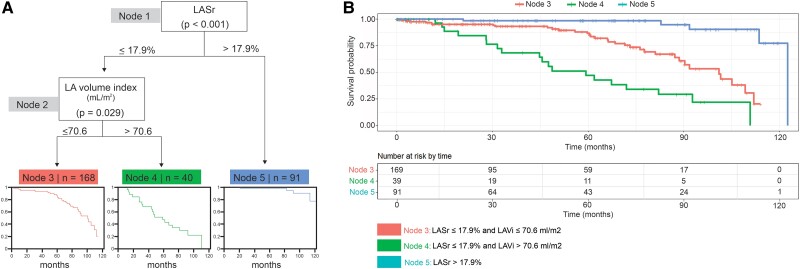
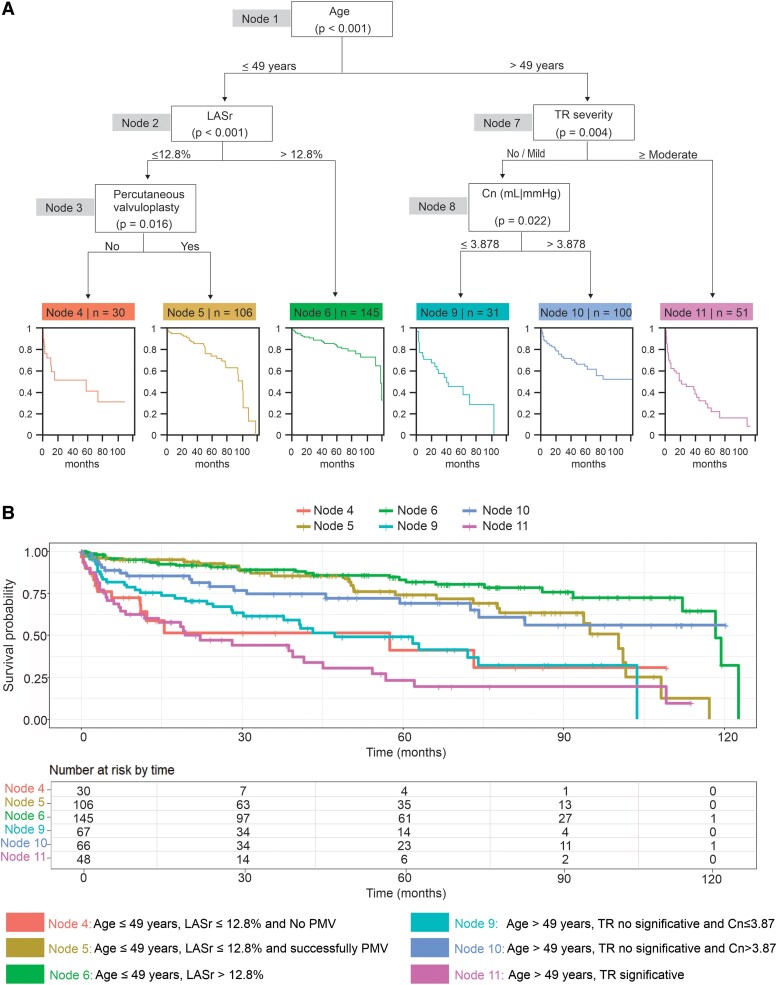
Between 2011 and 2021, patients with MS underwent LA function assessment using 2D-STE, with focus on the reservoir phase (LASr). Atrial fibrillation (AF) development constituted the primary outcome, with death or valve replacement as the secondary outcome. Conditional inference trees were employed for analysis, validated through sample splitting. The study included 493 patients with MS (mean valve area 1.1 ± 0.4 cm, 84% female). At baseline, 166 patients (34%) had AF, with 62 patients (19%) developing AF during follow-up. LASr emerged as the primary predictor for new-onset AF, with a threshold of 17.9%. Over a mean 3.8-year follow-up, 125 patients (25%) underwent mitral valve replacement, and 32 patients (6.5%) died. A decision tree analysis identified key predictors such as age, LASr, severity of tricuspid regurgitation (TR), net atrioventricular compliance ( ), and early percutaneous mitral valvuloplasty, especially in patients aged ≤49 years, where LASr, with a threshold of 12.8%, significantly predicted adverse outcomes.
LASr emerged as a significant predictor of cardiovascular events in this MS cohort, validated through a decision tree analysis. Patients were stratified into low- or high-risk categories for adverse outcomes, taking into account LASr, age, TR severity, and .
风湿性二尖瓣狭窄(MS)常因压力过载导致左心房(LA)功能受损,突显了潜在的心房病变。二维斑点追踪超声心动图(2D-STE)可早期检测LA功能障碍,可能改善MS患者的风险评估。本研究旨在评估通过2D-STE评估的LA功能对MS患者临床结局的预测价值。
2011年至2021年期间,MS患者接受了使用2D-STE的LA功能评估,重点关注储存期(LASr)。房颤(AF)的发生构成主要结局,死亡或瓣膜置换作为次要结局。采用条件推断树进行分析,并通过样本拆分进行验证。该研究纳入了493例MS患者(平均瓣膜面积1.1±0.4 cm,84%为女性)。基线时,166例患者(34%)患有AF,62例患者(19%)在随访期间发生AF。LASr成为新发AF的主要预测指标,阈值为17.9%。在平均3.8年的随访中,125例患者(25%)接受了二尖瓣置换,32例患者(6.5%)死亡。决策树分析确定了年龄、LASr、三尖瓣反流(TR)严重程度、净房室顺应性( )和早期经皮二尖瓣球囊成形术等关键预测指标,特别是在年龄≤49岁的患者中,LASr阈值为12.8%时可显著预测不良结局。
在这个MS队列中,LASr成为心血管事件的重要预测指标,并通过决策树分析得到验证。考虑到LASr、年龄、TR严重程度和 ,将患者分为不良结局的低风险或高风险类别。