Istituto Auxologico Italiano, IRCCS, Via L. Ariosto 13, Milano, 20145, Italy.
Biostatistics and Clinical Epidemiology, Fondazione IRCCS San Gerardo dei Tintori, Monza, Italy.
Ital J Pediatr. 2024 Sep 4;50(1):161. doi: 10.1186/s13052-024-01732-8.
Elevated lipoprotein (Lp(a)) levels are associated with increased risk of atherosclerotic processes and cardiovascular events in adults. The amount of Lp(a) is mainly genetically determined. Therefore, it is important to identify individuals with elevated Lp(a) as early as possible, particularly if other cardiovascular risk factors are present. The purpose of the study was to investigate whether, in a population of children and adolescents already followed for the presence of one or more cardiovascular risk factors (elevated blood pressure (BP), and/or excess body weight, and/or dyslipidemia), the measurement of Lp(a) can be useful for better stratifying their risk profile.
In a sample of 195 children and adolescents, height, body weight, waist circumference and systolic (SBP) and diastolic (DBP) BP were measured. Body Mass Index (BMI) and SBP and DBP z-scores were calculated. Plasma Lp(a), total cholesterol, high-density lipoprotein (HDL), triglycerides, glucose, insulin, uric acid and creatinine were assessed. Low-density lipoprotein (LDL) cholesterol was calculated with the Friedewald formula. High Lp(a) was defined as ≥ 75 nmol/L and high LDL cholesterol as ≥ 3.37 mmol/L.
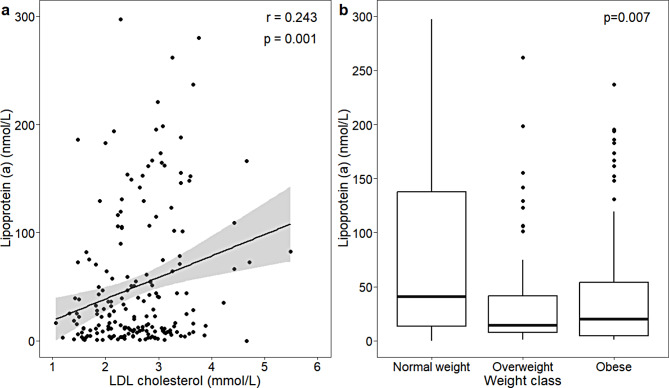
Our sample of children and adolescents (54.4% males, mean age 11.5 years) had median LDL cholesterol and Lp(a) values equal to 2.54 (interquartile range, IQR: 2.07-3.06) mmol/L and 22 (IQR: 7.8-68.6) nmol/L respectively. 13.8% of children had LDL cholesterol ≥ 3.37 mmol/L and 22.6 Lp(a) values ≥ 75 nmol/L. Lp(a) values were higher in children of normal weight than in those with excess weight (p = 0.007), but the difference disappeared if normal weight children referred for dyslipidemia only were excluded from the analysis (p = 0.210). 69.4% of children had normal Lp(a) and LDL cholesterol values and only 6.2% showed both elevated Lp(a) and LDL cholesterol levels. However, 16.6% of the sample, despite having normal LDL cholesterol, had elevated Lp(a) values. Multivariable analyses showed a significant association of LDL cholesterol both with Lp(a) values, and with the presence of elevated Lp(a) levels. For each mmol/L increase in LDL cholesterol the risk of having an elevated Lp(a) value increased by 73%. There was an inverse correlation between BMI z-score and Lp(a). Neither BP z-scores, nor other biochemical parameters were associated with Lp(a).
In our population more than one out of five children had elevated Lp(a) values, and in about 17% of children elevated Lp(a) values were present in the absence of increased LDL cholesterol. Our results suggest that Lp(a) measurement can be useful to better define the cardiovascular risk profile in children and adolescents already followed for the presence of other cardiovascular risk factors such as elevated BP, excess body weight and high LDL cholesterol.
脂蛋白(Lp(a))水平升高与成人动脉粥样硬化过程和心血管事件风险增加有关。Lp(a)的水平主要由遗传决定。因此,尽早识别出 Lp(a)升高的个体非常重要,特别是如果存在其他心血管危险因素。本研究旨在探讨在已经存在一个或多个心血管危险因素(血压升高和/或超重,和/或血脂异常)的儿童和青少年人群中,测量 Lp(a)是否可以更好地分层其风险状况。
在 195 名儿童和青少年的样本中,测量了身高、体重、腰围以及收缩压(SBP)和舒张压(DBP)。计算了体重指数(BMI)和 SBP 和 DBP 的 z 分数。评估了血浆 Lp(a)、总胆固醇、高密度脂蛋白(HDL)、甘油三酯、葡萄糖、胰岛素、尿酸和肌酐。使用 Friedewald 公式计算低密度脂蛋白(LDL)胆固醇。高 Lp(a)定义为≥75nmol/L,高 LDL 胆固醇定义为≥3.37mmol/L。
我们的儿童和青少年样本(54.4%为男性,平均年龄为 11.5 岁)的 LDL 胆固醇和 Lp(a)中位数分别为 2.54(四分位距,IQR:2.07-3.06)mmol/L 和 22(IQR:7.8-68.6)nmol/L。13.8%的儿童 LDL 胆固醇≥3.37mmol/L,22.6%的儿童 Lp(a)值≥75nmol/L。与超重儿童相比,体重正常的儿童 Lp(a)值更高(p=0.007),但如果将仅因血脂异常而就诊的体重正常儿童从分析中排除,差异就会消失(p=0.210)。69.4%的儿童 LDL 胆固醇和 Lp(a)值正常,只有 6.2%的儿童同时出现 LDL 胆固醇和 Lp(a)值升高。然而,样本中仍有 16.6%的儿童尽管 LDL 胆固醇正常,但 Lp(a)值升高。多变量分析显示 LDL 胆固醇与 Lp(a)值以及升高的 Lp(a)水平均有显著相关性。LDL 胆固醇每增加 1mmol/L,Lp(a)值升高的风险就会增加 73%。BMI z 分数与 Lp(a)呈负相关。BP z 分数和其他生化参数均与 Lp(a)无关。
在我们的人群中,超过五分之一的儿童 Lp(a)值升高,约 17%的儿童在 LDL 胆固醇升高的情况下出现 Lp(a)值升高。我们的结果表明,在已经存在其他心血管危险因素(如血压升高、超重和高 LDL 胆固醇)的儿童和青少年中,测量 Lp(a)可以更好地定义心血管风险状况。