Oeding Jacob F, Boos Alexander M, Kalk Josh R, Sorenson Dane, Verhooven F Martijn, Moatshe Gilbert, Camp Christopher L
Alix School of Medicine, Mayo Clinic, Rochester, Minnesota, USA.
Department of Orthopaedics, Institute of Clinical Sciences, Sahlgrenska Academy, University of Gothenburg, Gothenburg, Sweden.
Orthop J Sports Med. 2024 Aug 30;12(8):23259671241264260. doi: 10.1177/23259671241264260. eCollection 2024 Aug.
Understanding interactions between multiple risk factors for shoulder and elbow injuries in Major League Baseball (MLB) pitchers is important to identify potential avenues by which risk can be reduced while minimizing impact on player performance.
To apply a novel game theory-based approach to develop a machine-learning model predictive of next-season shoulder and elbow injuries in MLB pitchers and use this model to understand interdependencies and interaction effects between the most important risk factors.
Case-control study; Level of evidence, 3.
Pitcher demographics, workload measures, pitch-tracking metrics, and injury data between 2017 and 2022 were used to construct a database of MLB pitcher-years, where each item in the database corresponded to a pitcher's information and metrics for that year. An extreme gradient boosting machine-learning model was trained to predict next-season shoulder and elbow injuries utilizing Shapley additive explanation values to quantify feature importance as well as interdependencies and interaction effects between predictive variables.
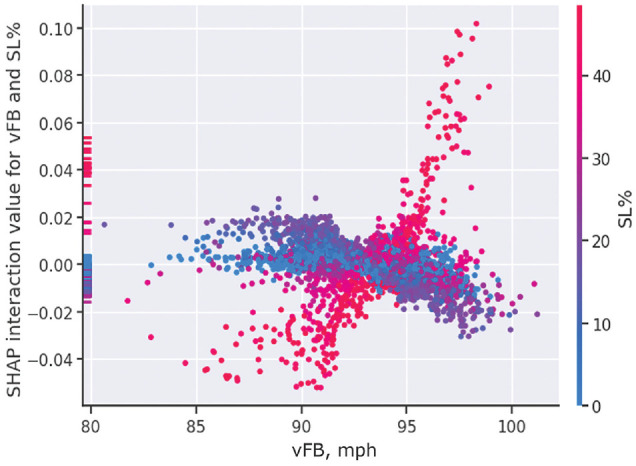
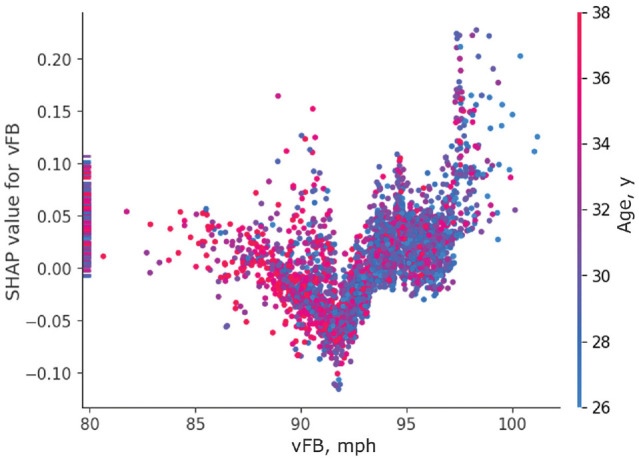
A total of 3808 pitcher-years were included in this analysis; 606 (15.9%) of these involved a shoulder or elbow injury resulting in placement on the MLB injured list. Of the >65 candidate features (including workload, demographic, and pitch-tracking metrics), the most important contributors to predicting shoulder/elbow injury were increased: pitch velocity (all pitch types), utilization of sliders (SLs), fastball (FB) spin rate, FB horizontal movement, and player age. The strongest game theory interaction effects were that higher FB velocity did not alter a younger pitcher's predicted risk of shoulder/elbow injury versus older pitchers, risk of shoulder/elbow injury increased with the number of high-velocity pitches thrown (regardless of pitch type and in an additive fashion), and FB velocity <95 mph (<152.9 kph) demonstrated strong negative interaction effects with higher SL percentage, suggesting that the overall predicted risk of injury for pitchers throwing a high number of SLs could be attenuated by lower FB velocity.
Pitch-tracking metrics were substantially more predictive of future injury than player demographics and workload metrics. There were many significant game theory interdependencies of injury risk. Notably, the increased risk of injury that was conferred by throwing with a high velocity was even further magnified if the pitchers were also older, threw a high percentage of SLs, and/or threw a greater number of pitches.
了解美国职业棒球大联盟(MLB)投手肩部和肘部受伤的多种风险因素之间的相互作用,对于确定降低风险的潜在途径非常重要,同时要尽量减少对球员表现的影响。
应用一种基于博弈论的新方法来开发一个预测MLB投手下赛季肩部和肘部受伤的机器学习模型,并使用该模型来了解最重要风险因素之间的相互依存关系和相互作用效应。
病例对照研究;证据等级,3级。
使用2017年至2022年间投手的人口统计学数据、工作量指标、投球跟踪指标和受伤数据构建一个MLB投手年度数据库,其中数据库中的每个项目对应于一名投手该年的信息和指标。训练一个极端梯度提升机器学习模型来预测下赛季肩部和肘部受伤情况,利用夏普利值来量化特征重要性以及预测变量之间的相互依存关系和相互作用效应。
本分析共纳入3808个投手年度;其中606个(15.9%)涉及肩部或肘部受伤并因此被列入MLB伤病名单。在超过65个候选特征(包括工作量、人口统计学和投球跟踪指标)中,预测肩部/肘部受伤的最重要因素包括:投球速度(所有投球类型)、滑球(SL)的使用率、快球(FB)旋转速度、FB水平移动以及球员年龄。最强的博弈论相互作用效应为:与年长投手相比,较高的FB速度不会改变年轻投手肩部/肘部受伤的预测风险;肩部/肘部受伤风险随着高速投球数量的增加而增加(无论投球类型,且呈累加方式);FB速度<95英里/小时(<152.9公里/小时)与较高的SL百分比显示出强烈的负相互作用效应,这表明对于投大量SL的投手,较低的FB速度可能会降低总体受伤预测风险。
投球跟踪指标对未来受伤的预测能力远高于球员人口统计学数据和工作量指标。受伤风险存在许多显著的博弈论相互依存关系。值得注意的是,如果投手年龄较大、SL使用率较高和/或投球数量较多,高速投球带来的受伤风险增加会进一步放大。