Department of Animal Reproduction, INIA, CSIC, Madrid, Spain.
Department of Cell Biology and Histology, Universidad de Murcia. International Excellence Campus for Higher Education and Research (Campus Mare Nostrum), Murcia, Spain.
Reproduction. 2024 Oct 3;168(5). doi: 10.1530/REP-24-0211. Print 2024 Nov 1.
Bovine embryos lacking SMC2 (a core component of condensins I and II) are unable to survive maternal recognition of pregnancy. SMC2 KO embryos are able to form blastocysts, exhibiting a reduced cell proliferation ability, and arrest their development shortly after hatching.
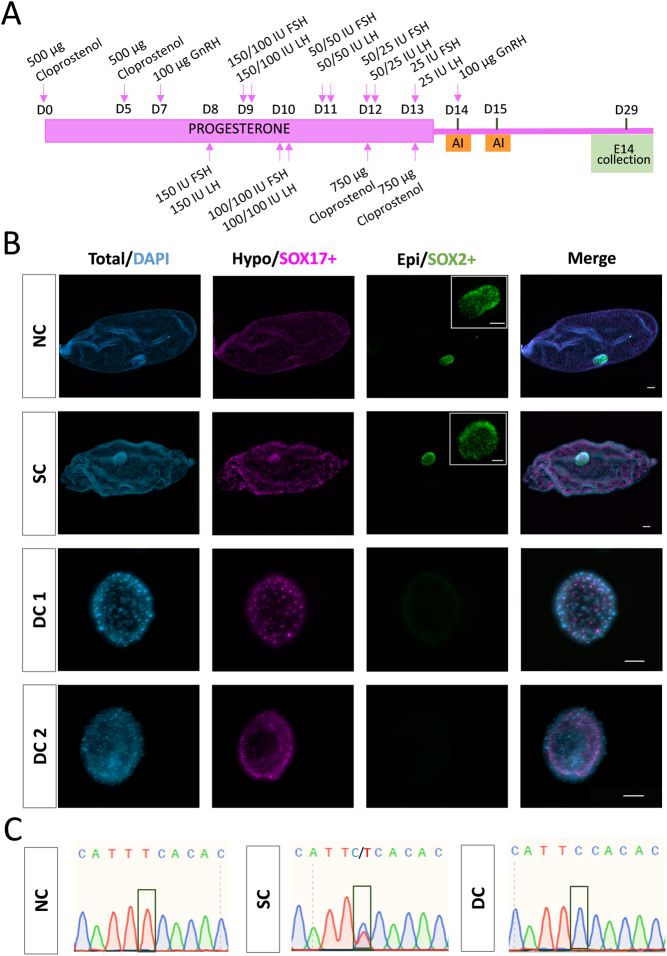
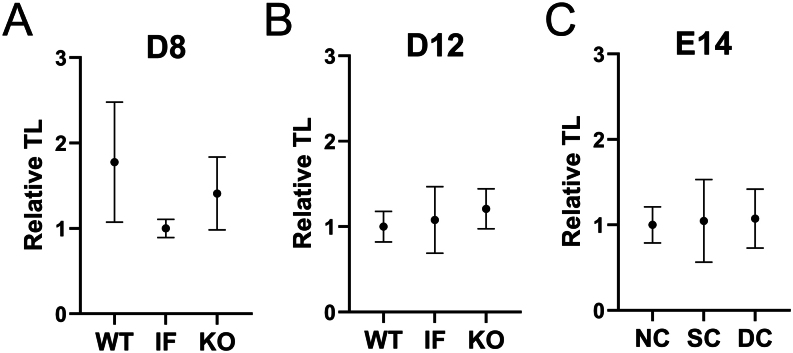
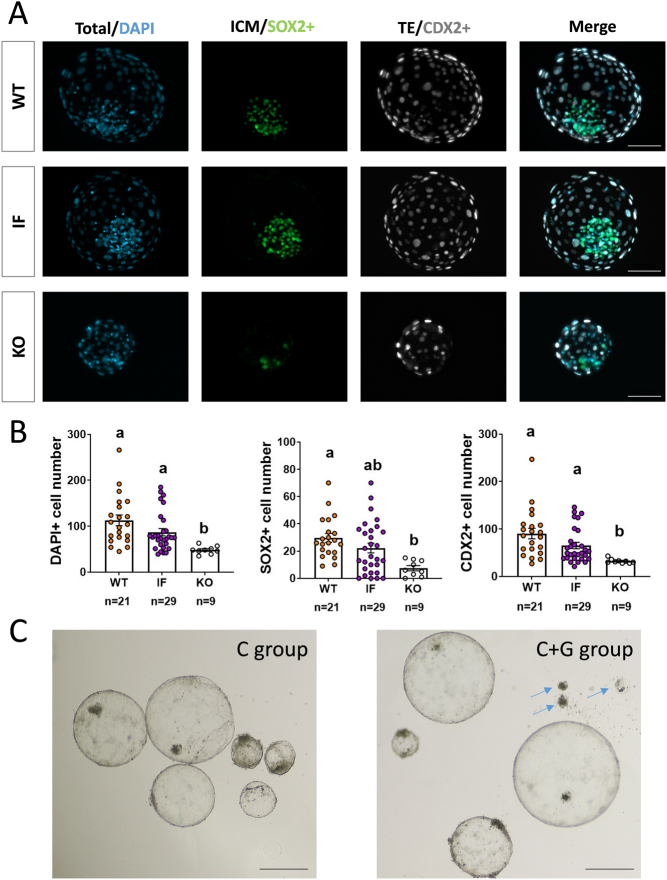
Condensins are large protein complexes required for chromosome assembly and segregation during mitosis and meiosis. Mouse or bovine embryos lacking SMC2 (a core component of condensins I and II) do not complete development to term, but it is unknown when they arrest their development. Herein, we have assessed the developmental ability of bovine embryos lacking SMC2 due to a naturally occurring mutation termed HH3 (Holstein Haplotype 3) or by CRISPR-mediated gene ablation. To determine if embryos homozygous for the HH3 allele survive to maternal recognition of pregnancy, embryonic day (E)14 embryos were flushed from superovulated carrier cows inseminated with a carrier bull. Mendelian inheritance of the HH3 allele was observed at E14 conceptuses but conceptuses homozygous for HH3 failed to achieve elongation and lacked an embryonic disc. To assess the consequence of the ablation of condensins I and II at earlier developmental stages, SMC2 KO bovine embryos were generated in vitro using CRISPR technology. SMC2 KO embryos were able to form blastocysts but exhibited reduced cell proliferation as evidenced by a significantly lower number of total, trophectoderm (CDX2+), and inner cell mass (SOX2+) cells at Day (D) 8 post-fertilization compared to their WT counterparts and were unable to survive to D12 in vitro. SMC2 ablation did not alter relative telomere length at D8, D12, or E14. In conclusion, condensins I and II are required for blastomere mitosis during early development, and embryos lacking those complexes arrest their development shortly after blastocyst hatching.
缺乏 SMC2(凝缩素 I 和 II 的核心组成部分)的牛胚胎无法存活到母体妊娠识别。SMC2 KO 胚胎能够形成囊胚,但增殖能力降低,并在孵化后不久停止发育。
凝缩素是在有丝分裂和减数分裂过程中组装和分离染色体所必需的大型蛋白质复合物。缺乏 SMC2(凝缩素 I 和 II 的核心组成部分)的小鼠或牛胚胎无法完成发育到足月,但它们何时停止发育尚不清楚。在此,我们评估了由于自然发生的突变 HH3(荷斯坦单倍型 3)或通过 CRISPR 介导的基因消融而缺乏 SMC2 的牛胚胎的发育能力。为了确定 HH3 等位基因纯合的胚胎是否能存活到母体妊娠识别,用携带公牛授精的超排卵供体牛从 E14 胚胎中冲洗胚胎。在 E14 胚胎中观察到 HH3 等位基因的孟德尔遗传,但 HH3 纯合的胚胎未能实现伸长,并且缺乏胚胎盘。为了评估在早期发育阶段消融凝缩素 I 和 II 的后果,使用 CRISPR 技术在体外生成 SMC2 KO 牛胚胎。SMC2 KO 胚胎能够形成囊胚,但增殖能力降低,表现为受精后第 8 天总细胞、滋养外胚层(CDX2+)和内细胞团(SOX2+)细胞的数量明显低于 WT 胚胎,并且在体外无法存活到第 12 天。SMC2 消融不会改变第 8、12 或 14 天的相对端粒长度。总之,凝缩素 I 和 II 在早期发育过程中的胚胎分裂中是必需的,缺乏这些复合物的胚胎在囊胚孵化后不久就会停止发育。