Department of Biomedical Engineering, University of Rochester, Rochester, New York 14642.
Department of Neuroscience, University of Rochester, Rochester, New York 14642.
eNeuro. 2024 Sep 20;11(9). doi: 10.1523/ENEURO.0365-24.2024. Print 2024 Sep.
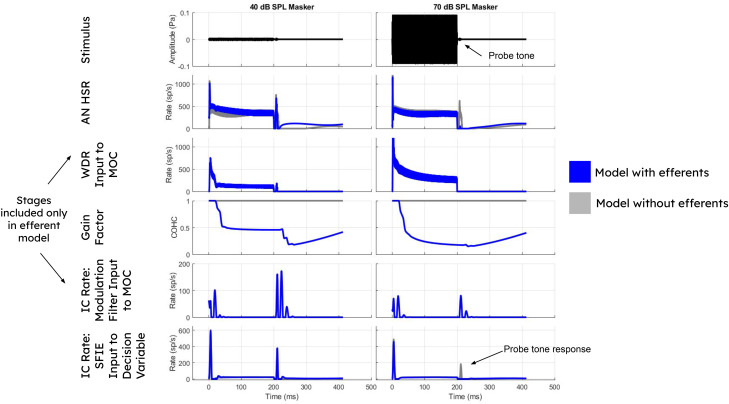
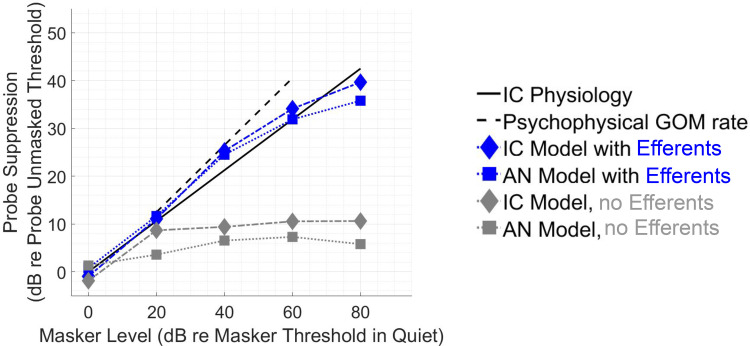
Previous physiological and psychophysical studies have explored whether feedback to the cochlea from the efferent system influences forward masking. The present work proposes that the limited growth-of-masking (GOM) observed in auditory nerve (AN) fibers may have been misunderstood; namely, that this limitation may be due to the influence of anesthesia on the efferent system. Building on the premise that the unanesthetized AN may exhibit GOM similar to more central nuclei, the present computational modeling study demonstrates that feedback from the medial olivocochlear (MOC) efferents may contribute to GOM observed physiologically in onset-type neurons in both the cochlear nucleus and inferior colliculus (IC). Additionally, the computational model of MOC efferents used here generates a decrease in masking with longer masker-signal delays similar to that observed in IC physiology and in psychophysical studies. An advantage of this explanation over alternative physiological explanations (e.g., that forward masking requires inhibition from the superior paraolivary nucleus) is that this theory can explain forward masking observed in the brainstem, early in the ascending pathway. For explaining psychoacoustic results, one strength of this model is that it can account for the lack of elevation in thresholds observed when masker level is randomly varied from interval-to-interval, a result that is difficult to explain using the conventional temporal window model of psychophysical forward masking. Future directions for evaluating the efferent mechanism as a contributing mechanism for psychoacoustic results are discussed.
先前的生理和心理物理研究探讨了传出系统对耳蜗的反馈是否会影响前向掩蔽。本研究提出,听觉神经(AN)纤维中观察到的掩蔽增长受限(GOM)可能被误解了;即,这种限制可能是由于麻醉对传出系统的影响。基于未麻醉的 AN 可能表现出与更中心核相似的 GOM 的前提,本计算模型研究表明,来自内侧橄榄耳蜗(MOC)传出的反馈可能有助于在耳蜗核和下丘(IC)中的起始型神经元中观察到的生理 GOM。此外,这里使用的 MOC 传出的计算模型产生了与在 IC 生理学和心理物理学研究中观察到的相似的掩蔽随掩蔽信号延迟增加而减少的情况。与替代生理解释(例如,前向掩蔽需要来自上橄榄核的抑制)相比,这种解释的一个优点是,该理论可以解释在听觉通路上较早的脑干中观察到的前向掩蔽。对于解释心理声学结果,该模型的一个优势是,它可以解释当掩蔽器水平随机在区间之间变化时观察到的阈值没有升高的现象,这一结果使用心理物理前向掩蔽的传统时间窗口模型很难解释。讨论了评估传出机制作为心理声学结果的贡献机制的未来方向。