Lyu Zhidong, Gao Linlin
Breast Surgery, The Affiliated Hospital of Qingdao University, Qingdao, China.
Front Oncol. 2024 Aug 21;14:1412051. doi: 10.3389/fonc.2024.1412051. eCollection 2024.
This study aimed to retrospectively analyse the pathological response and safety of combining albumin-bound paclitaxel (nab-paclitaxel) or docetaxel with anti-HER2 therapy as a neoadjuvant treatment for HER2-positive breast cancer.
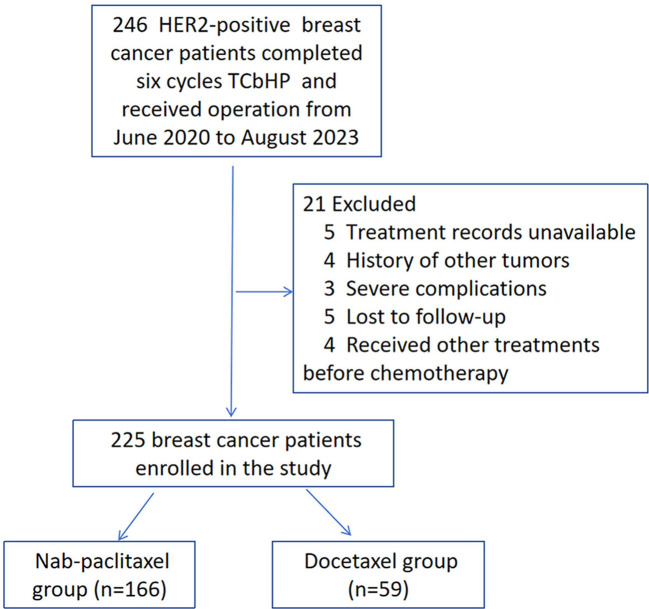
From June 2020 to August 2023, 225 HER2-positive breast cancer patients who underwent radical surgery following neoadjuvant treatment were enrolled in this study. The patients were divided into two groups based on the drugs they received: the nab-paclitaxel group (n=166, receiving nab-paclitaxel + platinum along with trastuzumab and pertuzumab) and the docetaxel group (n=59, receiving docetaxel + platinum along with trastuzumab and pertuzumab). The pathological response and adverse events related to the drugs were collected and evaluated in both groups.
In the nab-paclitaxel group, the rates of breast and total pathological complete response (bpCR and tpCR) were significantly greater than those in the docetaxel group (69.27% vs. 47.45%, P=0.003; 68.67% vs. 45.76%, P=0.002). For patients who did not achieve pCR after chemotherapy, the pathological response of chemotherapy was analysed using MP grading and RCB grading. The results showed that there was a statistically significant difference between the two groups (P<0.05). Multivariate analysis revealed that therapeutic drugs, clinical stage, ER status, and Ki-67 level were independent predictors of pCR. The nab-paclitaxel group had a significantly greater proportion of patients with peripheral sensory neuropathy than did the docetaxel group (58.43% vs. 38.98%, P=0.035), while the docetaxel group had a greater proportion of patients with allergies and elevated ALT (31.93% vs. 69.49%, P=0.000; 23.49% vs. 40.68%, P=0.021).
Our real-world study revealed that nab-paclitaxel combined with anti-HER2 therapy was an effective neoadjuvant therapy for HER2-positive breast cancer. The multivariate analysis revealed that chemotherapy drugs, clinical stage, ER status, and Ki-67 level was the significant factor influencing treatment outcome. These findings offer a valuable reference for the neoadjuvant treatment of patients with HER2-positive breast cancer.
本研究旨在回顾性分析白蛋白结合型紫杉醇(纳米白蛋白结合型紫杉醇)或多西他赛联合抗HER2治疗作为HER2阳性乳腺癌新辅助治疗的病理反应和安全性。
2020年6月至2023年8月,225例接受新辅助治疗后行根治性手术的HER2阳性乳腺癌患者纳入本研究。根据所接受的药物将患者分为两组:纳米白蛋白结合型紫杉醇组(n = 166,接受纳米白蛋白结合型紫杉醇+铂类联合曲妥珠单抗和帕妥珠单抗)和多西他赛组(n = 59,接受多西他赛+铂类联合曲妥珠单抗和帕妥珠单抗)。收集并评估两组与药物相关的病理反应和不良事件。
纳米白蛋白结合型紫杉醇组的乳腺病理完全缓解率和总病理完全缓解率(bpCR和tpCR)显著高于多西他赛组(69.27%对47.45%,P = 0.003;68.67%对45.76%,P = 0.002)。对于化疗后未达到pCR的患者,采用MP分级和RCB分级分析化疗的病理反应。结果显示两组间差异有统计学意义(P<0.05)。多因素分析显示治疗药物、临床分期、ER状态和Ki-67水平是pCR的独立预测因素。纳米白蛋白结合型紫杉醇组外周感觉神经病变患者比例显著高于多西他赛组(58.43%对38.98%,P = 0.035),而多西他赛组过敏和ALT升高患者比例更高(31.93%对69.49%,P = 0.000;23.49%对40.68%,P = 0.021)。
我们的真实世界研究表明,纳米白蛋白结合型紫杉醇联合抗HER2治疗是HER2阳性乳腺癌有效的新辅助治疗方法。多因素分析显示化疗药物、临床分期、ER状态和Ki-67水平是影响治疗结果的重要因素。这些发现为HER2阳性乳腺癌患者的新辅助治疗提供了有价值的参考。