Sagong Min, Kim Jae Hui, Woo Se Joon, Kim Yu Cheol, Cho Heeyoon, Lee Young Hoon, Byon Iksoo, Jo Young Joon, Chin Hee Seung, Kim Jeonghee, Chae Jae Eun, Kang Se Woong
Department of Ophthalmology, Yeungnam University College of Medicine, Daegu, Korea.
Department of Ophthalmology, Kim's Eye Hospital, Seoul, Korea.
Ophthalmol Ther. 2024 Nov;13(11):2839-2853. doi: 10.1007/s40123-024-01021-x. Epub 2024 Sep 5.
The aim of this study was to investigate the predictive factors for persistent disease activity following anti-vascular endothelial growth factors (anti-VEGF) and their long-term effects in patients to be treated for neovascular age-related macular degeneration (nAMD) under real-world conditions.
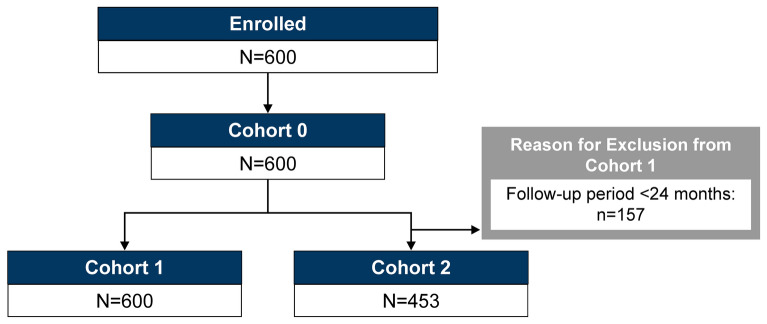
Retrospective data analysis of the PROOF study, a multi-center real-world retrospective chart review conducted across Korea in patients with nAMD included treatment-naive patients with nAMD who received first anti-VEGF (ranibizumab, bevacizumab, or aflibercept) between January 2017 and March 2019 was performed. All 600 patients (cohort 1) had a minimum follow-up of 12 months of which 453 patients (cohort 2) were followed-up for 24 months from baseline.
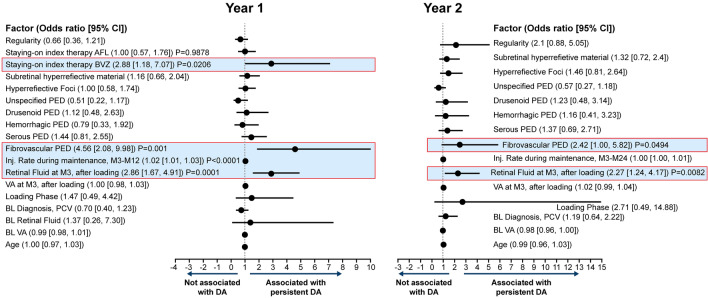
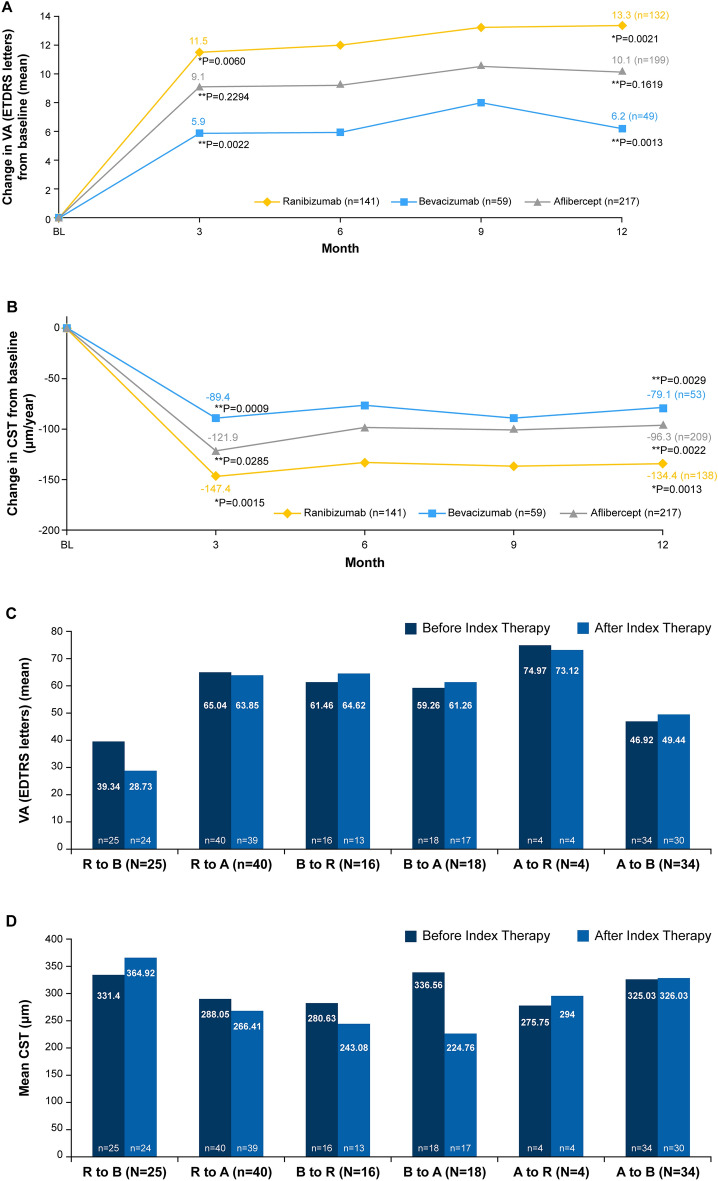
At month 12 after anti-VEGF therapy, 58.10% (95% confidence interval [CI]: 54.09, 62.12) of patients and at month 24, 66.02% of patients continued to have persistent retinal fluid. At both months 12 and 24, predictive factors for persistent disease activity were fibrovascular pigment epithelial detachments (PED) (P = 0.0494) and retinal fluid at month 3 after loading phase (P = 0.0082). The mean changes in visual acuity were + 6.2, + 10.1, and + 13.3 letters and in the central subfield thickness were - 79.1 µm, - 96.3 µm, and - 134.4 µm at 12 months from baseline, in the bevacizumab, aflibercept, and ranibizumab groups, respectively.
The presence of retinal fluid after loading phase and fibrovascular PED were predictors of persistent disease activity after at least 1 year of anti-VEGF treatment.
本研究的目的是在现实世界条件下,调查抗血管内皮生长因子(anti-VEGF)治疗后持续性疾病活动的预测因素及其对接受治疗的新生血管性年龄相关性黄斑变性(nAMD)患者的长期影响。
对PROOF研究进行回顾性数据分析,这是一项在韩国各地对nAMD患者进行的多中心现实世界回顾性病历审查,纳入了2017年1月至2019年3月期间接受首次抗VEGF(雷珠单抗、贝伐单抗或阿柏西普)治疗的初治nAMD患者。所有600例患者(队列1)至少随访12个月,其中453例患者(队列2)从基线开始随访24个月。
抗VEGF治疗后第12个月,58.10%(95%置信区间[CI]:54.09,62.12)的患者仍有持续性视网膜积液,第24个月时,66.02%的患者仍有持续性视网膜积液。在第12个月和第24个月时,持续性疾病活动的预测因素均为纤维血管性色素上皮脱离(PED)(P = 0.0494)和负荷期后第3个月的视网膜积液(P = 0.0082)。从基线开始12个月时,贝伐单抗、阿柏西普和雷珠单抗组的视力平均变化分别为+6.2、+10.1和+13.3个字母,中心子域厚度平均变化分别为-79.1 µm、-96.3 µm和-134.4 µm。
负荷期后视网膜积液的存在和纤维血管性PED是抗VEGF治疗至少1年后持续性疾病活动的预测因素。