Leedy Douglas J, Voit Jay M, Rillamas-Sun Eileen, Kwan Marilyn L, Shen Hanjie, Li Song, Laurent Cecile A, Rana Jamal S, Lee Valerie S, Roh Janise M, Huang Yuhan, Greenlee Heather, Cheng Richard K
Division of Cardiology, University of Washington Medical Center, Seattle, Washington, USA.
Division of Cardiology, VA Puget Sound Health Care System, Seattle, Washington, USA.
JACC Adv. 2024 Aug 14;3(9):101207. doi: 10.1016/j.jacadv.2024.101207. eCollection 2024 Sep.
Hypertension is an important contributor to cardiovascular disease (CVD) in breast cancer (BC) survivors; however, research on blood pressure (BP) and CVD outcomes in BC survivors is limited.
The purpose of this study was to better characterize the association between BP and CVD in a large, longitudinal cohort of BC patients.
Women with invasive BC diagnosed from 2005 to 2013 at Kaiser Permanente Northern California were matched 1:5 to women without BC. Patient data were obtained from electronic health records. Multivariable Cox regression and penalized spline models were used to explore the linear and nonlinear relationship of systolic blood pressure (SBP) and diastolic blood pressure (DBP) on CVD outcomes.
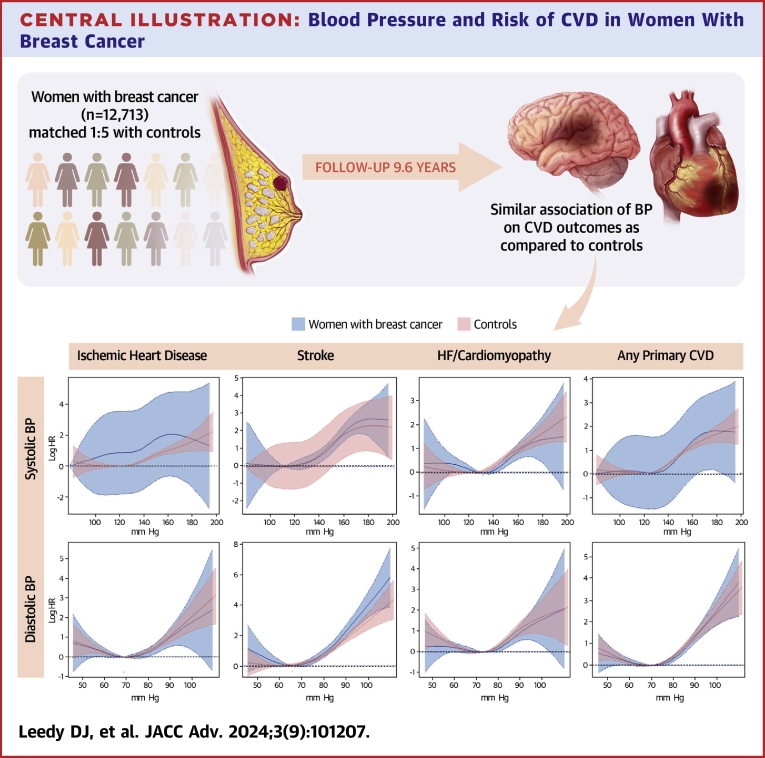
BC cases (n = 12,713) and controls (n = 55,886) had median follow-up of 9.6 years (IQR: 5.0-11.9 years). Women with BC had a mean age of 60.6 years; 64.8% were non-Hispanic White. For ischemic heart disease (IHD), every 10 mmHg increase in SBP and DBP was associated with 1.23 (95% CI: 1.14-1.33) and 1.10 (95% CI: 0.98-1.24) risk, respectively, in women with BC. For stroke, every 10 mmHg increase in SBP and DBP was associated with a 1.45 (95% CI: 1.34-1.58) and 1.91 (95% CI: 1.68-2.18) risk, respectively. A U-shaped relationship was observed between heart failure/cardiomyopathy and BP. The associations between BP and risk of IHD, stroke, and any primary CVD were not statistically different comparing women with BC to controls, but risks varied by BC status for heart failure/cardiomyopathy ( for interaction = 0.01).
Women with and without BC showed similar risks for IHD, stroke, and any primary CVD suggesting similar BP targets should be pursued regardless of BC survivorship status.
高血压是乳腺癌(BC)幸存者心血管疾病(CVD)的重要促成因素;然而,关于BC幸存者的血压(BP)和CVD结局的研究有限。
本研究的目的是更好地描述在一个大型的BC患者纵向队列中BP与CVD之间的关联。
2005年至2013年在北加利福尼亚州凯撒医疗机构被诊断为浸润性BC的女性与无BC的女性按1:5进行匹配。患者数据从电子健康记录中获取。使用多变量Cox回归和惩罚样条模型来探索收缩压(SBP)和舒张压(DBP)与CVD结局之间的线性和非线性关系。
BC病例(n = 12,713)和对照(n = 55,886)的中位随访时间为9.6年(四分位间距:5.0 - 11.9年)。BC女性的平均年龄为60.6岁;64.8%为非西班牙裔白人。对于缺血性心脏病(IHD),在BC女性中,SBP和DBP每升高10 mmHg分别与1.23(95%CI:1.14 - 1.33)和1.10(95%CI:0.98 - 1.24)的风险相关。对于中风,SBP和DBP每升高10 mmHg分别与1.45(95%CI:1.34 - 1.58)和1.91(95%CI:1.68 - 2.18)的风险相关。观察到心力衰竭/心肌病与BP之间呈U形关系。比较有BC和无BC的女性,BP与IHD、中风及任何原发性CVD风险之间的关联无统计学差异,但心力衰竭/心肌病的风险因BC状态而异(交互作用P = 0.01)。
有和无BC的女性在IHD、中风及任何原发性CVD方面显示出相似的风险,这表明无论BC生存状态如何,都应追求相似的血压目标。