Kielstra Sjoerd C, Reezigt Roland R, Coppieters Michel W, de Vries Ralph, Arendt-Nielsen Lars, Petersen Kristian K, Yarnitsky David, Scholten-Peeters Gwendolyne G M
Department of Human Movement Sciences, Faculty of Behavioural and Movement Sciences, Amsterdam Movement Sciences Program Musculoskeletal Health, Vrije Universiteit Amsterdam, Amsterdam, the Netherlands.
Academy of Health, Department of Physical Therapy, Hanze University of Applied Sciences, Groningen, the Netherlands.
Pain Rep. 2024 Sep 4;9(5):e1176. doi: 10.1097/PR9.0000000000001176. eCollection 2024 Oct.
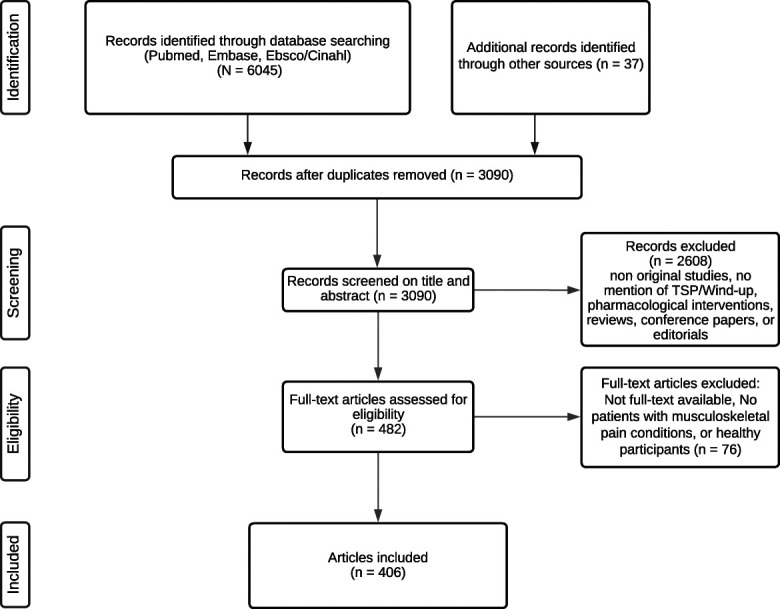
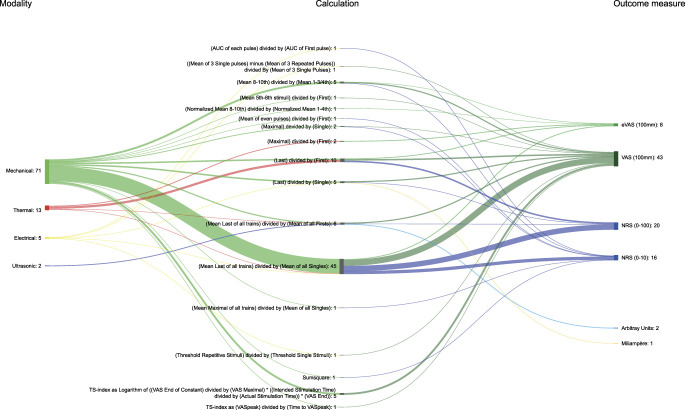
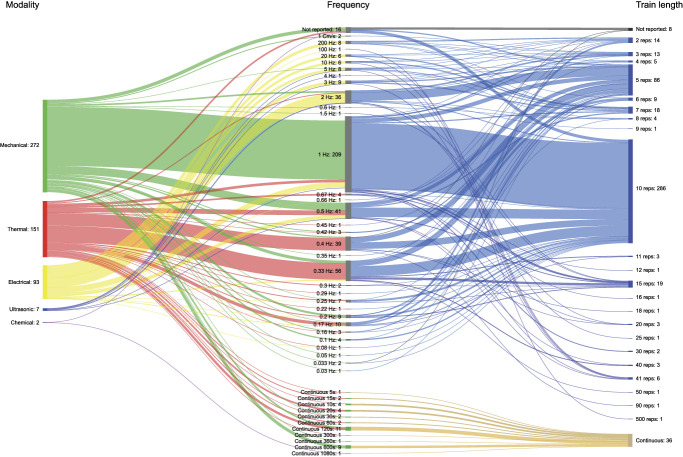
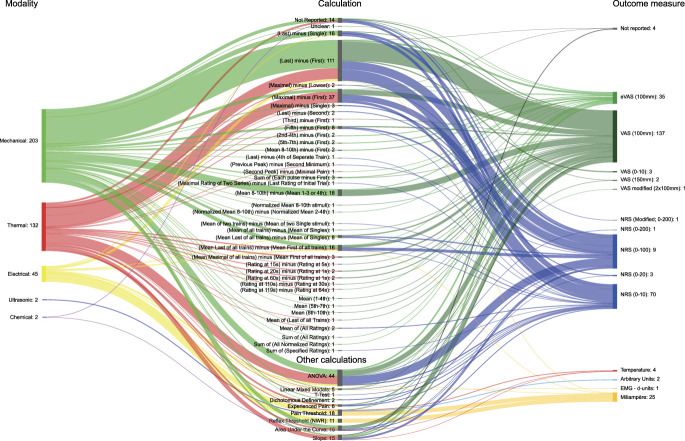
Temporal summation of pain (TSP) is a human proxy for wind-up of dorsal horn neurons as assessed in animals. The common paradigm for eliciting TSP is evoked by repetitive nociceptive stimuli of equal intensity. Various stimulation and assessment protocols have been used. This scoping review aims to provide insight into key elements of TSP stimulation and assessment: modality, instruments, test location, familiarization, train characteristics, and calculations. PubMed, Embase, and Ebsco/CINAHL were searched for studies that measured TSP in adults with musculoskeletal conditions and healthy people. Four hundred six studies were included. Mechanical stimuli were the most commonly used modality (250 studies), followed by thermal stimuli (125 studies). Forty-six different instruments were used. Disregarding studies on widespread musculoskeletal pain and healthy participants, 40 studies evaluated TSP at painful sites, 77 in remote areas, and 66 in both locations. Of the 13 tested locations in patients, the hand (74 studies), lower leg (64 studies), and forearm (59 studies) were most commonly tested. A single practice round was the most common familiarization method (46 studies). Repeated stimuli were applied using 31 different frequencies (0.03-200 Hz) and sustained stimulations ranging from 5 to 1080 seconds were used. Twenty-two different train lengths, 63 different calculations (37 absolute, 19 relative, and 7 alternatives using data directly), and 14 different outcome measures (eg, self-reported pain rating scales and reflex thresholds) were used. Temporal summation of pain protocols vary excessively, hindering the comparison and pooling of results. None of the studies provided substantiation for their protocol choice.
疼痛的时间总和(TSP)是一种用于替代动物实验中评估背角神经元wind-up现象的人体指标。诱发TSP的常见范式是由强度相等的重复性伤害性刺激引起的。已使用了各种刺激和评估方案。本综述旨在深入了解TSP刺激和评估的关键要素:方式、仪器、测试部位、预适应、刺激序列特征和计算方法。通过检索PubMed、Embase和Ebsco/CINAHL数据库,查找在患有肌肉骨骼疾病的成年人和健康人群中测量TSP的研究。共纳入406项研究。机械刺激是最常用的方式(250项研究),其次是热刺激(125项研究)。使用了46种不同的仪器。不考虑关于广泛肌肉骨骼疼痛和健康参与者的研究,40项研究在疼痛部位评估TSP,77项在偏远部位评估,66项在两个部位都进行了评估。在患者测试的13个部位中,手部(74项研究)、小腿(64项研究)和前臂(59项研究)是最常测试的部位。单次预适应训练是最常见的预适应方法(46项研究)。使用31种不同频率(0.03 - 200Hz)施加重复刺激,并使用持续时间从5秒到1080秒不等的持续刺激。使用了22种不同的刺激序列长度、63种不同的计算方法(37种绝对计算方法、19种相对计算方法以及7种直接使用数据的替代方法)和14种不同的结果测量指标(例如,自我报告的疼痛评分量表和反射阈值)。疼痛的时间总和方案差异过大,阻碍了结果的比较和汇总。没有一项研究为其方案选择提供依据。