Department of Hospital Pharmacy, Erasmus MC, University Medical Centre Rotterdam, Rotterdam, The Netherlands.
Rotterdam Clinical Pharmacometrics Group, Erasmus MC, Rotterdam, The Netherlands.
Drugs. 2024 Oct;84(10):1167-1178. doi: 10.1007/s40265-024-02084-7. Epub 2024 Sep 6.
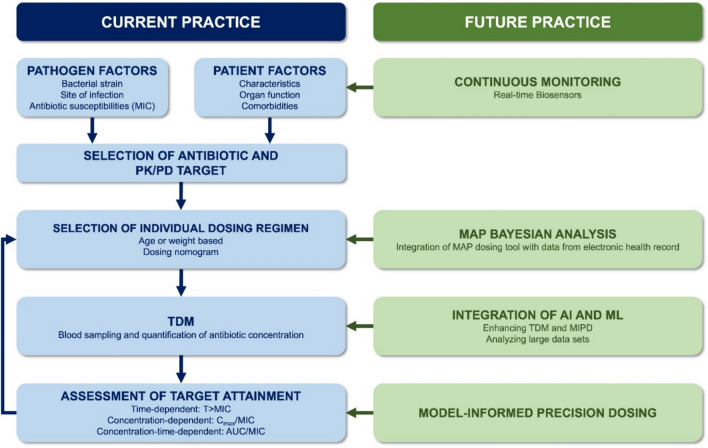
Successful antimicrobial therapy depends on achieving optimal drug concentrations within individual patients. Inter-patient variability in pharmacokinetics (PK) and differences in pathogen susceptibility (reflected in the minimum inhibitory concentration, [MIC]) necessitate personalised approaches. Dose individualisation strategies aim to address this challenge, improving treatment outcomes and minimising the risk of toxicity and antimicrobial resistance. Therapeutic drug monitoring (TDM), with the application of population pharmacokinetic (popPK) models, enables model-informed precision dosing (MIPD). PopPK models mathematically describe drug behaviour across populations and can be combined with patient-specific TDM data to optimise dosing regimens. The integration of machine learning (ML) techniques promises to further enhance dose individualisation by identifying complex patterns within extensive datasets. Implementing these approaches involves challenges, including rigorous model selection and validation to ensure suitability for target populations. Understanding the relationship between drug exposure and clinical outcomes is crucial, as is striking a balance between model complexity and clinical usability. Additionally, regulatory compliance, outcome measurement, and practical considerations for software implementation will be addressed. Emerging technologies, such as real-time biosensors, hold the potential for revolutionising TDM by enabling continuous monitoring, immediate and frequent dose adjustments, and near patient testing. The ongoing integration of TDM, advanced modelling techniques, and ML within the evolving digital health care landscape offers a potential for enhancing antimicrobial therapy. Careful attention to model development, validation, and ethical considerations of the applied techniques is paramount for successfully optimising antimicrobial treatment for the individual patient.
成功的抗菌治疗取决于在个体患者中达到最佳的药物浓度。药代动力学(PK)的个体间变异性和病原体敏感性的差异(反映在最小抑菌浓度 [MIC] 中)需要个性化的方法。剂量个体化策略旨在解决这一挑战,改善治疗效果,最大限度地降低毒性和抗菌耐药性的风险。治疗药物监测(TDM)结合群体药代动力学(popPK)模型,可实现基于模型的精准给药(MIPD)。popPK 模型在人群中数学描述药物行为,并可与患者特定的 TDM 数据结合,以优化给药方案。机器学习(ML)技术的整合有望通过在大量数据集中识别复杂模式来进一步增强剂量个体化。实施这些方法涉及到一些挑战,包括严格的模型选择和验证,以确保适用于目标人群。了解药物暴露与临床结果之间的关系至关重要,同时还要在模型复杂性和临床可用性之间取得平衡。此外,还需要考虑软件实施的监管合规性、结果测量和实际问题。实时生物传感器等新兴技术通过实现连续监测、即时和频繁的剂量调整以及床边检测,有潜力彻底改变 TDM。TDM、先进的建模技术和 ML 在不断发展的数字医疗保健领域中的不断整合,为增强抗菌治疗提供了潜力。在成功地为个体患者优化抗菌治疗方面,对模型开发、验证以及所应用技术的伦理考虑的仔细关注至关重要。