Division of Colon and Rectal Surgery, College of Medicine, Chang Gung Memorial Hospital at Linkou, Chang Gung University, Taoyuan, Taiwan.
World J Surg Oncol. 2024 Sep 6;22(1):237. doi: 10.1186/s12957-024-03513-3.
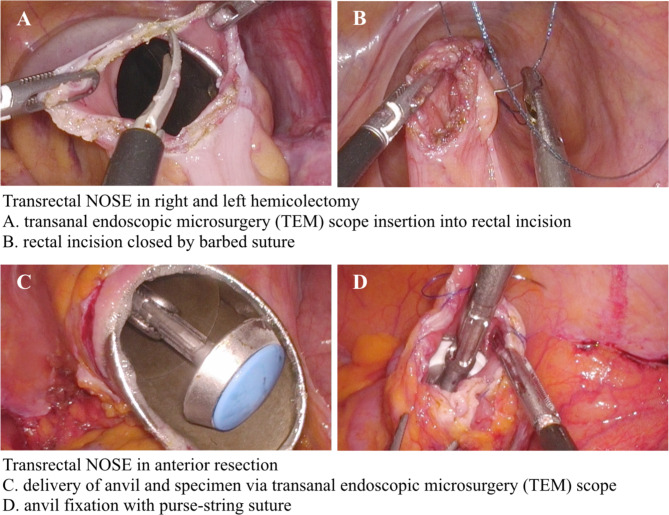
Conventional minimally invasive surgery requires mini-laparotomy to extract the pathological specimen. However, by using a natural orifice as the delivery route, natural orifice specimen extraction (NOSE) surgery avoids the need for a large incision. This study analyzed the short-term outcome of NOSE compared with conventional mini-laparotomy (CL) for colorectal cancer surgery.
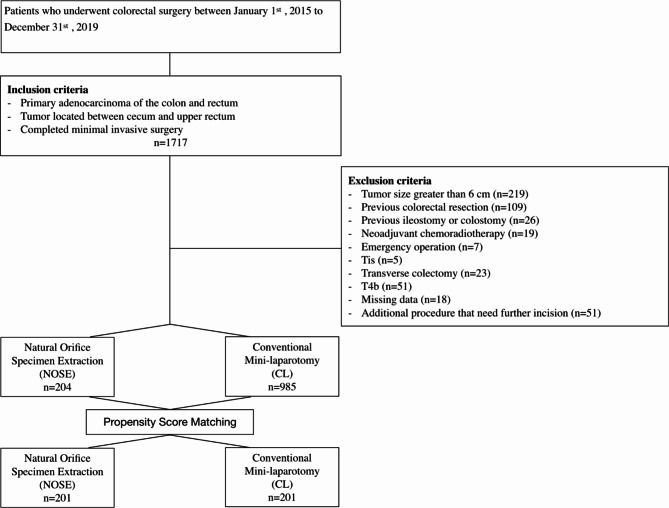
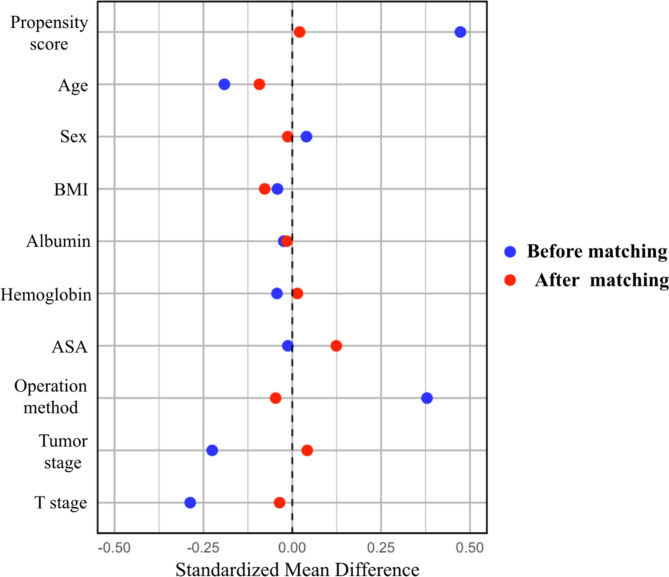
We conducted a retrospective analysis of 1,189 patients who underwent surgery for primary colorectal cancer between the cecum and upper rectum. Propensity score analyses were applied to the NOSE and CL groups in a 1:1 matched cohort.
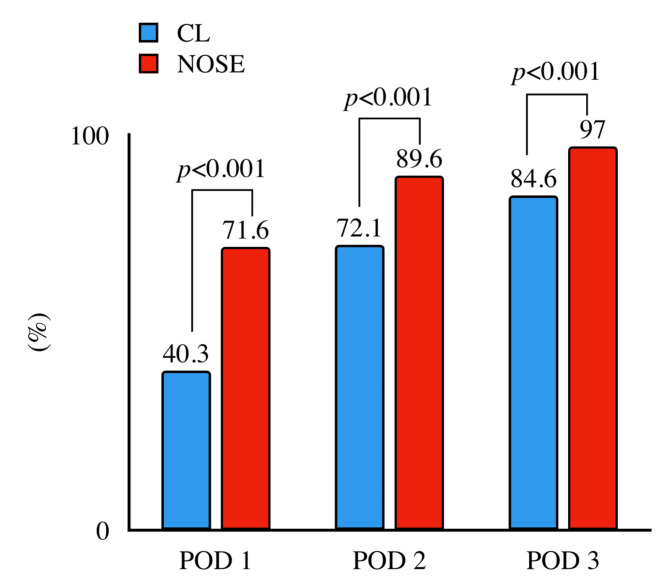
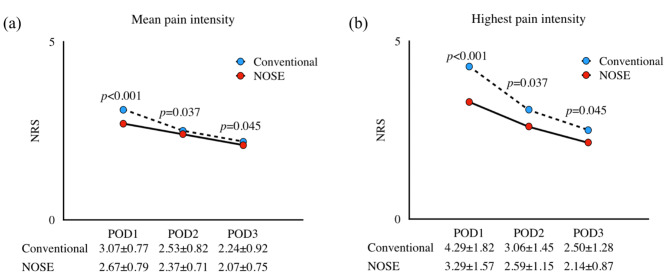
After propensity score matching, each group included 201 patients. The NOSE group and CL group did not differ significantly in terms of baseline characteristics. Postoperative morbidity and mortality rates were comparable. Compared with the CL group, the NOSE group experienced a shorter time to first flatus (1.6 ± 0.8 vs. 2.0 ± 1.2 days, p < 0.001), first stool (2.7 ± 1.5 vs. 4.1 ± 1.9, p < 0.001), liquid diet (2.3 ± 1.3 vs. 3.6 ± 1.8 days, p < 0.001), soft diet (3.9 ± 2.0 vs. 5.2 ± 1.9 days, p < 0.001) and a shorter hospital stay (5.1 ± 3.5 vs. 7.4 ± 4.8 days, p < 0.001). The NOSE group exhibited lower mean pain intensity and lower highest pain intensity on postoperative days 1, 2, and 3.
NOSE has several advantages over conventional mini-laparotomy following minimally invasive surgery for colon cancer. These advantages include reduced time to oral intake, shorter hospital stays, and less postoperative pain. NOSE can be adopted and applied to highly selective patients without additional risk of short-term complications.
传统的微创手术需要小切口来取出病理标本。然而,通过使用自然孔道作为输送途径,自然腔道标本提取(NOSE)手术避免了大切口的需要。本研究分析了与传统小切口(CL)相比,NOSE 手术治疗结直肠癌的短期疗效。
我们对 1189 例接受结直肠下段至直肠上段原发性结直肠癌手术的患者进行了回顾性分析。应用倾向评分分析对 NOSE 组和 CL 组进行 1:1 匹配队列分析。
经过倾向评分匹配后,每组各有 201 例患者。NOSE 组和 CL 组在基线特征方面无显著差异。术后发病率和死亡率相当。与 CL 组相比,NOSE 组首次排气时间(1.6±0.8 天比 2.0±1.2 天,p<0.001)、首次排便时间(2.7±1.5 天比 4.1±1.9 天,p<0.001)、进流食时间(2.3±1.3 天比 3.6±1.8 天,p<0.001)、进软食时间(3.9±2.0 天比 5.2±1.9 天,p<0.001)和住院时间(5.1±3.5 天比 7.4±4.8 天,p<0.001)均较短。NOSE 组术后第 1、2、3 天的平均疼痛强度和最高疼痛强度均较低。
NOSE 与微创治疗结肠癌的传统小切口相比具有多种优势。这些优势包括减少口服摄入时间、缩短住院时间和减轻术后疼痛。NOSE 可以在没有短期并发症风险增加的情况下,应用于高度选择性的患者。