Division of Colon and Rectal Surgery, Chang Gung Memorial Hospital, Linkou, Chang Gung University College of Medicine, No. 5, Fu-Hsing St., Kuei-Shan, Taoyuan, Taiwan.
School of Medicine, Chang Gung University, Taoyuan, Taiwan.
Tech Coloproctol. 2020 Nov;24(11):1197-1205. doi: 10.1007/s10151-020-02282-x. Epub 2020 Jul 6.
The transvaginal natural orifice specimen extraction (NOSE) approach for right-side colon surgery has been proven to exhibit favorable short-term outcomes. However, thus far, no study has reported the advantages of transrectal NOSE for right-side colon surgery. The aim of this study was to compare the technical feasibility, safety, and short-term outcomes of minimally invasive right hemicolectomy using the transrectal NOSE method and those of conventional mini-laparotomy specimen extraction.
A study was conducted on consecutive patients who had minimally invasive right hemicolectomy either for malignancy or benign disease at Chang Gung Memorial Hospital, Linkou, Taiwan, between January 2017 and December 2018. The patients were divided into two groups: conventional surgery with specimen extraction using mini-laparotomy and NOSE surgery. Surgical outcomes, including complications, postoperative short-term recovery, and pain intensity, were analyzed.
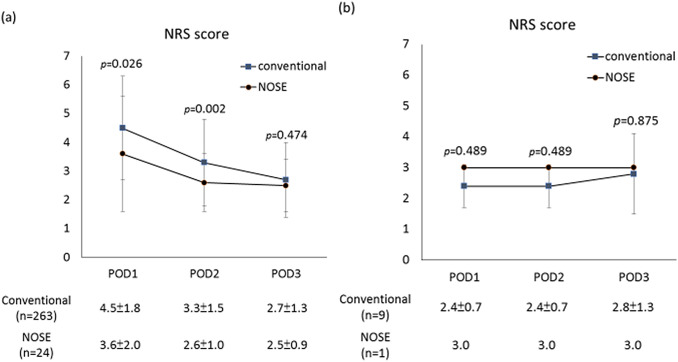
We enrolled 297 patients (151 males, mean age 64.9 ± 12.8 years) who had minimally invasive right hemicolectomy. Of these 297 patients, 272 patients had conventional surgery with specimen extraction through mini-laparotomy and 25 patients had NOSE surgery (23 transrectal, 2 transvaginal). The diagnosis of colon disease did not differ significantly between the conventional and NOSE groups. Postoperative morbidity and mortality rates were comparable. The postoperative hospital stay was significantly (p = 0.004) shorter in the NOSE group (median 5 days, range 3-17 days) than in the conventional group (median 7 days, range 3-45 days). Postoperative pain was significantly (p = 0.026 on postoperative day 1 and p = 0.002 on postoperative day 2) greater in the conventional group than in the NOSE group.
NOSE was associated with acceptable short-term surgical outcomes that were comparable to those of conventional surgery. NOSE results in less postoperative wound pain and a shorter hospital stay than conventional surgery. Larger studies are needed.
经阴道自然腔道标本取出(NOSE)入路在右半结肠癌手术中已被证明具有良好的短期效果。然而,迄今为止,尚无研究报道经直肠 NOSE 入路在右半结肠癌手术中的优势。本研究旨在比较微创右半结肠切除术经直肠 NOSE 方法与传统小切口标本取出术的技术可行性、安全性和短期效果。
本研究纳入了 2017 年 1 月至 2018 年 12 月期间在台湾长庚纪念医院接受微创右半结肠切除术(恶性或良性疾病)的连续患者。将患者分为两组:传统手术,采用小切口标本取出术和 NOSE 手术。分析手术结果,包括并发症、术后短期恢复和疼痛强度。
共纳入 297 例(男 151 例,平均年龄 64.9±12.8 岁)接受微创右半结肠切除术的患者。其中 272 例采用传统小切口标本取出术,25 例采用 NOSE 手术(23 例经直肠,2 例经阴道)。两组患者的结肠疾病诊断无显著差异。术后发病率和死亡率相当。NOSE 组的术后住院时间明显(p=0.004)短于传统组(中位数 5 天,范围 3-17 天)。术后第 1 天(p=0.026)和第 2 天(p=0.002)疼痛明显大于传统组。
NOSE 术具有可接受的短期手术效果,与传统手术相当。NOSE 术可减少术后伤口疼痛,缩短住院时间。需要更大规模的研究。