Neuroscience Drug Discovery Unit, Takeda Pharmaceutical Company Limited, 26-1, Muraoka-Higashi 2-Chome, Fujisawa, Kanagawa, 251-8555, Japan.
Drug Metabolism and Pharmacokinetics Research Laboratories, Research, Takeda Pharmaceutical Company Limited, 26-1, Muraoka-Higashi 2-Chome, Fujisawa, Kanagawa, 251-8555, Japan.
Sci Rep. 2024 Sep 6;14(1):20838. doi: 10.1038/s41598-024-70594-1.
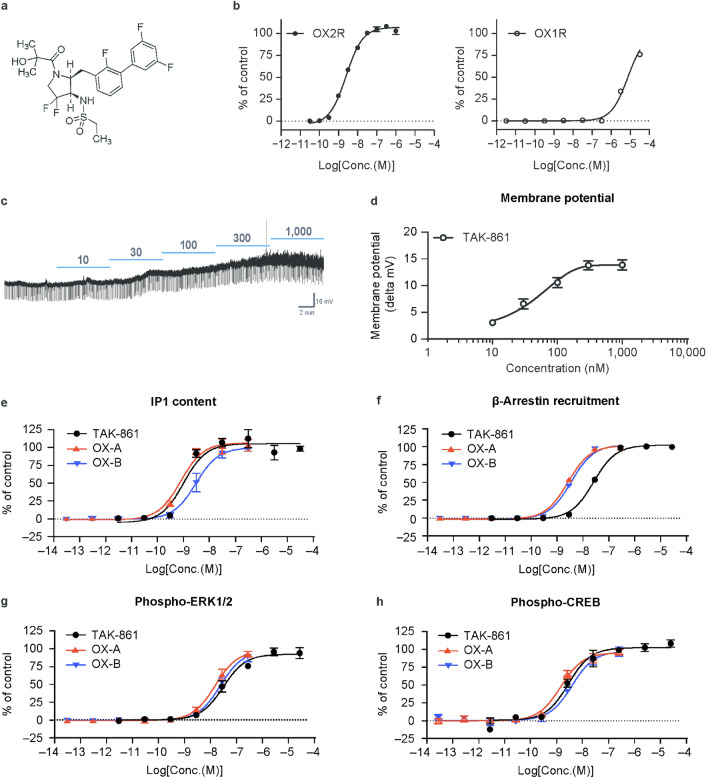
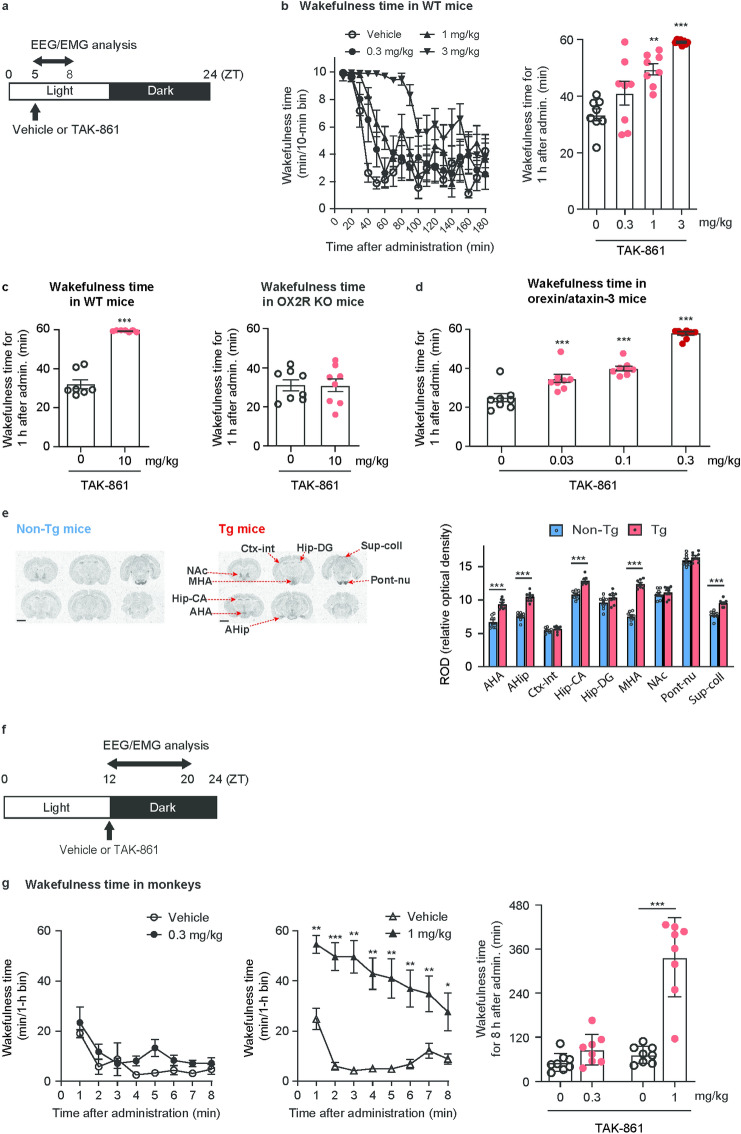
Narcolepsy type 1 (NT1) is associated with severe loss of orexin neurons and characterized by symptoms including excessive daytime sleepiness and cataplexy. Current medications indicated for NT1 often show limited efficacy, not addressing the full spectrum of symptoms, demonstrating a need for novel drugs. We discovered a parenteral orexin receptor 2 (OX2R) agonist, danavorexton, and an orally available OX2R agonist, TAK-994; both improving NT1 phenotypes in mouse models and individuals with NT1. However, danavorexton has limited oral availability and TAK-994 has a risk of off-target liver toxicity. To avoid off-target-based adverse events, a highly potent molecule with low effective dose is preferred. Here, we show that a novel OX2R-selective agonist, TAK-861 [N-{(2S,3R)-4,4-Difluoro-1-(2-hydroxy-2-methylpropanoyl)-2-[(2,3',5'-trifluoro[1,1'-biphenyl]-3-yl)methyl]pyrrolidin-3-yl}ethanesulfonamide], activates OX2R with a half-maximal effective concentration of 2.5 nM and promotes wakefulness at 1 mg/kg in mice and monkeys, suggesting ~ tenfold higher potency and lower effective dosage than TAK-994. Similar to TAK-994, TAK-861 substantially ameliorates wakefulness fragmentation and cataplexy-like episodes in orexin/ataxin-3 and orexin-tTA;TetO DTA mice (NT1 mouse models). Compared with modafinil, TAK-861 induces highly correlated brain-wide neuronal activation in orexin-tTA;TetO DTA mice, suggesting efficient wake-promoting effects. Thus, TAK-861 has potential as an effective treatment for individuals with hypersomnia disorders including narcolepsy, potentially with a favorable safety profile.
发作性睡病 1 型(NT1)与食欲素神经元的严重缺失有关,其特征是包括白天过度嗜睡和猝倒在内的症状。目前用于 NT1 的药物往往疗效有限,无法解决所有症状,这表明需要新型药物。我们发现了一种可注射的食欲素受体 2(OX2R)激动剂,danavorexton,以及一种口服可用的 OX2R 激动剂,TAK-994;这两种药物都改善了 NT1 小鼠模型和 NT1 患者的表型。然而,danavorexton 的口服生物利用度有限,TAK-994 有脱靶肝脏毒性的风险。为了避免基于脱靶的不良反应,首选具有低有效剂量的高活性分子。在这里,我们表明一种新型的 OX2R 选择性激动剂,TAK-861 [N-{(2S,3R)-4,4-二氟-1-(2-羟基-2-甲基丙酰基)-2-[(2,3',5'-三氟[1,1'-联苯]-3-基)甲基]吡咯烷-3-基}乙磺酰胺],以 2.5 nM 的半最大有效浓度激活 OX2R,并在小鼠和猴子中以 1 mg/kg 的剂量促进觉醒,提示其效力比 TAK-994 高约 10 倍,有效剂量低。与 TAK-994 相似,TAK-861 可显著改善 orexin/ataxin-3 和 orexin-tTA;TetO DTA 小鼠(NT1 小鼠模型)中的觉醒片段化和猝倒样发作。与莫达非尼相比,TAK-861 在 orexin-tTA;TetO DTA 小鼠中诱导高度相关的全脑神经元激活,提示其具有高效的促醒作用。因此,TAK-861 有可能成为治疗包括发作性睡病在内的过度嗜睡障碍的有效药物,具有潜在的良好安全性。