• 文献检索
  • 文档翻译
  • 深度研究
  • 学术资讯
  • Suppr Zotero 插件Zotero 插件
  • 邀请有礼
  • 套餐&价格
  • 历史记录
应用&插件
Suppr Zotero 插件Zotero 插件浏览器插件Mac 客户端Windows 客户端微信小程序
定价
高级版会员购买积分包购买API积分包
服务
文献检索文档翻译深度研究API 文档MCP 服务
关于我们
关于 Suppr公司介绍联系我们用户协议隐私条款
关注我们

Suppr 超能文献

核心技术专利:CN118964589B侵权必究
粤ICP备2023148730 号-1Suppr @ 2026

文献检索

告别复杂PubMed语法,用中文像聊天一样搜索,搜遍4000万医学文献。AI智能推荐,让科研检索更轻松。

立即免费搜索

文件翻译

保留排版,准确专业,支持PDF/Word/PPT等文件格式,支持 12+语言互译。

免费翻译文档

深度研究

AI帮你快速写综述,25分钟生成高质量综述,智能提取关键信息,辅助科研写作。

立即免费体验

COVID-19 后最大呼吸压力与健康成年人参考值的比较:一项前瞻性队列研究(SECURE 研究)。

Maximal respiratory pressure after COVID-19 compared with reference material in healthy adults: A prospective cohort study (The SECURe study).

机构信息

Department of Clinical Physiology and Nuclear Medicine, Copenhagen University Hospital-Rigshospitalet, Copenhagen, Denmark.

Department of Occupational Therapy and Physiotherapy, Copenhagen University Hospital-Rigshospitalet, Copenhagen, Denmark.

出版信息

Physiol Rep. 2024 Sep;12(17):e16184. doi: 10.14814/phy2.16184.

DOI:10.14814/phy2.16184
PMID:39245803
原文链接:https://pmc.ncbi.nlm.nih.gov/articles/PMC11381190/
Abstract

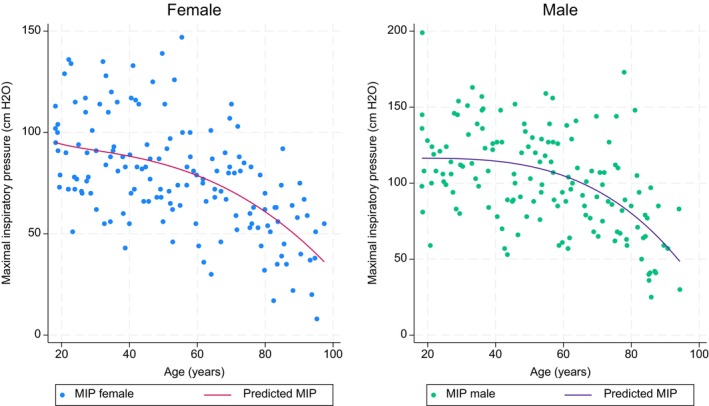
After COVID-19 long term respiratory symptoms and reduced lung function including maximal inspiratory pressure (MIP) and maximal expiratory pressure (MEP) have been reported. However, no studies have looked at MIP and MEP in all disease groups and the reference materials collection methods differ substantially. We aimed to determine MIP and MEP in individuals after COVID-19 infection with different disease severity using reference material of healthy control group obtained using the same standardized method. Patients with COVID-19 were included March 2020-March 2021 at Rigshospitalet, Denmark. MIP and MEP were measured using microRPM. Predicted MIP and MEP were calculated using reference material obtained from 298 healthy adults aged 18-97 years using the same method. In SECURe, 145 participants were measured median 5 months after COVID-19 diagnosis and of these 16% had reduced MIP and/or MEP. There was reduced spirometry and total lung capacity, but not reduced diffusion capacity in those with abnormal MIP and/or MEP compared with normal MIP and MEP. Of those with reduced MIP and/or MEP at 5 months, 80% still had reduced MIP and/or MEP at 12 months follow-up. In conclusion, few have reduced MIP and/or MEP 5 months after COVID-19 and little improvement was seen over time.

摘要

在 COVID-19 之后,已经报道了长期的呼吸症状和肺功能下降,包括最大吸气压力(MIP)和最大呼气压力(MEP)。然而,尚无研究观察到所有疾病组中的 MIP 和 MEP,并且参考材料的收集方法有很大差异。我们旨在使用相同标准化方法获得的健康对照组参考材料,确定 COVID-19 感染后不同疾病严重程度个体的 MIP 和 MEP。2020 年 3 月至 2021 年 3 月在丹麦 Rigshospitalet 纳入 COVID-19 患者。使用 microRPM 测量 MIP 和 MEP。使用相同方法获得的 298 名年龄在 18-97 岁的健康成年人的参考材料计算预测的 MIP 和 MEP。在 SECURe 中,145 名参与者在 COVID-19 诊断后中位 5 个月进行了测量,其中 16%的人 MIP 和/或 MEP 降低。与 MIP 和 MEP 正常的患者相比,MIP 和/或 MEP 异常的患者的肺活量和肺总量下降,但弥散能力正常。在 5 个月时 MIP 和/或 MEP 降低的患者中,80%在 12 个月随访时仍存在 MIP 和/或 MEP 降低。总之,COVID-19 后 5 个月时,MIP 和/或 MEP 降低的患者很少,并且随着时间的推移,改善甚微。

https://cdn.ncbi.nlm.nih.gov/pmc/blobs/cb9c/11381190/9bca1c2d878f/PHY2-12-e16184-g002.jpg
https://cdn.ncbi.nlm.nih.gov/pmc/blobs/cb9c/11381190/aba882e4db5e/PHY2-12-e16184-g001.jpg
https://cdn.ncbi.nlm.nih.gov/pmc/blobs/cb9c/11381190/9bca1c2d878f/PHY2-12-e16184-g002.jpg
https://cdn.ncbi.nlm.nih.gov/pmc/blobs/cb9c/11381190/aba882e4db5e/PHY2-12-e16184-g001.jpg
https://cdn.ncbi.nlm.nih.gov/pmc/blobs/cb9c/11381190/9bca1c2d878f/PHY2-12-e16184-g002.jpg

相似文献

1
Maximal respiratory pressure after COVID-19 compared with reference material in healthy adults: A prospective cohort study (The SECURe study).COVID-19 后最大呼吸压力与健康成年人参考值的比较:一项前瞻性队列研究(SECURE 研究)。
Physiol Rep. 2024 Sep;12(17):e16184. doi: 10.14814/phy2.16184.
2
Maximal Static Respiratory and Sniff Pressures in Healthy Children. A Systematic Review and Meta-Analysis.健康儿童的最大静态呼吸和嗅探压力。系统评价和荟萃分析。
Ann Am Thorac Soc. 2019 Apr;16(4):478-487. doi: 10.1513/AnnalsATS.201808-506OC.
3
Utility of maximum inspiratory and expiratory pressures as a screening method for respiratory insufficiency in slowly progressive neuromuscular disorders.最大吸气和呼气压力作为一种筛选方法,用于检测缓慢进展性神经肌肉疾病中的呼吸功能不全。
Neuromuscul Disord. 2020 Aug;30(8):640-648. doi: 10.1016/j.nmd.2020.06.009. Epub 2020 Jun 25.
4
Respiratory muscular strength in children with mucopolysacaridosis: comparison with predictive equations.儿童黏多糖贮积症的呼吸肌肉力量:与预测方程的比较。
Minerva Pediatr (Torino). 2024 Aug;76(4):507-516. doi: 10.23736/S2724-5276.21.06144-9.
5
A follow-up study on respiratory outcomes, quality of life and performance perception of SARS-CoV-2 primary and reinfection in elite athletes: A 9-month prospective study.一项关于 SARS-CoV-2 原发感染和再感染对精英运动员的呼吸道结局、生活质量和运动表现影响的随访研究:一项 9 个月的前瞻性研究。
Eur J Sport Sci. 2024 Jul;24(7):964-974. doi: 10.1002/ejsc.12109. Epub 2024 Apr 23.
6
Respiratory Muscle Strength as a Discriminator of Sarcopenia in Community-Dwelling Elderly: A Cross-Sectional Study.呼吸肌力量作为社区居住老年人肌少症的鉴别指标:一项横断面研究。
J Nutr Health Aging. 2018;22(8):952-958. doi: 10.1007/s12603-018-1079-4.
7
Maximal Respiratory Muscle Strength and Vital Capacity in Children With Early Onset Scoliosis.早期发病脊柱侧弯儿童的最大呼吸肌力量和肺活量。
Spine (Phila Pa 1976). 2017 Dec 1;42(23):1799-1804. doi: 10.1097/BRS.0000000000002351.
8
Respiratory muscle strength and pulmonary function in unvaccinated athletes before and after COVID-19 infection: A prospective cohort study.未接种疫苗运动员在 COVID-19 感染前后的呼吸肌力量和肺功能:一项前瞻性队列研究。
Respir Physiol Neurobiol. 2023 Feb;308:103983. doi: 10.1016/j.resp.2022.103983. Epub 2022 Nov 4.
9
Normal values for maximal respiratory pressures in children and adolescents: A systematic review with meta-analysis.儿童和青少年最大呼吸压力的正常值:系统评价与荟萃分析。
Braz J Phys Ther. 2024 Jan-Feb;28(1):100587. doi: 10.1016/j.bjpt.2023.100587. Epub 2023 Dec 29.
10
[Maximal inspiratory and expiratory pressures long after lung resection].肺切除术后很长时间的最大吸气和呼气压力
Nihon Kyobu Shikkan Gakkai Zasshi. 1995 Dec;33(12):1382-1385.

本文引用的文献

1
Potential Diaphragm Muscle Weakness-related Dyspnea Persists 2 Years after COVID-19 and Could Be Improved by Inspiratory Muscle Training: Results of an Observational and an Interventional Clinical Trial.新冠肺炎后 2 年仍存在与膈肌肌无力相关的呼吸困难,吸气肌训练可改善:一项观察性和一项干预性临床试验的结果。
Am J Respir Crit Care Med. 2024 Sep 1;210(5):618-628. doi: 10.1164/rccm.202309-1572OC.
2
Can inspiratory muscle training benefit patients with COVID-19? A systematic review and meta-analysis.吸气肌训练能否使 COVID-19 患者受益?系统评价和荟萃分析。
J Med Virol. 2023 Aug;95(8):e28956. doi: 10.1002/jmv.28956.
3
FEASIBILITY OF INSPIRATORY MUSCLE TRAINING FOR PATIENTS WITH PERSISTENT DYSPNOEA AFTER COVID-19 INFECTION: A PILOT STUDY.
新型冠状病毒肺炎感染后持续性呼吸困难患者进行吸气肌训练的可行性:一项试点研究。
J Rehabil Med Clin Commun. 2023 Jun 5;6:6507. doi: 10.2340/jrmcc.v6.6507. eCollection 2023.
4
Heterogeneous Treatment Effects after Inspiratory Muscle Training during Recovery from Postacute COVID-19 Syndrome.急性COVID-19综合征康复期间吸气肌训练后的异质性治疗效果。
Med Sci Sports Exerc. 2023 Oct 1;55(10):1761-1769. doi: 10.1249/MSS.0000000000003207. Epub 2023 May 12.
5
Physical activity levels respiratory and peripheral muscle strength and pulmonary function in young post-COVID-19 patients : A cross-sectional study.新冠康复后青少年患者的体力活动水平、呼吸及外周肌肉力量和肺功能:一项横断面研究。
Wien Klin Wochenschr. 2023 May;135(9-10):251-259. doi: 10.1007/s00508-023-02204-5. Epub 2023 Apr 28.
6
A temporal examination of inspiratory muscle strength and endurance in hospitalized COVID-19 patients.对住院 COVID-19 患者吸气肌力量和耐力的时间性考察。
Heart Lung. 2023 Jul-Aug;60:95-101. doi: 10.1016/j.hrtlng.2023.03.007. Epub 2023 Mar 13.
7
Pulmonary function three to five months after hospital discharge for COVID-19: a single centre cohort study.COVID-19 患者出院后 3 至 5 个月的肺功能:一项单中心队列研究。
Sci Rep. 2023 Jan 13;13(1):681. doi: 10.1038/s41598-023-27879-8.
8
Low Intensity Respiratory Muscle Training in COVID-19 Patients after Invasive Mechanical Ventilation: A Retrospective Case-Series Study.有创机械通气后新冠病毒肺炎患者的低强度呼吸肌训练:一项回顾性病例系列研究
Biomedicines. 2022 Nov 4;10(11):2807. doi: 10.3390/biomedicines10112807.
9
Respiratory muscle strength and pulmonary function in unvaccinated athletes before and after COVID-19 infection: A prospective cohort study.未接种疫苗运动员在 COVID-19 感染前后的呼吸肌力量和肺功能:一项前瞻性队列研究。
Respir Physiol Neurobiol. 2023 Feb;308:103983. doi: 10.1016/j.resp.2022.103983. Epub 2022 Nov 4.
10
Impairment of Inspiratory Muscle Function after COVID-19.新冠病毒感染后吸气肌功能障碍。
Respiration. 2022;101(11):981-989. doi: 10.1159/000527361. Epub 2022 Oct 28.