MS Center Amsterdam, Neurology, Vrije Universiteit Amsterdam, Amsterdam Neuroscience, Amsterdam UMC, Location VU Medical Centre, Amsterdam, The Netherlands.
Queen Square Multiple Sclerosis Centre, Department of Neuroinflammation, UCL Queen Square Institute of Neurology, Faculty of Brain Sciences, University College London, London, UK.
Mult Scler. 2024 Sep;30(10):1296-1308. doi: 10.1177/13524585241272938. Epub 2024 Sep 8.
Higher age is associated with less inflammatory disease activity in relapsing-remitting multiple sclerosis (RRMS). It is unknown whether age itself or disease duration underlies this association.
This study investigated the effects of age, disease duration, and inflammatory disease activity in people with RRMS.
Individual patient-level data from five large phase III randomized controlled trials (RCTs) was utilized to investigate the association of both age and disease duration with annualized relapse rate (ARR), contrast-enhancing lesions (CELs), and new T2 lesions on magnetic resonance imaging (MRI) at baseline and follow-up.
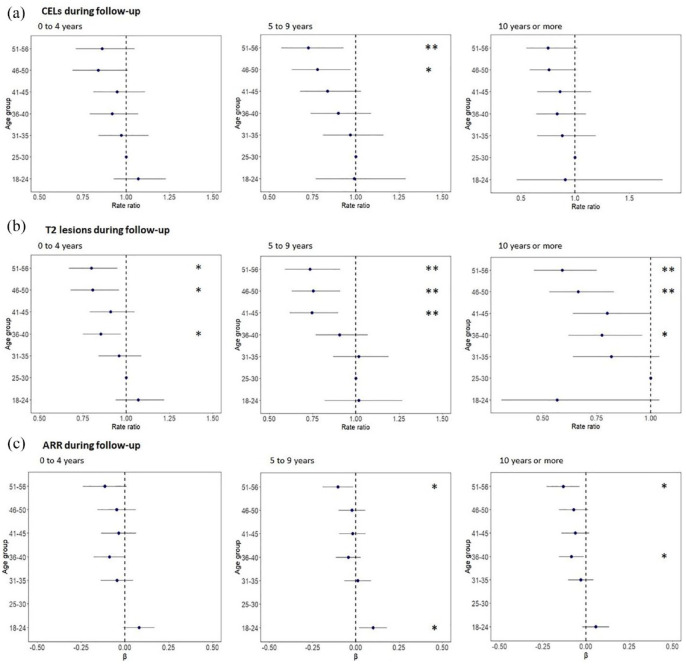
The data set included 5626 participants. Higher age was associated with lower ARRs, lower CEL number on MRI at baseline and follow-up, and lower new T2 lesion numbers at follow-up. This effect was present in all disease duration groups. For example, we found a lower number of new T2 lesions on MRI during follow-up in higher age groups compared to lower age groups, independent of disease duration.
Aging in RRMS is associated with a lower risk of inflammatory disease activity, across different disease durations. Age should be taken into account when designing clinical trials and future research should investigate how age should be integrated into personalized predictions of treatment response and risk profiling.
在复发缓解型多发性硬化症(RRMS)中,较高的年龄与较低的炎症性疾病活动度相关。尚不清楚这种关联是由年龄本身还是疾病持续时间引起的。
本研究旨在探讨 RRMS 患者的年龄、疾病持续时间和炎症性疾病活动度的影响。
利用五项大型 III 期随机对照试验(RCT)的个体患者水平数据,研究年龄和疾病持续时间与基线和随访时的年复发率(ARR)、对比增强病变(CEL)和新的 T2 病变磁共振成像(MRI)之间的关联。
数据集包括 5626 名参与者。较高的年龄与较低的 ARR、基线和随访时 MRI 上的 CEL 数量以及随访时的新 T2 病变数量减少相关。这种影响存在于所有疾病持续时间组中。例如,我们发现,与年龄较低的组相比,年龄较高的组在随访期间 MRI 上新 T2 病变的数量较少,而与疾病持续时间无关。
RRMS 中的衰老与不同疾病持续时间的炎症性疾病活动度降低相关。在设计临床试验和未来研究时应考虑年龄因素,应研究如何将年龄纳入到治疗反应的个体化预测和风险分层中。