University of Zagreb Faculty of Kinesiology, Zagreb, Croatia.
National University of Singapore, Healthy Longevity Translational Research Program, Yong Loo Lin School of Medicine, Singapore.
J Int Soc Sports Nutr. 2024 Dec;21(1):2400513. doi: 10.1080/15502783.2024.2400513. Epub 2024 Sep 8.
Caffeine is one of the most popular ergogenic aids consumed by athletes. Caffeine's ergogenic effect has been generally explained by its ability to bind to adenosine receptors, thus modulating pain and reducing perceived exertion. Another pharmacological agent that may improve performance due to its analgesic proprieties is paracetamol. This study aimed to explore the effects of caffeine, paracetamol, and caffeine + paracetamol consumption on muscular endurance, strength, power, anaerobic endurance, and jumping performance.
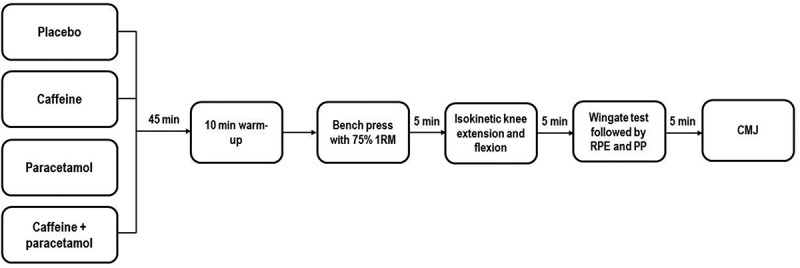
In this randomized, crossover, double-blind study, 29 resistance-trained participants (11 men and 18 women) ingested either a placebo, caffeine (3 mg/kg), paracetamol (1500 mg) or caffeine + paracetamol 45 min before the testing sessions. The testing sessions included performing the bench press exercise with 75% of one-repetition maximum to momentary muscular failure, isokinetic knee extension and flexion at angular velocities of 60°/sec and 180°/sec, Wingate, and countermovement jump (CMJ) tests.
Compared to placebo, isolated caffeine ingestion increased the number of repetitions performed in the bench press ( = 0.005; = 0.42). Compared to placebo, isolated caffeine ingestion and/or caffeine + paracetamol consumption was ergogenic for strength (torque), muscular endurance (total work), or power in the isokinetic assessment, particularly at slower angular velocities ( = 0.027 to 0.002; = 0.16 to 0.26). No significant differences between the conditions were observed for outcomes related to the Wingate and CMJ tests.
This study provided novel evidence into the effectiveness of caffeine, paracetamol, and their combination on exercise performance. We found improvements in muscular endurance, strength, or power only when caffeine was consumed in isolation, or in combination with paracetamol. Isolated paracetamol consumption did not improve performance for any of the analyzed outcomes, thus calling into question its ergogenic potential.
咖啡因是运动员最常使用的一种兴奋性物质。咖啡因的兴奋作用通常归因于其与腺苷受体结合的能力,从而调节疼痛并减轻感知的疲劳。另一种可能因其镇痛特性而提高表现的药物是对乙酰氨基酚。本研究旨在探索咖啡因、对乙酰氨基酚和咖啡因+对乙酰氨基酚的摄入对肌肉耐力、力量、功率、无氧耐力和跳跃表现的影响。
在这项随机、交叉、双盲研究中,29 名受过抗阻训练的参与者(11 名男性和 18 名女性)分别摄入安慰剂、咖啡因(3mg/kg)、对乙酰氨基酚(1500mg)或咖啡因+对乙酰氨基酚,在测试前 45 分钟。测试包括进行卧推运动,使用 75%的最大重复次数至瞬间肌肉疲劳,在角速度为 60°/秒和 180°/秒时进行等速膝关节伸展和屈曲,进行瓦格纳测试和反向跳跃测试(CMJ)。
与安慰剂相比,单独摄入咖啡因可增加卧推运动的重复次数( = 0.005; = 0.42)。与安慰剂相比,单独摄入咖啡因和/或咖啡因+对乙酰氨基酚对力量(扭矩)、肌肉耐力(总功)或等速评估中的功率具有兴奋作用,尤其是在较慢的角速度时( = 0.027 至 0.002; = 0.16 至 0.26)。在与瓦格纳和 CMJ 测试相关的结果方面,不同条件之间没有观察到显著差异。
本研究为咖啡因、对乙酰氨基酚及其组合对运动表现的有效性提供了新的证据。我们发现,只有在单独摄入咖啡因或与对乙酰氨基酚联合摄入时,才会改善肌肉耐力、力量或功率。单独摄入对乙酰氨基酚不能提高任何分析结果的表现,因此对其兴奋潜力提出了质疑。