Pai Amritha, Ramanarayanan Venkitachalam, Rajeev Keerthana
Public Health Dentistry, Amrita School of Dentistry, Amrita Vishwa Vidyapeetham, Kochi, IND.
Cureus. 2024 Aug 8;16(8):e66418. doi: 10.7759/cureus.66418. eCollection 2024 Aug.
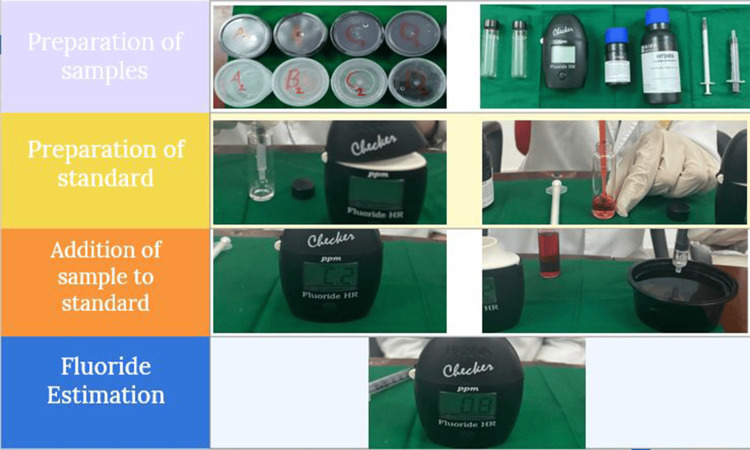
Introduction Salt is an essential component of the Indian diet. Edible salt contains fluoride, and its concentration varies depending on the source and manufacturing process. This study aimed to assess the fluoride concentration of commonly available varieties of edible salts in India. Methodology This in vitro study was conducted with four different types of edible salts viz. iodized salt, rock salt, pink salt, and black salt. Two brands of each salt available in the market were procured. Fluoride estimation was conducted using the sodium 2-(parasulphophenylazo-)- 1,8-dihydroxy-3,6-naphthalene disulphonate (SPADNS) method using Fluoride High-Range Checker® HC (Hanna Equipments India Pvt. Ltd., Mumbai, India) with HI739-26 reagent. The reaction between fluoride and the reagent forms a colorless complex in the sample. The concentration is then determined from the color produced, measured in parts per million (ppm). Results Iodized salt showed the least fluoride content (12.5 ± 7.5 ppm), while it was highest for black salt (77.5 ± 19.9 ppm). There was a statistically significant difference between the study groups (p=0.009). Rock salt also showed high amounts of fluoride (40.8 ± 52.4 ppm). Conclusion Fluoride content in different types of edible salt varied, though well within the prescribed limits. This calls for nutritional labelling of fluoride to help the consumer make informed choices.
引言
盐是印度饮食的重要组成部分。食用盐含有氟化物,其浓度因来源和生产工艺而异。本研究旨在评估印度常见食用盐品种中的氟化物浓度。
方法
本体外研究使用了四种不同类型的食用盐,即加碘盐、岩盐、粉红盐和黑盐。采购了市场上每种盐的两个品牌。使用配备HI739 - 26试剂的氟化物高量程检测仪®HC(印度孟买汉纳设备私人有限公司),采用2 -(对磺基苯偶氮)- 1,8 - 二羟基 - 3,6 - 萘二磺酸钠(SPADNS)法进行氟化物测定。氟化物与试剂之间的反应在样品中形成无色络合物。然后根据产生的颜色测定浓度,以百万分之一(ppm)为单位。
结果
加碘盐的氟化物含量最低(12.5±7.5 ppm),而黑盐的氟化物含量最高(77.5±19.9 ppm)。研究组之间存在统计学显著差异(p = 0.009)。岩盐的氟化物含量也很高(40.8±52.4 ppm)。
结论
不同类型食用盐中的氟化物含量各不相同,不过均在规定限值内。这就需要对氟化物进行营养标签标注,以帮助消费者做出明智的选择。