Habibizadeh Mina, Lotfollahzadeh Shima, Mahdavi Parisa, Mohammadi Soheila, Tavallaei Omid
Regenerative Medicine Research Center, Kermanshah University of Medical Sciences, Kermanshah, Iran.
Nano Drug Delivery Research Center, Health Technology Institute, Kermanshah University of Medical Sciences, Kermanshah, Iran.
Heliyon. 2024 Aug 8;10(16):e36057. doi: 10.1016/j.heliyon.2024.e36057. eCollection 2024 Aug 30.
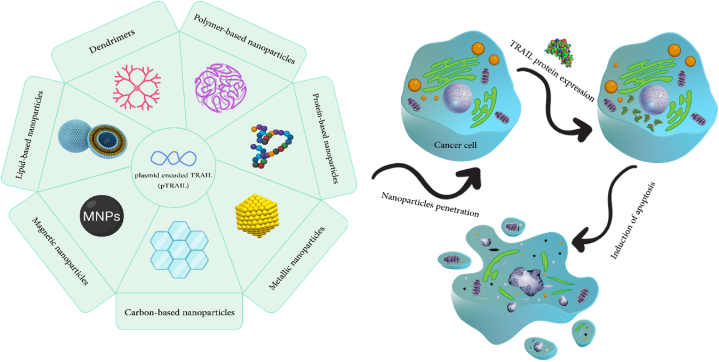
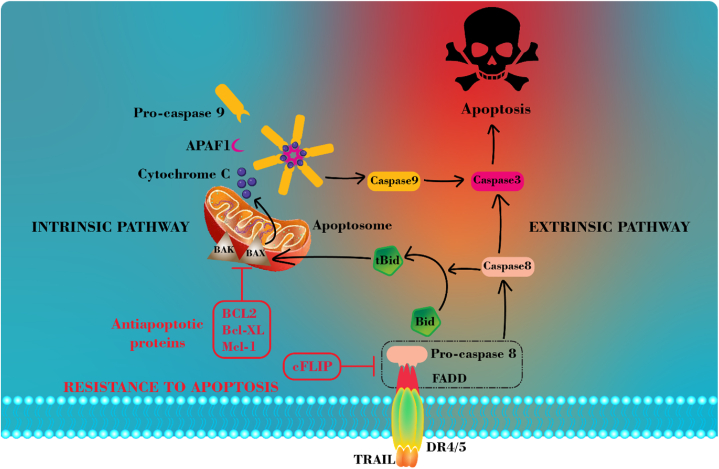
Tumor necrosis factor-related apoptosis-inducing ligand (TRAIL), also known as APO2L, has emerged as a highly potential anticancer agent because of its capacity to effectively trigger apoptosis in tumor cells by specifically binding to either of its death receptors (DR4 or DR5) while having no adverse effects on normal cells. Nevertheless, its practical use has been hindered by its inefficient pharmacokinetics characteristics, the challenges involved in its administration and delivery to targeted cells, and the resistance exhibited by most cancer cells towards TRAIL. Gene therapy, as a promising approach would be able to potentially circumvent TRAIL-based cancer therapy challenges mainly through localized TRAIL expression and generating a bystander impact. Among different strategies, using nanoparticles in gene delivery allows for precise targeting, and overcoming TRAIL resistance by combination therapy. In this review, we go over potential mechanisms by which cancer cells achieve resistance to TRAIL and provide an overview of different carriers for delivering of the gene to resistant cancer cells, focusing on different types of nanoparticles utilized in this context. We will also explore the challenges, and investigate future perspectives of this nanomedicine approach for cancer therapy.
肿瘤坏死因子相关凋亡诱导配体(TRAIL),也称为APO2L,已成为一种极具潜力的抗癌药物,因为它能够通过特异性结合其死亡受体(DR4或DR5)之一,有效触发肿瘤细胞凋亡,同时对正常细胞无不良影响。然而,其实际应用受到其低效的药代动力学特性、给药和递送至靶细胞所涉及的挑战以及大多数癌细胞对TRAIL表现出的抗性的阻碍。基因治疗作为一种有前景的方法,将有可能主要通过局部TRAIL表达和产生旁观者效应来规避基于TRAIL的癌症治疗挑战。在不同策略中,在基因递送中使用纳米颗粒可实现精确靶向,并通过联合治疗克服TRAIL抗性。在本综述中,我们探讨了癌细胞对TRAIL产生抗性的潜在机制,并概述了将该基因递送至耐药癌细胞的不同载体,重点关注在此背景下使用的不同类型纳米颗粒。我们还将探讨挑战,并研究这种纳米医学癌症治疗方法的未来前景。