Chen Shouzheng, Harder Constantin, Ribca Iuliana, Sochor Benedikt, Erbes Elisabeth, Bulut Yusuf, Pluntke Luciana, Meinhardt Alexander, Schummer Bernhard, Oberthür Markus, Keller Thomas F, Söderberg L Daniel, Techert Simone A, Stierle Andreas, Müller-Buschbaum Peter, Johansson Mats K G, Navarro Julien, Roth Stephan V
Deutsches Elektronen-Synchrotron DESY Notkestraße 85 22607 Hamburg Germany
Institute of Wood Science, Universität Hamburg Leuschnerstraße 91 21031 Hamburg Germany.
Nanoscale Adv. 2024 Aug 28;6(20):5031-41. doi: 10.1039/d4na00191e.
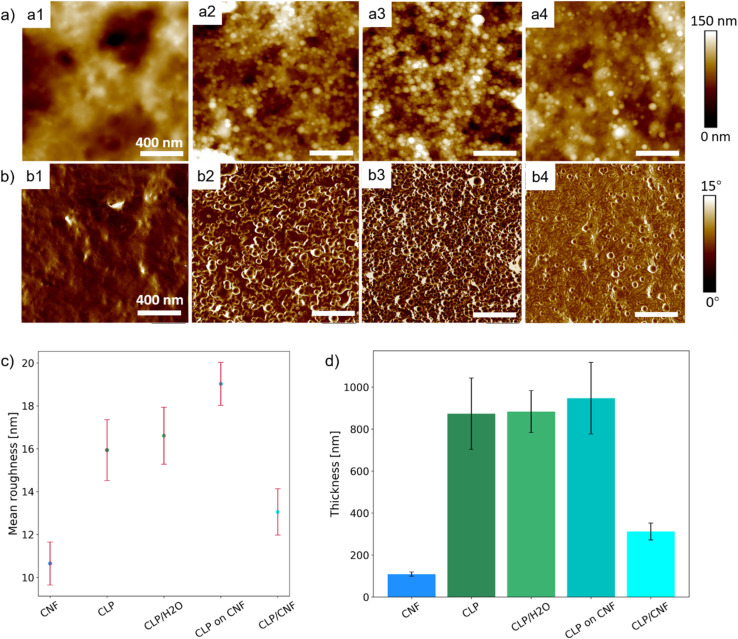
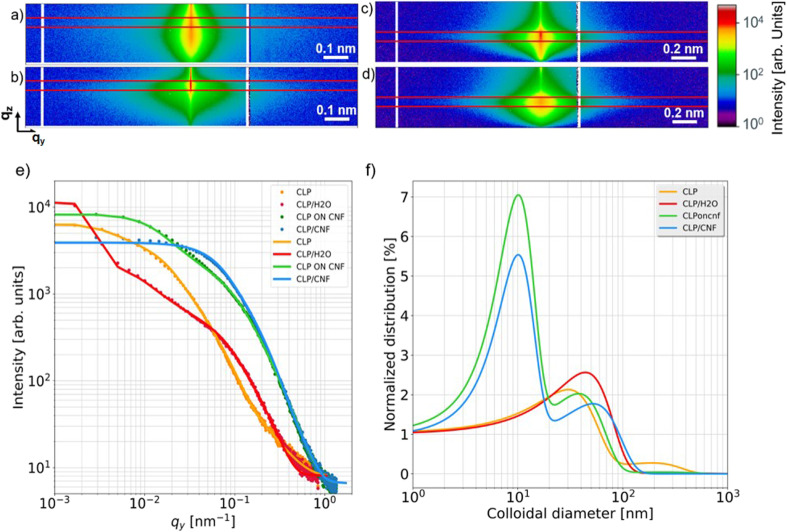
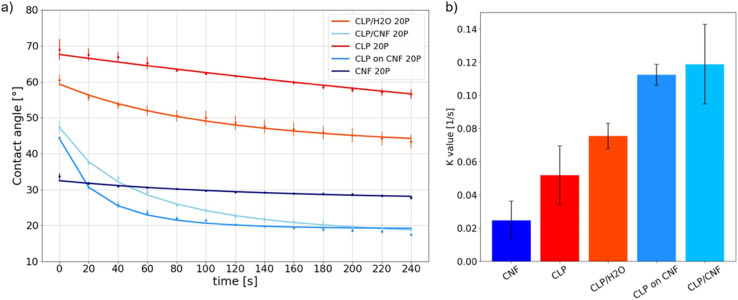
In the context of global climate change, the demand for new functional materials that are sustainable and environmentally friendly is rapidly increasing. Cellulose and lignin are the two most abundant raw materials in nature, and are ideal components for functional materials. The hydrophilic interface and easy film-forming properties of cellulose nanofibrils make them excellent candidates for natural biopolymer templates and network structures. Lignin is a natural UV-shielding material, as it contains a large number of phenolic groups. In this work, we have applied two routes for spray deposition of hybrid films with different laminar structures using surface-charged cellulose nanofibrils and water-based colloidal lignin particles. As the first route, we prepare stacked colloidal lignin particles and cellulose nanofibrils hybrid film through a layer-by-layer deposition. As the second route, we spray-deposite premixed colloidal lignin particles and cellulose nanofibrils dispersion to prepare a mixed hybrid film. We find that cellulose nanofibrils act as a directing agent to dominate the arrangement of the colloidal lignin particles in a mixed system. Additionally, cellulose nanofibrils eliminate the agglomerations and thus increase the visible light transparency while retaining the UV shielding ability. Our research on these colloidal lignin and cellulose nanofibril hybrid films provides a fundamental understanding of using colloidal lignin nanoparticles as functional material on porous cellulose-based materials, for example on fabrics.
在全球气候变化的背景下,对可持续且环保的新型功能材料的需求正在迅速增长。纤维素和木质素是自然界中最丰富的两种原材料,是功能材料的理想组分。纤维素纳米纤丝的亲水性界面和易于成膜的特性使其成为天然生物聚合物模板和网络结构的极佳候选材料。木质素是一种天然的紫外线屏蔽材料,因为它含有大量的酚基。在这项工作中,我们采用了两种途径,利用表面带电的纤维素纳米纤丝和水性胶体木质素颗粒喷雾沉积具有不同层状结构的混合膜。作为第一种途径,我们通过逐层沉积制备堆叠的胶体木质素颗粒和纤维素纳米纤丝混合膜。作为第二种途径,我们喷雾沉积预混合的胶体木质素颗粒和纤维素纳米纤丝分散体以制备混合混合膜。我们发现纤维素纳米纤丝在混合体系中充当导向剂,主导胶体木质素颗粒的排列。此外,纤维素纳米纤丝消除了团聚现象,从而在保留紫外线屏蔽能力的同时提高了可见光透明度。我们对这些胶体木质素和纤维素纳米纤丝混合膜的研究为在多孔纤维素基材料(例如织物)上使用胶体木质素纳米颗粒作为功能材料提供了基本认识。