Mekschrat Liza, Schmalbach Bjarne, Rohleder Nicolas, Petrowski Katja
Medical Psychology & Medical Sociology, University Medical Center of the Johannes Gutenberg University Mainz, Mainz, Germany.
Department of Psychology, Friedrich-Alexander-Universität Erlangen-Nürnberg, Erlangen, Germany.
Brain Behav Immun Health. 2024 Aug 2;40:100833. doi: 10.1016/j.bbih.2024.100833. eCollection 2024 Oct.
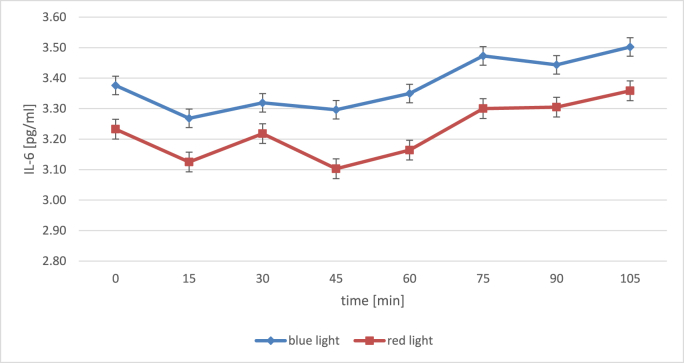
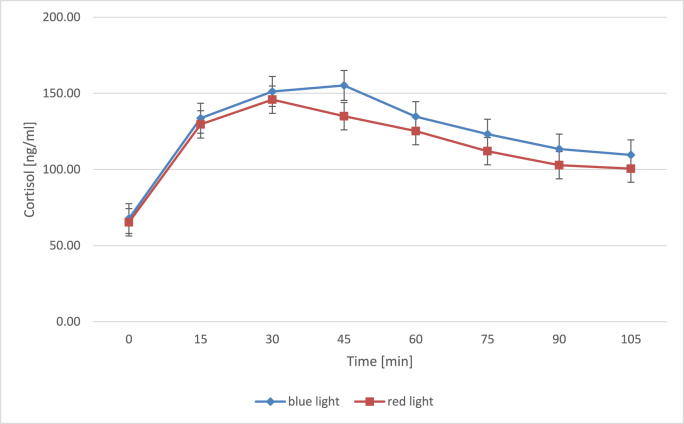
Light is essential in shaping human circadian rhythms, including that of the hormone cortisol. While cortisol is known to influence secretion of the cytokine IL-6, the influence of light itself on IL-6 remains unclear. Thus, this study investigated the effects of two light conditions - red and blue - on IL-6 concentrations and the cortisol awakening response in blood. The interplay between cortisol and IL-6 was explored as well. The between-subject experiment was conducted with 71 healthy adult men (aged = 24.30, = 3.56; = 24.40, = 3.51) in a standardized sleep laboratory setting with 60-min light exposure post-awakening at 05:00 a.m. Two mixed models, with light condition and time across measurement points as factors, were calculated. In the one for cortisol, chronotype was introduced as a covariate. Mean cortisol concentrations did not differ between exposure to red vs. blue light ( = 0.443), but overall cortisol output (area under the curve with respect to ground; AUC) and sensitivity (area under the curve with respect to increase; AUC) were greater in the blue-light condition ( = 0.050 and < 0.001, respectively). Additionally, chronotype significantly influenced cortisol concentrations ( = 0.035). As for IL-6, a main effect of time was obtained, with increasing concentrations over time ( = 0.002). Total IL-6 secretion was greater under blue-light exposure ( <. 001), but mean IL-6 concentrations ( = 0.230) and IL-6 sensitivity ( = 0.777) did not differ between the red- and blue-light condition. Mean and total cortisol and IL-6 concentrations were significantly negatively correlated ( = 0.021 and < 0.001, respectively) during the red-light exposure. In the blue-light condition, cortisol sensitivity was significantly negatively correlated with IL-6 sensitivity ( = 0.034). Overall, blue light seemed to have exerted a greater influence on cortisol and IL-6. For cortisol, this effect might be moderated by chronotype. Additionally, cortisol and IL-6 seem to interact under light exposure. However, these effects were mixed and could not be found consistently across mean secretion, AUCg and AUCi.
光线对于塑造人类昼夜节律至关重要,包括激素皮质醇的昼夜节律。虽然已知皮质醇会影响细胞因子白细胞介素 -6(IL-6)的分泌,但光线本身对IL-6的影响仍不清楚。因此,本研究调查了两种光照条件——红光和蓝光——对血液中IL-6浓度及皮质醇觉醒反应的影响。同时也探讨了皮质醇与IL-6之间的相互作用。在标准化睡眠实验室环境中,对71名健康成年男性(年龄 = 24.30,标准差 = 3.56;年龄 = 24.40,标准差 = 3.51)进行了受试者间实验,在上午05:00醒来后进行60分钟的光照暴露。计算了两个混合模型,将光照条件和各测量点的时间作为因素。在皮质醇模型中,引入了生物钟类型作为协变量。红光与蓝光照射下的平均皮质醇浓度没有差异(P = 0.443),但蓝光条件下的总体皮质醇输出(相对于基线的曲线下面积;AUC)和敏感性(相对于增加量的曲线下面积;AUC)更高(分别为P = 0.050和P < 0.001)。此外,生物钟类型显著影响皮质醇浓度(P = 0.035)。至于IL-6,获得了时间的主效应,其浓度随时间增加(P = 0.002)。蓝光照射下的总IL-6分泌更高(P < 0.001),但红光和蓝光条件下的平均IL-6浓度(P = 0.230)和IL-6敏感性(P = 0.777)没有差异。在红光照射期间,平均和总皮质醇及IL-6浓度显著负相关(分别为P = 0.021和P < 0.001)。在蓝光条件下,皮质醇敏感性与IL-6敏感性显著负相关(P = 0.034)。总体而言,蓝光似乎对皮质醇和IL-6有更大影响。对于皮质醇,这种影响可能受生物钟类型调节。此外,皮质醇和IL-6在光照下似乎相互作用。然而,这些影响是混合的,在平均分泌、AUCg和AUCi中并非始终一致。