Shields Ryan K, Dorazio Ava J, Tiseo Giusy, Squires Kevin M, Leonildi Alessandro, Giordano Cesira, Kline Ellen G, Barnini Simona, Iovleva Alina, Griffith Marissa P, Van Tyne Daria, Doi Yohei, Falcone Marco
Department of Medicine, University of Pittsburgh, Pittsburgh, PA, USA.
Center for Innovative Antimicrobial Therapy, University of Pittsburgh, Pittsburgh, PA, USA.
JAC Antimicrob Resist. 2024 Sep 9;6(5):dlae146. doi: 10.1093/jacamr/dlae146. eCollection 2024 Oct.
Cefiderocol exhibits potent activity against carbapenem-resistant (CRAb), but this activity has not consistently translated to improved outcomes among patients. Cefiderocol heteroresistance, or the presence of a resistant subpopulation, has been proposed as one possible explanation. The objective of this study was to explore associations between heteroresistance and outcomes of patients with CRAb infections.
Baseline CRAb isolates were collected from 27 consecutive patients in the USA and Italy. Cefiderocol susceptibility was tested by broth microdilutions in triplicate. Heteroresistance was defined by population analysis profiling in duplicate. Resistance mechanisms and strain relatedness were evaluated through comparative genomic analysis.
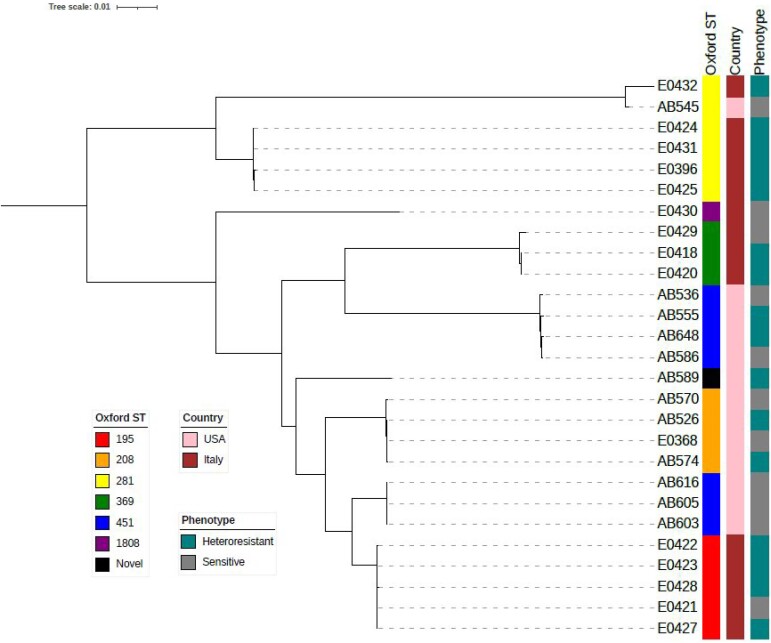
Overall, 59% of infecting CRAb isolates were identified as cefiderocol-heteroresistant; rates were higher among isolates from Italy (79%) than the USA (38%). The median Charlson Comorbidity and SOFA scores were 4 and 5, respectively; 44% of patients had pneumonia, which was the most common infection type. Rates of 28-day clinical success and survival were 30% and 73%, respectively. By broth microdilution, cefiderocol MICs ≥1 mg/L were associated with higher failure rates than MICs ≤0.5 mg/L (81% versus 55%). Rates of clinical failure were numerically higher among patients infected by cefiderocol-heteroresistant compared with susceptible CRAb (81% versus 55%). Whole-genome sequencing identified a premature stop codon in the TonBdependent receptor gene in six isolates, all of which were heteroresistant.
This pilot study supports the hypothesis that cefiderocol treatment failure may be associated with higher MICs and/or the presence of heteroresistance. Further studies are needed to confirm these findings.
头孢地尔对耐碳青霉烯类鲍曼不动杆菌(CRAb)显示出强大活性,但这种活性并未始终转化为患者更好的治疗结局。有人提出头孢地尔异质性耐药,即耐药亚群的存在,是一种可能的解释。本研究的目的是探讨异质性耐药与CRAb感染患者结局之间的关联。
从美国和意大利的27例连续患者中收集基线CRAb分离株。通过肉汤微量稀释法一式三份检测头孢地尔敏感性。通过一式两份的群体分析谱定义异质性耐药。通过比较基因组分析评估耐药机制和菌株相关性。
总体而言,59%的感染性CRAb分离株被鉴定为对头孢地尔异质性耐药;来自意大利的分离株(79%)的发生率高于美国(38%)。Charlson合并症评分和序贯器官衰竭评估(SOFA)评分的中位数分别为4分和5分;44%的患者患有肺炎,这是最常见的感染类型。28天临床成功率和生存率分别为30%和73%。通过肉汤微量稀释法,头孢地尔最低抑菌浓度(MIC)≥1mg/L与高于MIC≤0.5mg/L的失败率相关(81%对55%)。与敏感的CRAb感染患者相比,头孢地尔异质性耐药感染患者的临床失败率在数值上更高(81%对55%)。全基因组测序在六个分离株中鉴定出TonB依赖性受体基因中的一个提前终止密码子,所有这些分离株均为异质性耐药。
这项初步研究支持以下假设,即头孢地尔治疗失败可能与较高的MIC和/或异质性耐药的存在有关。需要进一步研究来证实这些发现。