Adami Giovanni, Orsolini Giovanni, Rossini Maurizio, Fratucello Anna, Fassio Angelo, Viapiana Ombretta, Fracassi Elena, Bixio Riccardo, Gatti Davide
Rheumatology Unit, University of Verona, Pz Scuro 10, Verona, 37134, +0458124049, Italy.
Research Unit, Azienda Ospedaliera Universitaria Integrata di Verona, Verona, Italy.
BMC Rheumatol. 2024 Sep 10;8(1):40. doi: 10.1186/s41927-024-00414-6.
Rheumatoid arthritis (RA) is characterized by bone loss. It is unclear whether JAK inhibitors can attenuate bone loss in RA by modulating bone metabolism. The main objective of our study is to investigate the effects of tofacitinib on serum levels of bone turnover markers and modulators. Secondary objectives were to assess changes in bone mineral density (BMD), metacarpal index, bone erosions.
We conducted a prospective observational study on patients with active RA failure to bDMARDs or tsDMARDs initiating treatment with tofacitinib. We measured at baseline and after 1, 2, 3, 6, 9 and 12 months: serum bone turnover markers (CTX, P1nP, B-ALP), bone modulators (Dkk-1, sclerostin, vitamin D, PTH, OPG and RANKL), BMD and radiographic parameters (Sharp van der Heijde score [SvdH], bone health index [BHI] and metacarpal index [MCI]).
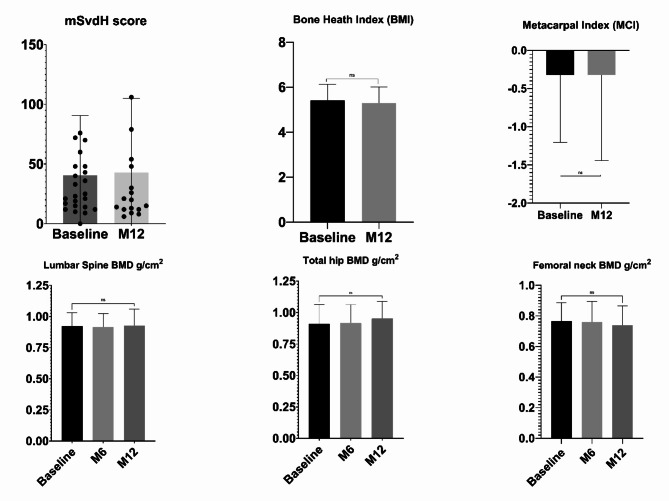
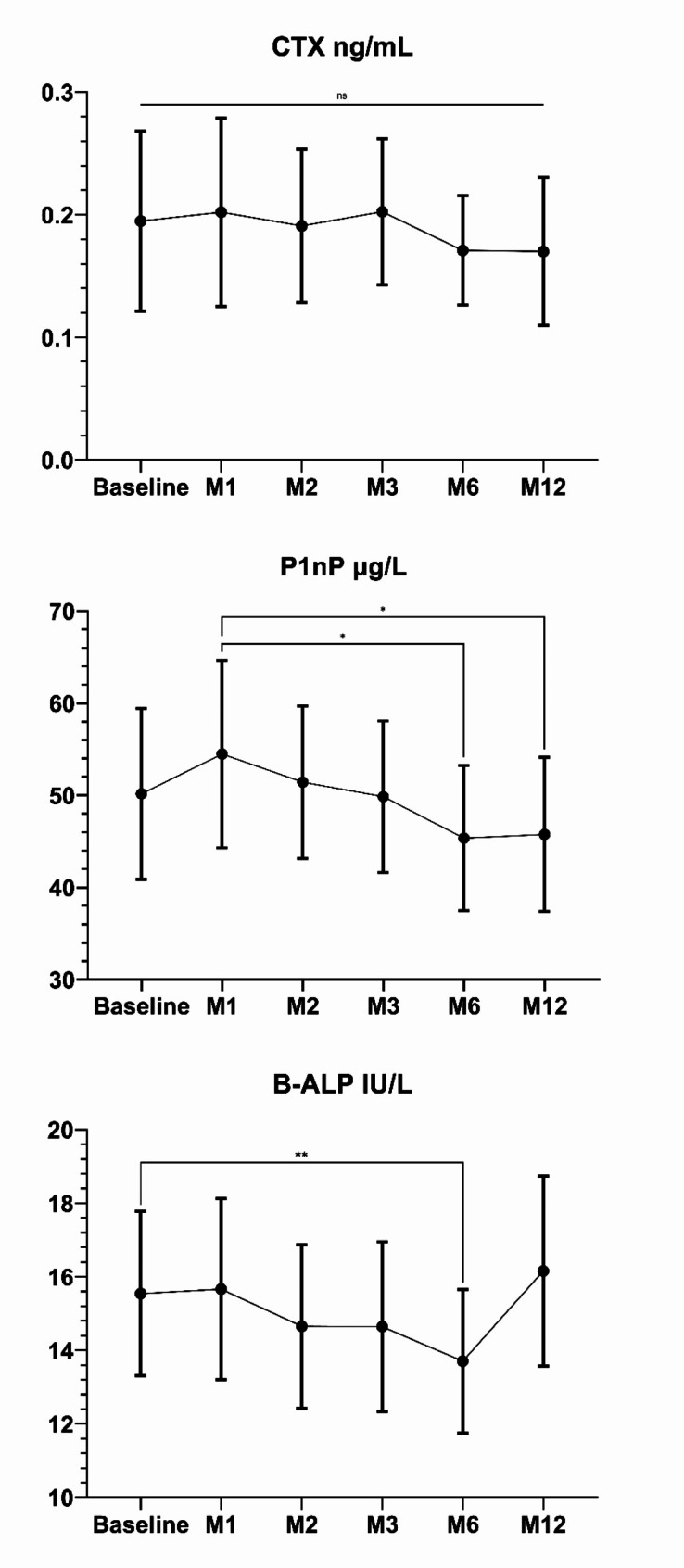
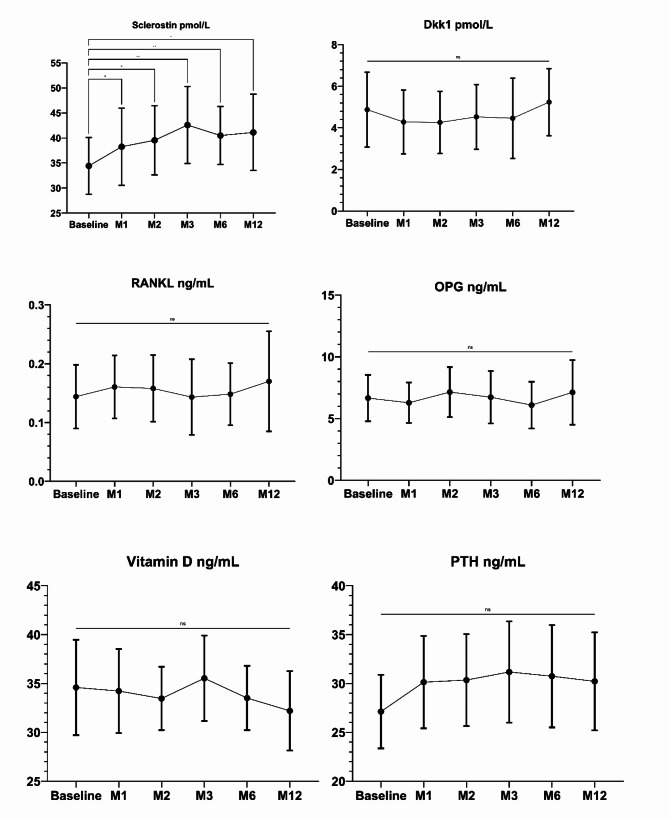
30 patients were enrolled in the study of whom 21 completed the study through month 12. Tofacitinib was clinically effective by suppressing DAS28-CRP. Glucocorticoids daily dose significantly decreased from baseline. We found a negative correlation between pre-study cumulative and daily dose of glucocorticoids and baseline B-ALP serum levels (r -0.592, p 0.012). Sclerostin serum levels increased significantly during the study period, while P1nP and B-ALP (markers of bone formation) decreased significantly. BMD levels, BHI, MCI and SvdH score did not change.
Treatment with tofacitinib was associated with a significant increase in sclerostin serum levels and a parallel decrease in markers of bone formation. However, no significant bone loss was observed.
类风湿关节炎(RA)的特征是骨质流失。目前尚不清楚JAK抑制剂是否可通过调节骨代谢来减轻RA患者的骨质流失。我们研究的主要目的是调查托法替布对骨转换标志物和调节剂血清水平的影响。次要目的是评估骨密度(BMD)、掌骨指数、骨侵蚀的变化。
我们对使用托法替布开始治疗的活动性RA患者进行了一项前瞻性观察研究,这些患者对生物改善病情抗风湿药(bDMARDs)或靶向合成改善病情抗风湿药(tsDMARDs)治疗无效。我们在基线以及1、2、3、6、9和12个月后测量:血清骨转换标志物(CTX、P1nP、骨碱性磷酸酶[B-ALP])、骨调节剂(Dickkopf-1蛋白[Dkk-1]、硬化蛋白、维生素D、甲状旁腺激素[PTH]、骨保护素[OPG]和核因子κB受体活化因子配体[RANKL])、BMD和影像学参数(Sharp van der Heijde评分[SvdH]、骨健康指数[BHI]和掌骨指数[MCI])。
30名患者参与了本研究,其中21名患者完成了为期12个月的研究。托法替布通过抑制DAS28-CRP在临床上有效。糖皮质激素的每日剂量从基线水平显著降低。我们发现研究前糖皮质激素的累积剂量和每日剂量与基线B-ALP血清水平之间呈负相关(r = -0.592,p = 0.012)。在研究期间,硬化蛋白血清水平显著升高,而P1nP和B-ALP(骨形成标志物)显著降低。BMD水平、BHI、MCI和SvdH评分未发生变化。
托法替布治疗与硬化蛋白血清水平显著升高以及骨形成标志物平行下降相关。然而,未观察到明显的骨质流失。