Lin Hanyang, Chen Luxi, Cai Chaonan, Ma Junxia, Li Junmin, Ashman Tia-Lynn, Liston Aaron, Dong Ming
School of Advanced Study, Taizhou University, Taizhou 318000, China.
Zhejiang Provincial Key Laboratory of Plant Evolutionary Ecology and Conservation, School of Life Sciences, Taizhou University, Taizhou 318000, China.
Hortic Res. 2024 Jul 11;11(9):uhae194. doi: 10.1093/hr/uhae194. eCollection 2024 Sep.
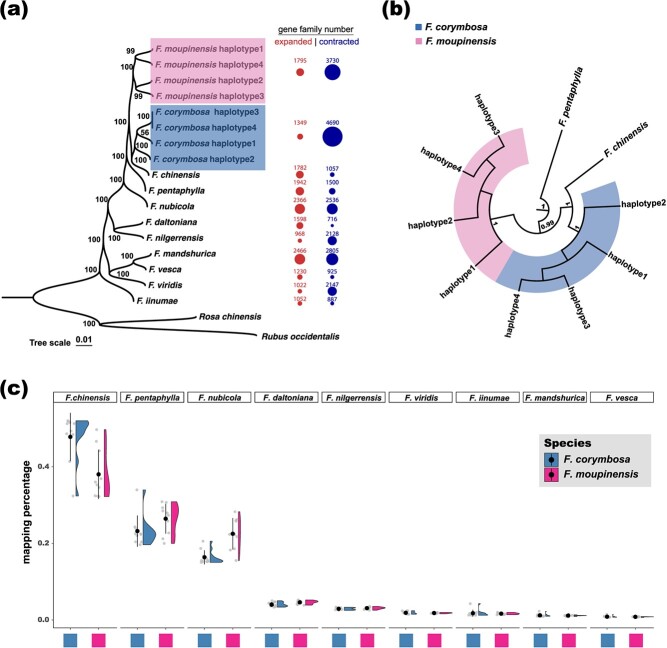
Over the decades, evolutionists and ecologists have shown intense interest in the role of polyploidization in plant evolution. Without clear knowledge of the diploid ancestor(s) of polyploids, we would not be able to answer fundamental ecological questions such as the evolution of niche differences between them or its underlying genetic basis. Here, we explored the evolutionary history of two tetraploids, and . We assembled five genomes including these two tetraploids and three diploid relatives. Based on multiple lines of evidence, we found no evidence of subgenomes in either of the two tetraploids, suggesting autopolyploid origins. We determined that was the diploid ancestor of while either an extinct species affinitive to or an unsampled population of could be the progenitor of . Meanwhile, we found introgression signals between and , leading to the genomic similarity between these two diploids. Compared to , gene families related to high ultraviolet (UV)-B and DNA repair were expanded, while those that responded towards abiotic and biotic stresses (such as salt stress, wounding, and various pathogens) were contracted in both tetraploids. Furthermore, the two tetraploids tended to down-regulate defense response genes but up-regulate UV-B response, DNA repairing, and cell division gene expression compared to . These findings may reflect adaptions toward high-altitude habitats. In summary, our work provides insights into the genome evolution of wild tetraploids and opens up an avenue for future works to answer deeper evolutionary and ecological questions regarding the strawberry genus.
几十年来,进化生物学家和生态学家一直对多倍体化在植物进化中的作用表现出浓厚兴趣。如果不清楚多倍体的二倍体祖先,我们就无法回答一些基本的生态学问题,比如它们之间生态位差异的进化及其潜在的遗传基础。在此,我们探究了两种四倍体[物种名称未给出]的进化历史。我们组装了五个基因组,包括这两种四倍体以及三个二倍体近缘种。基于多方面的证据,我们发现这两种四倍体中均没有亚基因组的证据,表明其起源为同源多倍体。我们确定[物种名称未给出]是[物种名称未给出]的二倍体祖先,而与[物种名称未给出]亲缘关系相近的一个已灭绝物种或未采样的[物种名称未给出]种群可能是[物种名称未给出]的祖先。同时,我们发现[物种名称未给出]和[物种名称未给出]之间存在渐渗信号,导致这两个二倍体之间存在基因组相似性。与[物种名称未给出]相比,与高紫外线(UV)-B和DNA修复相关的基因家族在两种四倍体中均有所扩展,而对非生物和生物胁迫(如盐胁迫、创伤和各种病原体)有响应的基因家族则收缩了。此外,与[物种名称未给出]相比,这两种四倍体倾向于下调防御反应基因,但上调UV-B反应、DNA修复和细胞分裂基因的表达。这些发现可能反映了对高海拔栖息地的适应。总之,我们的工作为野生四倍体草莓的基因组进化提供了见解,并为未来回答有关草莓属更深层次的进化和生态问题开辟了一条途径。