Xu Yani, Yang Xuening, Yao Lina, Liu Yanping, Hao Panpan
State Key Laboratory for Innovation and Transformation of Luobing Theory, The Key Laboratory of Cardiovascular Remodeling and Function Research, Chinese Ministry of Education, Chinese National Health Commission and Chinese Academy of Medical Sciences, Department of Cardiology, Qilu Hospital of Shandong University, Jinan, Shandong, China.
School of Basic Medical Science, Cheeloo College of Medicine, Shandong University, Jinan, Shandong, China.
Front Nutr. 2024 Aug 27;11:1419743. doi: 10.3389/fnut.2024.1419743. eCollection 2024.
The association between a plant-based diet and weight loss and atherosclerotic cardiovascular disease (ASCVD) has not been fully elucidated. We performed a pooled analysis and Mendelian randomization (MR) analysis to investigate this question.
We searched for randomized controlled trials on the effects of a plant-based diet on weight loss compared with a non-plant-based diet. In addition, a two-sample MR study was conducted. IVs were obtained from the genome-wide association studies (GWAS) on the exposures, and we obtained summary statistics on the outcomes. The inverse-variance weighted (IVW) method was used as the main analysis and other MR methods were performed as supplementary analyses.
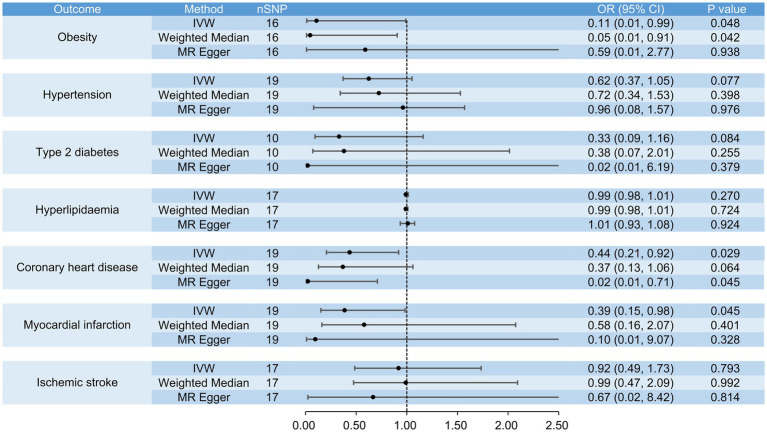
Individuals on the plant-based diet lost more weight than the non-plant-based diet group (WMD -0.96 kg; 95% CI: -1.32 to -0.60). Population conditions and energy restriction were identified as the study-level factors that influenced the pooling results in the subgroup analyses. Increased consumption of raw vegetables was significantly associated with lower BMI (IVW, β -0.35, 95% CI: -0.62 to -0.08, = 0.012) and lower risk of obesity (IVW, OR 0.11, 95% CI: 0.01 to 0.99, = 0.048), coronary heart disease (IVW, OR 0.44, 95% CI: 0.21 to 0.92, = 0.029) and myocardial infarction (IVW, OR 0.39,95% CI: 0.15 to 0.98, = 0.045) and a higher HDL-C (IVW, β 0.47, 95% CI: 0.24 to 0.70, = 4×10).
The present findings suggest that raw vegetable intake is beneficial for weight loss and prevention of ASCVD.
以植物为基础的饮食与体重减轻和动脉粥样硬化性心血管疾病(ASCVD)之间的关联尚未完全阐明。我们进行了一项汇总分析和孟德尔随机化(MR)分析来研究这个问题。
我们检索了关于以植物为基础的饮食与非植物性饮食相比对体重减轻影响的随机对照试验。此外,还进行了一项两样本MR研究。从全基因组关联研究(GWAS)中获取暴露因素的工具变量(IVs),并获取结局的汇总统计数据。采用逆方差加权(IVW)方法作为主要分析方法,其他MR方法作为补充分析。
以植物为基础的饮食个体比非植物性饮食组体重减轻更多(加权均数差-0.96 kg;95%置信区间:-1.32至-0.60)。在亚组分析中,人群状况和能量限制被确定为影响汇总结果的研究水平因素。生蔬菜摄入量增加与较低的体重指数(IVW,β -0.35,95%置信区间:-0.62至-0.08,P = 0.012)、较低的肥胖风险(IVW,比值比0.11,95%置信区间:0.01至0.99,P = 0.048)、冠心病(IVW,比值比0.44,95%置信区间:0.21至0.92,P = 0.029)和心肌梗死(IVW,比值比0.39,95%置信区间:0.15至0.98,P = 0.045)以及较高的高密度脂蛋白胆固醇(HDL-C)(IVW,β 0.47,95%置信区间:0.24至0.70,P = 4×10)显著相关。
目前的研究结果表明,摄入生蔬菜有利于体重减轻和预防ASCVD。