Fauroux Brigitte, Sacco Silvia, Couloigner Vincent, Amaddeo Alessandro, Ravel Aimé, Prioux Emmanuelle, Toulas Jeanne, Cieuta-Walti Cécile, Walti Hervé, Luscan Romain, Falquero Ségolène, Clert Manon, Caillaud Marie-Anne, De Sanctis Livio, Khirani Sonia, Marey Isabelle, Mircher Clotilde
Assistance Publique-Hôpitaux de Paris (AP-HP), Pediatric Noninvasive Ventilation and Sleep Unit, Hôpital Necker Enfants Malades, Paris F-75015, France.
Université Paris Cité, Equipe d'Accueil EA VIFASOM, Paris F-75004, France.
Lancet Reg Health Eur. 2024 Aug 21;45:101035. doi: 10.1016/j.lanepe.2024.101035. eCollection 2024 Oct.
Infants with Down syndrome (DS) are at high risk of obstructive sleep apnoea (OSA) which is associated with neurocognitive dysfunction and behaviour problems. The aim of our study was to evaluate the effect of early OSA treatment in infants with DS on neurocognitive development and behaviour.
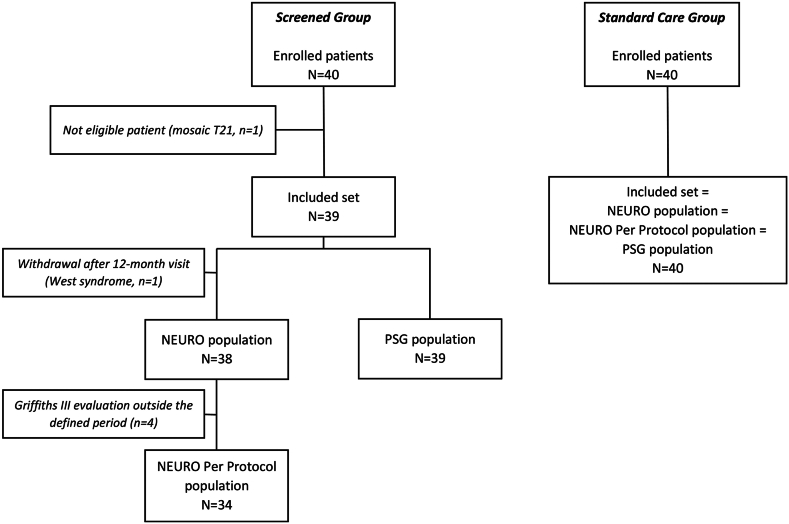
In this prospective, interventional, non-randomised study, 40 infants with DS underwent polysomnography (PSG) every 6 months in room air between 6 and 36 months of age () and were compared to a control group of 40 infants with DS receiving standard of care and a single, systematic PSG in room air at 36 months of age (). When present, OSA was treated. The primary endpoint was the total score of the Griffiths Scales of Child Development, Third Edition (Griffiths III) and its subscores at 36 months. Secondary endpoints included a battery of neurocognitive and behaviour questionnaires, and PSG outcomes.
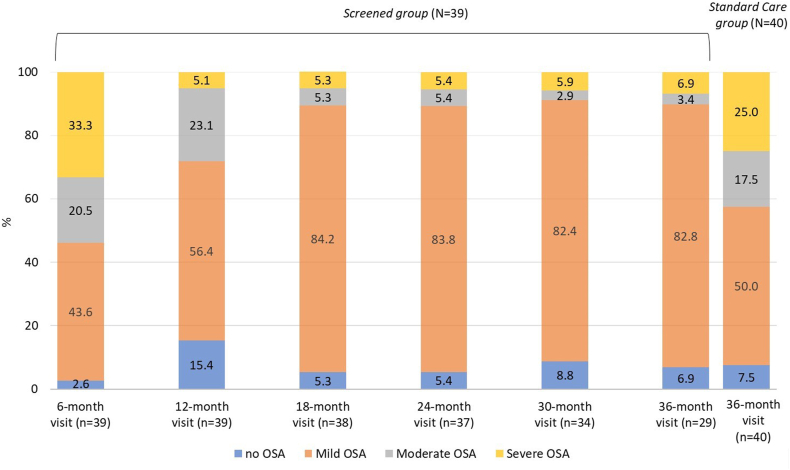
On the Griffiths III, the total score was significantly higher in the compared to the (difference: 4.1; 95%CI: 1.3; 7.6; p = 0.009). Results in Griffiths III subscores and secondary endpoints were in support of better neurocognitive outcomes in the compared with the At 36 months, median (Q1; Q3) apnoea-hypopnea index was higher in the (4.0 [1.5; 9.0] events/hour) compared to the (1.0 [1.0; 3.0] events/hour, p = 0.006). Moderate and severe OSA were more frequent in the as compared to the (18.9% versus 3.7% for moderate OSA and 27.0% versus 7.4% for severe OSA).
Early diagnosis and treatment of OSA in infants with DS may contribute to a significantly better neurocognitive outcome and behaviour at the age of 36 months.
The study was funded by the Jérôme Lejeune Foundation.
唐氏综合征(DS)患儿患阻塞性睡眠呼吸暂停(OSA)的风险很高,这与神经认知功能障碍和行为问题有关。我们研究的目的是评估早期治疗DS患儿的OSA对神经认知发育和行为的影响。
在这项前瞻性、干预性、非随机研究中,40名DS患儿在6至36个月龄时每隔6个月在室内空气中进行一次多导睡眠图(PSG)检查(),并与40名接受标准护理且在36个月龄时在室内空气中进行一次系统性PSG检查的DS患儿对照组进行比较()。出现OSA时进行治疗。主要终点是36个月时格塞尔儿童发展量表第三版(格塞尔III)的总分及其子分数。次要终点包括一系列神经认知和行为问卷以及PSG结果。
在格塞尔III量表上,与对照组相比,干预组的总分显著更高(差异:4.1;95%置信区间:1.3;7.6;p = 0.009)。格塞尔III子分数和次要终点的结果支持干预组与对照组相比有更好的神经认知结果。在36个月时,干预组的呼吸暂停低通气指数中位数(Q1;Q3)高于对照组(4.0 [1.5;9.0]次/小时),而对照组为(1.0 [1.0;3.0]次/小时,p = 0.006)。与对照组相比,干预组中重度OSA更为常见(中度OSA分别为18.9%和3.7%,重度OSA分别为27.0%和7.4%)。
早期诊断和治疗DS患儿的OSA可能有助于在36个月龄时显著改善神经认知结果和行为。
该研究由杰罗姆·勒琼基金会资助。