Srivastava Rajkamal, González-Prieto Coral, Lynch Jason P, Muscolo Michele E, Lin Catherine Y, Brown Markus A, Lemos Luisa, Shrestha Anishma, Osburne Marcia S, Leong John M, Lesser Cammie F
Center for Bacterial Pathogenesis, Division of Infectious Diseases, Department of Medicine, Massachusetts General Hospital, MA 02115, USA.
Department of Microbiology, Blavatnik Institute, Harvard Medical School, Boston, MA 02115, USA.
PNAS Nexus. 2024 Sep 2;3(9):pgae374. doi: 10.1093/pnasnexus/pgae374. eCollection 2024 Sep.
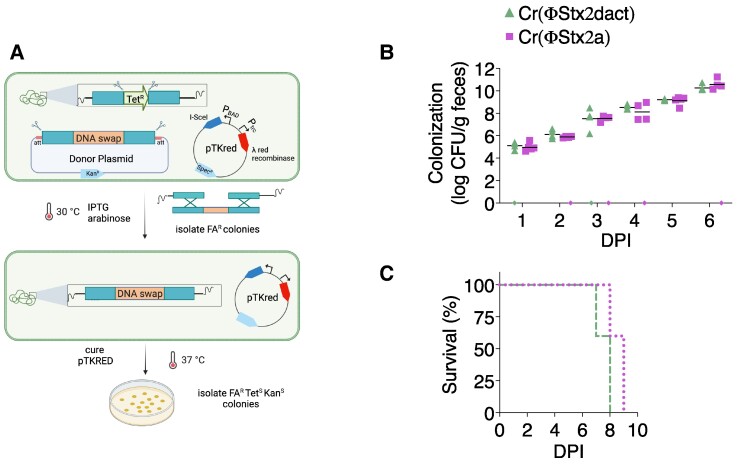
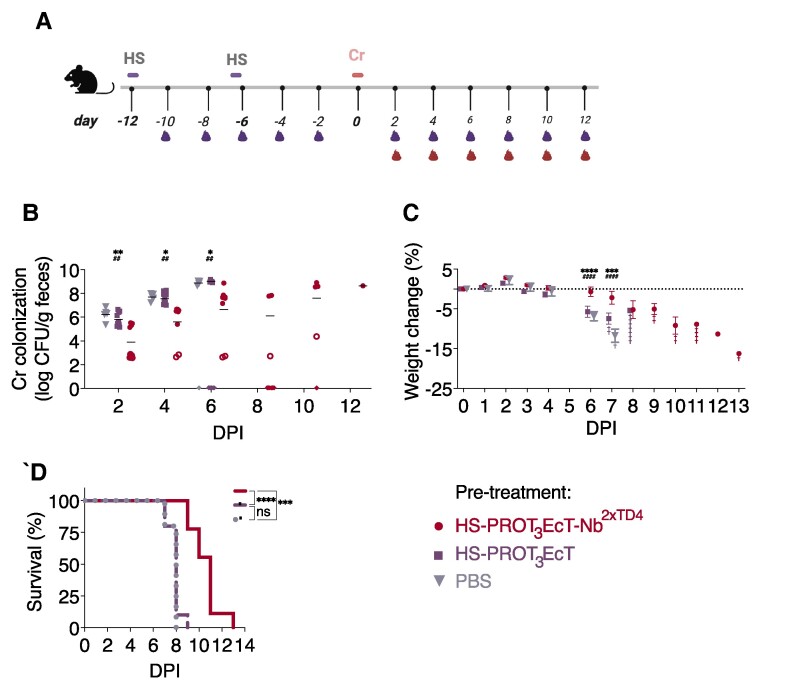
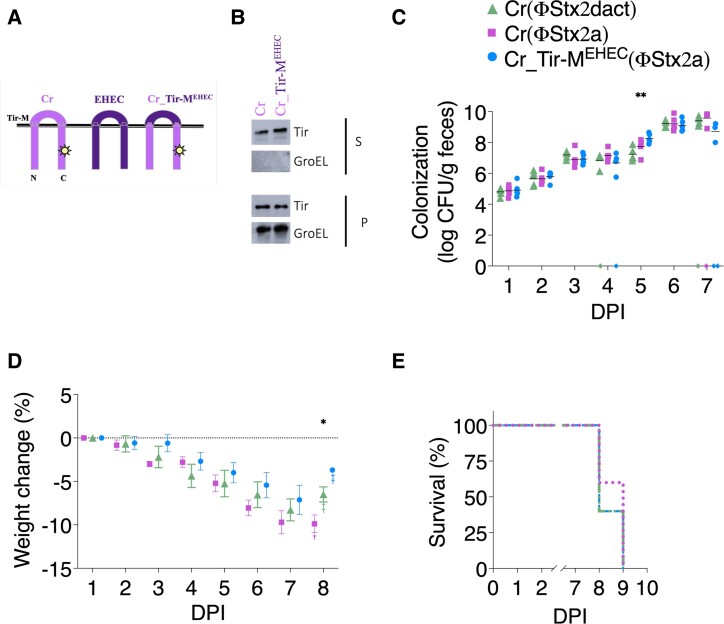
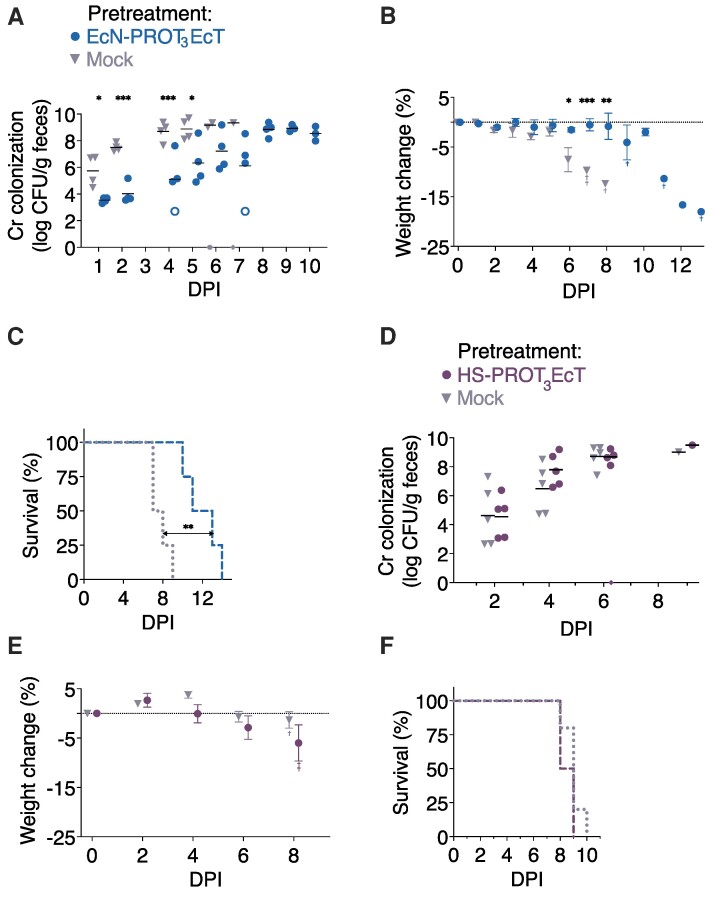
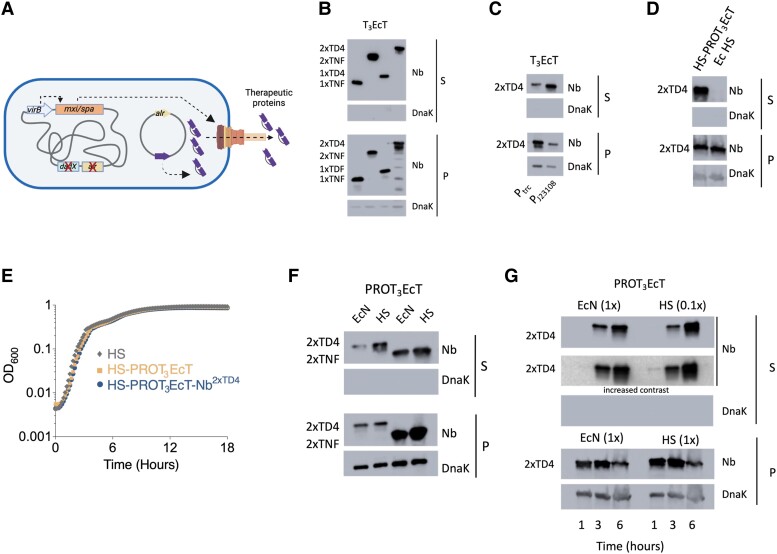
Engineered smart microbes that deliver therapeutic payloads are emerging as treatment modalities, particularly for diseases with links to the gastrointestinal tract. Enterohemorrhagic (EHEC) is a causative agent of potentially lethal hemolytic uremic syndrome. Given concerns that antibiotic treatment increases EHEC production of Shiga toxin (Stx), which is responsible for systemic disease, novel remedies are needed. EHEC encodes a type III secretion system (T3SS) that injects Tir into enterocytes. Tir inserts into the host cell membrane, exposing an extracellular domain that subsequently binds intimin, one of its outer membrane proteins, triggering the formation of attaching and effacing (A/E) lesions that promote EHEC mucosal colonization. (Cr), a natural A/E mouse pathogen, similarly requires Tir and intimin for its pathogenesis. Mice infected with Cr(ΦStx2dact), a variant lysogenized with an EHEC-derived phage that produces Stx2dact, develop intestinal A/E lesions and toxin-dependent disease. Stx2a is more closely associated with human disease. By developing an efficient approach to seamlessly modify the genome, we generated Cr_Tir-M(ΦStx2a), a variant that expresses Stx2a and the EHEC extracellular Tir domain. We found that mouse precolonization with HS-PROTEcT-TD4, a human commensal strain ( HS) engineered to efficiently secrete an anti-EHEC Tir nanobody, delayed bacterial colonization and improved survival after challenge with Cr_Tir-M(ΦStx2a). This study suggests that commensal engineered to deliver payloads that block essential virulence determinants can be developed as a new means to prevent and potentially treat infections including those due to antibiotic resistant microbes.
能够递送治疗性有效载荷的工程化智能微生物正在成为一种治疗方式,特别是对于与胃肠道相关的疾病。肠出血性大肠杆菌(EHEC)是潜在致命的溶血尿毒综合征的病原体。鉴于担心抗生素治疗会增加EHEC产生志贺毒素(Stx),而Stx是导致全身性疾病的原因,因此需要新的治疗方法。EHEC编码一种III型分泌系统(T3SS),该系统将Tir注入肠上皮细胞。Tir插入宿主细胞膜,暴露出一个细胞外结构域,该结构域随后与EHEC的一种外膜蛋白紧密素结合,触发形成黏附和损毁(A/E)损伤,促进EHEC在黏膜上的定植。鼠柠檬酸杆菌(Cr)是一种天然的A/E小鼠病原体,其发病机制同样需要Tir和紧密素。感染了Cr(ΦStx2dact)(一种用产生Stx2dact的EHEC衍生噬菌体溶原化的变体)的小鼠会出现肠道A/E损伤和毒素依赖性疾病。Stx2a与人类疾病的关联更为密切。通过开发一种高效的方法来无缝修饰基因组,我们构建了Cr_Tir-M(ΦStx2a),这是一种表达Stx2a和EHEC细胞外Tir结构域的变体。我们发现,用HS-PROTEcT-TD4(一种经过工程改造以高效分泌抗EHEC Tir纳米抗体的人共生菌株)对小鼠进行预定植,可延迟细菌定植,并提高在用Cr_Tir-M(ΦStx2a)攻击后的存活率。这项研究表明,经过工程改造以递送能够阻断关键毒力决定因素的有效载荷的共生菌,可以作为一种预防和潜在治疗感染(包括由抗生素耐药微生物引起的感染)的新手段来开发。