Littleford-Colquhoun Bethan L, Geremia Chris, McGarvey Lauren M, Merkle Jerod A, Hoff Hannah K, Anderson Heidi, Segal Carlisle R, Kartzinel Rebecca Y, Maywar Ian J, Nantais Natalie, Moore Camela, Kartzinel Tyler R
Department of Ecology, Evolution & Organismal Biology, Brown University, Providence, RI 02912, USA.
Institute at Brown for Environment and Society, Brown University, Providence, RI 02912, USA.
R Soc Open Sci. 2024 Sep 11;11(9):240136. doi: 10.1098/rsos.240136. eCollection 2024 Sep.
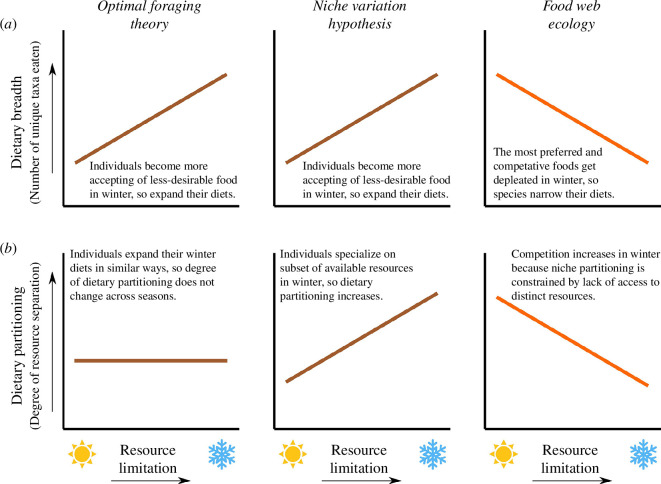
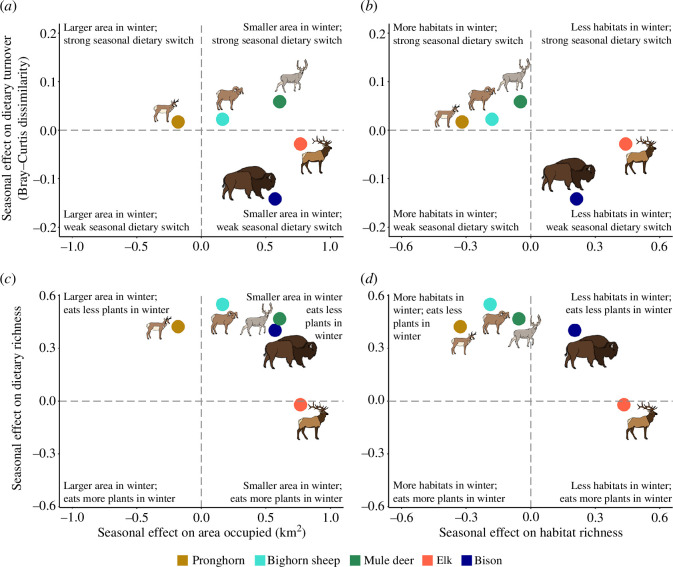
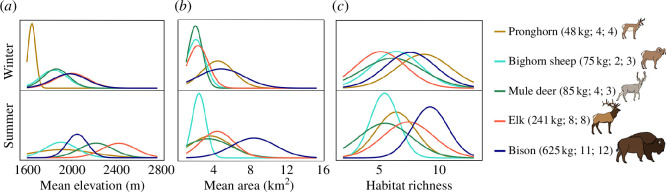
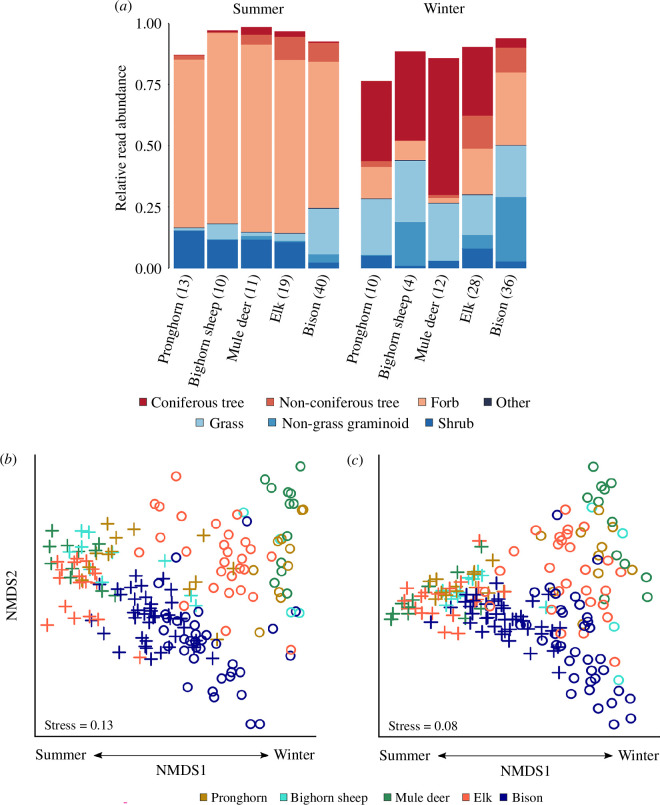
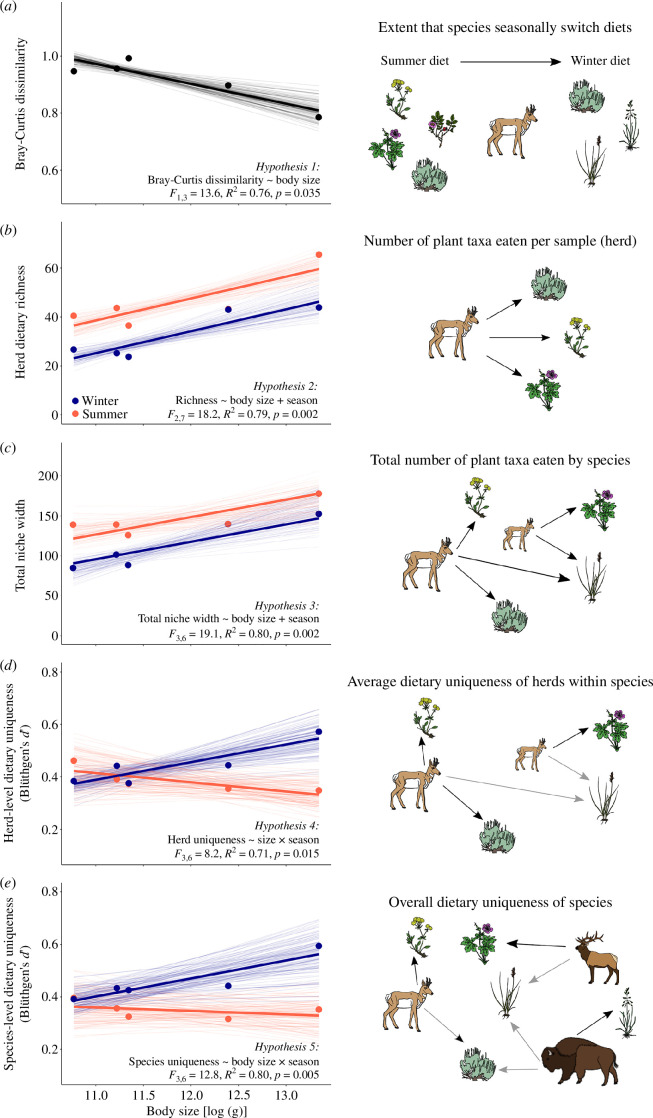
Prevailing theories about animal foraging behaviours and the food webs they occupy offer divergent predictions about whether seasonally limited food availability promotes dietary diversification or specialization. Emphasis on how animals compete for food predominates in work on the foraging ecology of large mammalian herbivores, whereas emphasis on how the diversity of available foods generally constrains dietary opportunity predominates work on entire food webs. Reconciling predictions about what promotes dietary diversification is challenging because species' different body sizes and mobilities modulate how they seek and compete for resources-the mechanistic bases of common predictions may not pertain to all species equally. We evaluated predictions about five large-herbivore species that differ in body size and mobility in Yellowstone National Park using GPS tracking and dietary DNA. The data illuminated remarkably strong and significant correlations between body size and five key indicators of diet seasonality ( = 0.71-0.80). Compared to smaller species, bison and elk showed muted diet seasonality and maintained access to more unique foods when winter conditions constrained food availability. Evidence from GPS collars revealed size-based differences in species' seasonal movements and habitat-use patterns, suggesting that better accounting for the allometry of foraging behaviours may help reconcile disparate ideas about the ecological drivers of seasonal diet switching.
关于动物觅食行为及其所处食物网的主流理论,对于季节性有限的食物供应是促进饮食多样化还是专业化给出了不同的预测。在大型哺乳动物食草动物的觅食生态学研究中,重点主要放在动物如何争夺食物上,而在整个食物网的研究中,重点则主要放在可获得食物的多样性通常如何限制饮食机会上。调和关于促进饮食多样化因素的预测具有挑战性,因为物种不同的体型和移动能力会调节它们寻找和竞争资源的方式——常见预测的机制基础可能并非同等适用于所有物种。我们利用GPS追踪和饮食DNA评估了黄石国家公园中五种体型和移动能力不同的大型食草动物的相关预测。数据揭示了体型与饮食季节性的五个关键指标之间存在非常强且显著的相关性(r = 0.71 - 0.80)。与体型较小的物种相比,当冬季条件限制食物供应时,野牛和麋鹿的饮食季节性较弱,并且能够获取更多独特的食物。GPS项圈提供的证据揭示了物种季节性移动和栖息地利用模式存在基于体型的差异,这表明更好地考虑觅食行为的异速生长可能有助于调和关于季节性饮食转换生态驱动因素的不同观点。