Forcellati Meghan R, Green Todd L, Watanabe Akinobu
Department of Ecology, Evolution, and Environmental Biology, Columbia University, New York, NY 10027, USA.
Richard Gilder Graduate School, American Museum of Natural History, New York, NY 10024, USA.
R Soc Open Sci. 2024 Sep 11;11(9):240765. doi: 10.1098/rsos.240765. eCollection 2024 Sep.
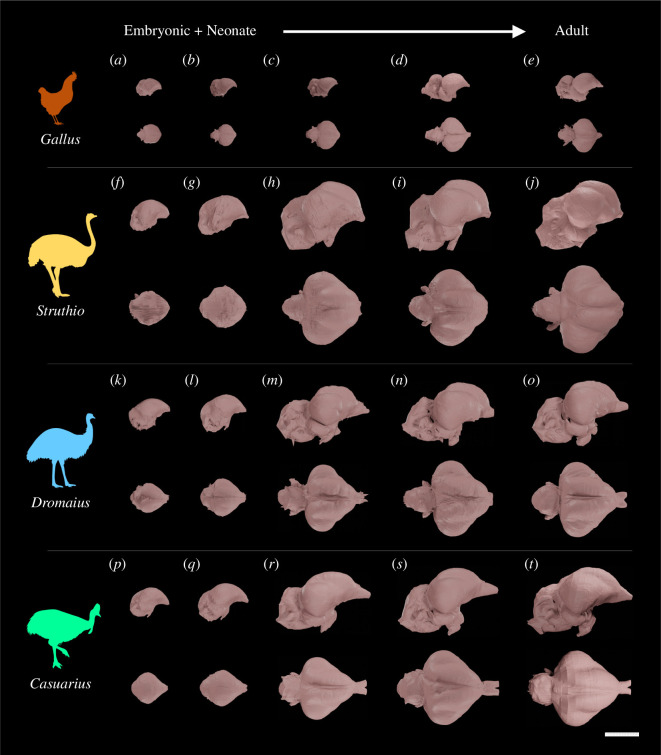
Comparative neuroanatomical studies have long debated the role of development in the evolution of novel and disparate brain morphologies. Historically, these studies have emphasized whether evolutionary shifts along conserved or distinct developmental allometric trends cause changes in brain morphologies. However, the degree to which interspecific differences between variably sized taxa originate through modifying developmental allometry remains largely untested. Taxa with disparate brain shapes and sizes thus allow for investigation into how developmental trends contribute to neuroanatomical diversification. Here, we examine a developmental series of large-bodied ratite birds (approx. 60-140 kg). We use three-dimensional geometric morphometrics on cephalic endocasts of common ostriches, emus and southern cassowaries and compare their developmental trajectories with those of the more modestly sized domestic chicken, previously shown to be in the same allometric grade as ratites. The results suggest that ratites and chickens exhibit disparate endocranial shapes not simply accounted for by their size differences. When shape and age are examined, chickens partly exhibit more accelerated and mature brain shapes than ratites of similar size and age. Taken together, our study indicates that disparate brain shapes between these differently sized taxa have emerged from the evolution of distinct developmental allometries, rather than simply following conserved scaling trends.
比较神经解剖学研究长期以来一直在争论发育在新型和不同脑形态进化中的作用。从历史上看,这些研究强调沿着保守或不同发育异速生长趋势的进化转变是否会导致脑形态的变化。然而,大小各异的分类群之间的种间差异通过改变发育异速生长产生的程度在很大程度上仍未得到检验。因此,具有不同脑形状和大小的分类群有助于研究发育趋势如何促进神经解剖学的多样化。在这里,我们研究了一系列大型平胸鸟类(约60-140千克)的发育情况。我们对普通鸵鸟、鸸鹋和南鹤鸵的头部内模进行了三维几何形态测量,并将它们的发育轨迹与体型较小的家鸡进行比较,此前已证明家鸡与平胸鸟类处于相同的异速生长等级。结果表明,平胸鸟类和家鸡表现出不同的颅内形状,这不仅仅是由它们的大小差异造成的。当同时考虑形状和年龄时,家鸡在一定程度上比大小和年龄相似的平胸鸟类表现出更快速和成熟的脑形状。综合来看,我们的研究表明,这些大小不同的分类群之间不同的脑形状是由不同发育异速生长的进化产生的,而不是简单地遵循保守的比例趋势。