Department of Medicine, School of Medicine, University of California, San Diego, La Jolla, CA, USA.
Moores Cancer Center, University of California, San Diego, La Jolla, CA, USA.
STAR Protoc. 2024 Sep 20;5(3):103302. doi: 10.1016/j.xpro.2024.103302. Epub 2024 Sep 12.
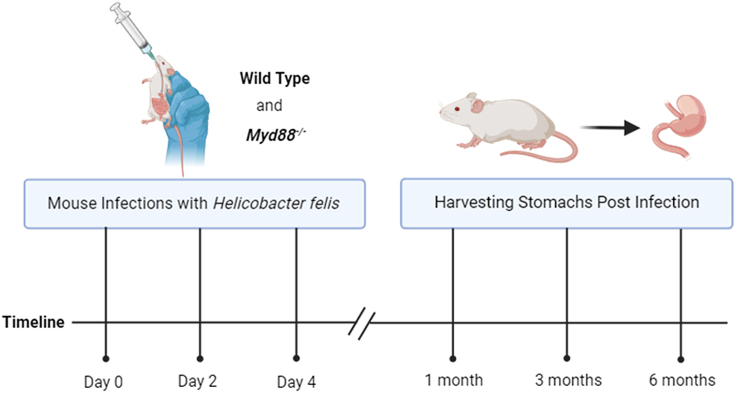
Helicobacter-induced gastric cancer progresses very slowly, even in animal models, making it difficult to study. Here, we present a protocol to establish an accelerated murine model for Helicobacter-induced gastric cancer. We describe steps for infecting mice with Helicobacter felis, harvesting gastric tissue, assessing disease severity by histopathologic scoring, and performing gene expression studies with RT-qPCR and RNA sequencing. The accelerated model shows rapid progression of the disease, with gastric precancerous lesions developing within 6 months post-infection with Helicobacter. For complete details on the use and execution of this protocol, please refer to Bali et al..
幽门螺杆菌引起的胃癌进展非常缓慢,即使在动物模型中也是如此,这使得研究变得困难。在这里,我们提出了一种建立加速型幽门螺杆菌诱导胃癌小鼠模型的方案。我们描述了用猫型螺杆菌感染小鼠、采集胃组织、通过组织病理学评分评估疾病严重程度以及使用 RT-qPCR 和 RNA 测序进行基因表达研究的步骤。加速模型显示疾病快速进展,感染幽门螺杆菌后 6 个月内即可出现胃癌前病变。有关该方案使用和执行的完整详细信息,请参见 Bali 等人的研究。