National Engineering Research Center for Nanomedicine, College of Life Science and Technology, Huazhong University of Science and Technology, 1037 Luoyu Road, Wuhan 430074, P. R. China.
Theranostics. 2024 Aug 12;14(13):4933-4947. doi: 10.7150/thno.98097. eCollection 2024.
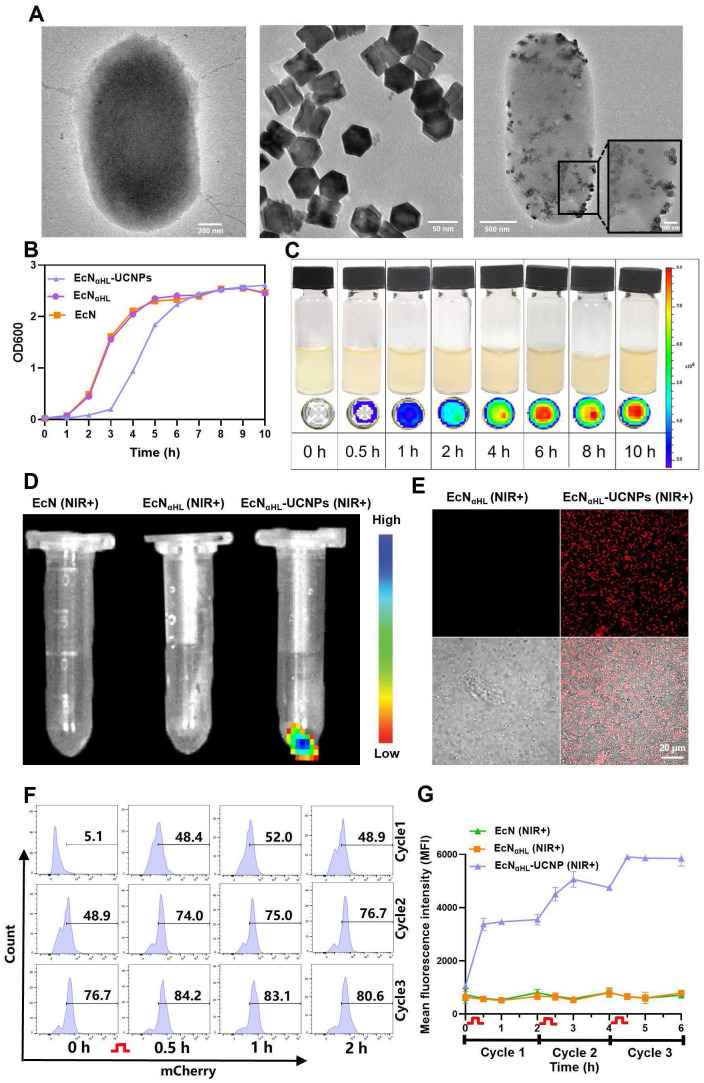
Optogenetically engineered facultative anaerobic bacteria exhibit a favorable tendency to colonize at solid tumor sites and spatiotemporally-programmable therapeutics release abilities, attracting extensive attention in precision tumor therapy. However, their therapeutic efficacy is moderate. Conventional photothermal agents with high tumor ablation capabilities exhibit low tumor targeting efficiency, resulting in significant off-target side effects. The combination of optogenetics and photothermal therapy may offer both tumor-targeting and excellent tumor-elimination capabilities, which unfortunately has rarely been investigated. Herein, we construct a bacteria-based cascade near-infrared optogentical-photothermal system (EcN-UCNPs) for enhanced tumor therapy. EcN-UCNPs consists of an optogenetically engineered Escherichia coli Nissle 1917 (EcN) conjugated with lanthanide-doped upconversion nanoparticles (UCNPs), which are capable of locally secreting α-hemolysin (αHL), a pore-forming protein, in responsive to NIR irradiation. Anti-tumor effects of EcN-UCNPs were determined in both H22 and 4T1 tumors. The αHL not only eliminates tumor cells, but more importantly disrupts endothelium to form thrombosis as an photothermal agent in tumors. The formed thrombosis significantly potentiates the photothermic ablation of H22 tumors upon subsequent NIR light irradiation. Besides, αHL secreted by EcN-UCNPs under NIR light irradiation not only inhibits 4T1 tumor growth, but also suppresses metastasis of 4T1 tumor via inducing the immune response. Our studies highlight bacteria-based cascade optogenetical-photothermal system for precise and effective tumor therapy.
光遗传学工程兼性厌氧菌表现出在实体瘤部位定植的有利趋势和时空可编程的治疗药物释放能力,在精准肿瘤治疗中引起了广泛关注。然而,它们的治疗效果是中等的。具有高肿瘤消融能力的传统光热剂表现出低肿瘤靶向效率,导致明显的脱靶副作用。光遗传学和光热治疗的结合可能具有肿瘤靶向和优异的肿瘤消除能力,但不幸的是,这方面的研究很少。在此,我们构建了基于细菌的级联近红外光遗传学-光热系统(EcN-UCNPs)用于增强肿瘤治疗。EcN-UCNPs 由工程化大肠杆菌 Nissle 1917(EcN)与镧系掺杂上转换纳米颗粒(UCNPs)偶联而成,能够在近红外照射下局部分泌α-溶血素(αHL),一种孔形成蛋白。在 H22 和 4T1 肿瘤中测定了 EcN-UCNPs 的抗肿瘤作用。αHL 不仅消除肿瘤细胞,而且更重要的是在肿瘤中作为光热剂破坏内皮形成血栓。形成的血栓在随后的近红外光照射下显著增强了 H22 肿瘤的光热消融。此外,在近红外光照射下 EcN-UCNPs 分泌的 αHL 不仅抑制了 4T1 肿瘤的生长,而且通过诱导免疫反应抑制了 4T1 肿瘤的转移。我们的研究强调了基于细菌的级联光遗传学-光热系统用于精确有效的肿瘤治疗。