Gonçales Tierre Aguiar, Moszkowicz Thiago Lucas Bastos de Melo, Debastiani Mariana Severo, Parreira Marcos Souza, Lima Julia Kasali, Alves Rafael José Vargas, Bica Claudia Giuliano
Graduate Program in Pathology at the Federal University of Health Sciences of Porto Alegre (UFCSPA), Porto Alegre, RS, Brazil.
Undergraduate Medicine Program at the Federal University of Health Sciences of Porto Alegre (UFCSPA), Porto Alegre, RS, Brazil.
Surg Open Sci. 2024 Aug 22;21:1-6. doi: 10.1016/j.sopen.2024.08.003. eCollection 2024 Sep.
COVID-19 has further burdened the Brazilian healthcare system, especially emergencies. Patients may have delayed seeking care for surgical abdominal pain. Delays in the approach may have impacted clinical evolution and outcomes. This study evaluated appendectomies and their complications performed by the public system during one-year follow-up of COVID-19 in a hospital in southern Brazil.
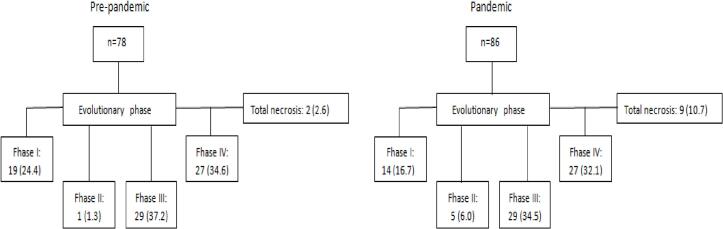
In this hospital-based cross-sectional study, we included adult patients who underwent appendectomy from March 2019 to April 2021 (n = 162). Patients were divided into pre-pandemic (n = 78) and pandemic (n = 84) groups based on the surgery date. The analyzed variables included hospitalization duration, intensive care unit (ICU) admission, surgical approach, histopathological findings, COVID-19 testing, patient outcomes, and 30-day survival rate.
The cohorts exhibited similar epidemiology, with the sex ratio and average age being maintained. No statistical difference was found in the 30-day survival rate and clinical outcomes. Of the four patients admitted to the ICU, three belonged to the pandemic cohort and tested negative for COVID-19. Only 47.6 % of the patients in the pandemic cohort underwent COVID-19 polymerase chain reaction examination; one tested positive (2.5 %).
This study demonstrated that there was no increased risk for appendectomies during the first wave of the pandemic. Surgeries were safe during this period. Patients continued to access the emergency service despite surgical abdominal pain and restrictive measures imposed by health authorities. The similar results observed across cohorts are attributed to the readiness of the teams and the availability of medical surgical equipment in safe quantities.
新型冠状病毒肺炎(COVID-19)给巴西医疗系统带来了更大负担,尤其是急诊方面。患者可能会推迟因腹部手术疼痛而寻求治疗。治疗延迟可能影响了临床病程和治疗结果。本研究评估了巴西南部一家医院在对COVID-19进行为期一年的随访期间,公立系统所实施的阑尾切除术及其并发症情况。
在这项基于医院的横断面研究中,我们纳入了2019年3月至2021年4月期间接受阑尾切除术的成年患者(n = 162)。根据手术日期,将患者分为疫情前组(n = 78)和疫情组(n = 84)。分析的变量包括住院时间、重症监护病房(ICU)收治情况、手术方式、组织病理学检查结果、COVID-19检测、患者治疗结果及30天生存率。
两组队列的流行病学特征相似,性别比和平均年龄保持一致。30天生存率和临床结果无统计学差异。在入住ICU的4例患者中,3例属于疫情组,且COVID-19检测呈阴性。疫情组中只有47.6%的患者接受了COVID-19聚合酶链反应检测;1例检测呈阳性(2.5%)。
本研究表明,在疫情第一波期间,阑尾切除术风险并未增加。在此期间手术是安全的。尽管存在腹部手术疼痛以及卫生当局实施的限制措施,患者仍继续使用急诊服务。各队列观察到的相似结果归因于团队的准备情况以及医疗手术设备的充足供应。