Bhatti Abu Bakar Hafeez, Ul Haq Nauman, Mehmood Nayyer, Hassan Danyal, Ahmed Arsalan, Malik Wasim Tariq, Zia Haseeb Haider, Salih Mohammad, Khan Nusrat Yar, Ilyas Abid, Khan Nasir Ayub
Department of HPB Surgery and Liver Transplantation Shifa International Hospital, Islamabad, Pakistan.
Department of Nephrology Shifa International Hospital, Islamabad, Pakistan.
Int J Hepatol. 2024 Sep 5;2024:8422308. doi: 10.1155/2024/8422308. eCollection 2024.
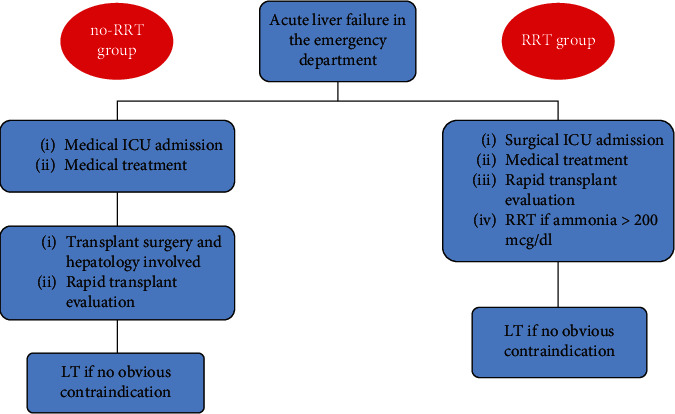
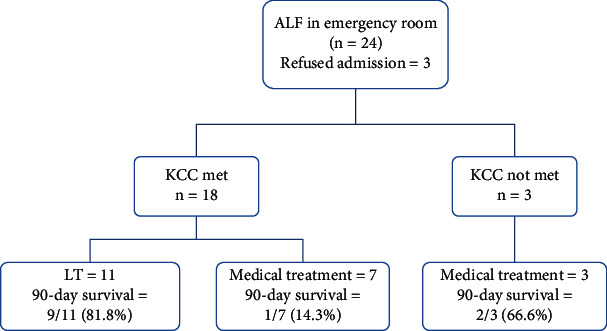
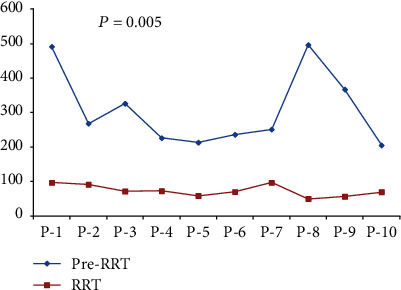
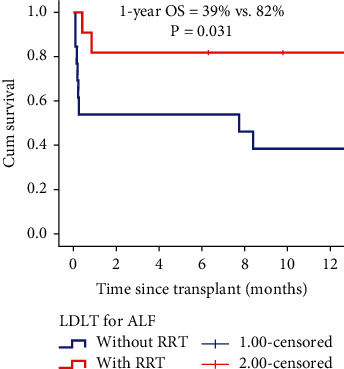
Despite the promising role of renal replacement therapy (RRT) in acute liver failure (ALF), high-risk patients need liver transplantation and remain at risk for death due to cerebral complications. The objective of this study was to report outcomes of living donor liver transplantation (LDLT) for ALF with perioperative RRT. This was a single-center retrospective cohort study. Out of 1167 LDLTs, 24 patients had ALF and met the King's College criteria for transplantation. They were categorized into no-RRT ( = 13) and RRT ( = 11) groups. We looked at 1-year posttransplant survival in these patients. The median serum ammonia level at the time of transplant in the no-RRT and RRT groups was 259.5 mcg/dL (222.7-398) and 70.6 mcg/dL (58.1-92.6) ( = 0.005). In the RRT group, serum ammonia level < 100 mcg/dL was achieved in all patients. Seven (53.8%) patients in the no-RRT group and 11/11 (100%) in the RRT group were extubated and regained full consciousness after LDLT ( = 0.013). The 90-day mortality was 6/13 (46.1%) and 2/11 (18.1%) ( = 0.211). There was no brainstem herniation-related mortality in the RRT group, that is, 5/13 (38.4%) and 0/11 (0%) ( = 0.030). The 1-year posttransplant survival was also significantly higher in the RRT group ( = 0.031). The use of RRT lowers serum ammonia levels and might reduce posttransplant mortality due to brainstem herniation.
尽管肾脏替代疗法(RRT)在急性肝衰竭(ALF)中具有潜在作用,但高危患者仍需要肝移植,并且因脑部并发症而面临死亡风险。本研究的目的是报告接受围手术期RRT的ALF患者活体肝移植(LDLT)的结果。这是一项单中心回顾性队列研究。在1167例LDLT中,24例患者患有ALF并符合国王学院移植标准。他们被分为非RRT组(n = 13)和RRT组(n = 11)。我们观察了这些患者移植后1年的生存率。非RRT组和RRT组移植时的血清氨水平中位数分别为259.5μg/dL(222.7 - 398)和70.6μg/dL(58.1 - 92.6)(P = 0.005)。在RRT组中,所有患者的血清氨水平均降至<100μg/dL。非RRT组7例(53.8%)患者和RRT组11例(100%)患者在LDLT后拔管并恢复完全意识(P = 0.013)。90天死亡率分别为6/13(46.1%)和2/11(18.1%)(P = 0.211)。RRT组无与脑干疝相关的死亡,即分别为5/13(38.4%)和0/11(0%)(P = 0.030)。RRT组移植后1年生存率也显著更高(P = 0.031)。使用RRT可降低血清氨水平,并可能降低因脑干疝导致的移植后死亡率。