First Radiation and Clinical Oncology Department, Maria Sklodowska-Curie National Research Institute of Oncology, Gliwice, Poland.
Department of Nuclear Medicine and Endocrine Oncology, Maria Sklodowska-Curie National Research Institute of Oncology, Gliwice, Poland.
Cancer Med. 2024 Sep;13(17):e70232. doi: 10.1002/cam4.70232.
The aim of this study is comparison the effectiveness of stereotactic, hypofractionated and conventional radiotherapy assessed by the tumor volume changes of paraganglioma located in the head and neck region concerning fractional and total doses.
We analyzed 76 patients after radiotherapy due to paraganglioma who were assigned to 3 groups considering fractional (≤2 Gy, 3-5.5 Gy, ≥6 Gy) and total (≤20 Gy, 21-40 Gy, >40 Gy) doses. The volumes of irradiated tumors were measured and compared based on diagnostic images performed before and after the treatment.
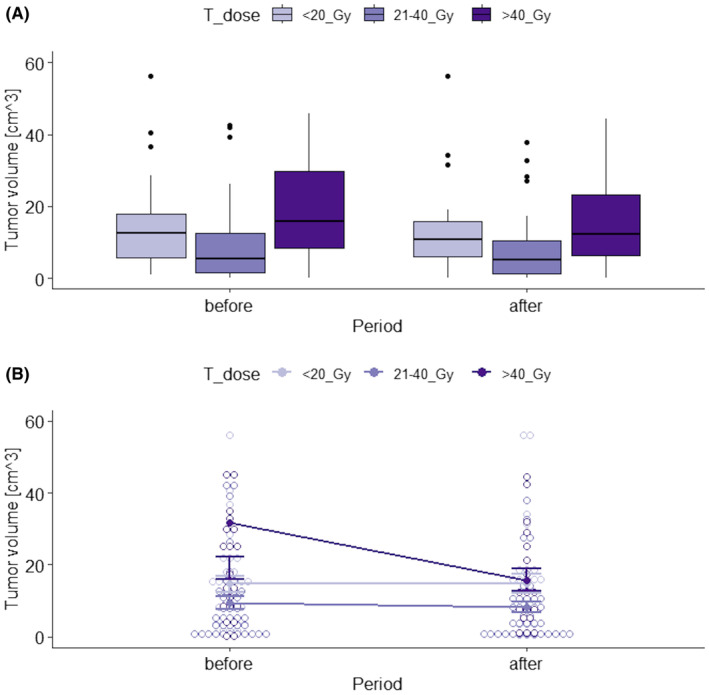
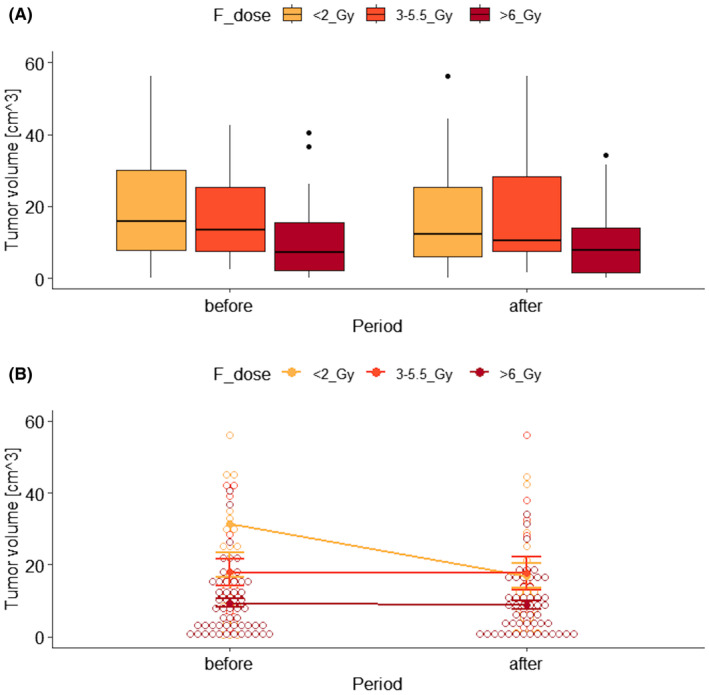
The mean tumor volume after the treatment with the lowest fractional dose (≤2 Gy) was decreased by 14.4 cm. In patients treated with higher fractional doses (>2 Gy), the mean tumor volumes decreased by less than 1 cm for hypofractionated and stereotactic radiotherapy. 15.9 cm reduction of the mean tumor volume after the treatment with the highest RT total dose (>40 Gy) was stated. In patients treated with total doses ≤20 Gy and 21-40 Gy, the mean tumor volume was stable and reduced by 1.15 cm, respectively. The analysis demonstrates a statistically significant (p < 0.05) treatment advantage in patients after the lowest fractional and highest total doses.
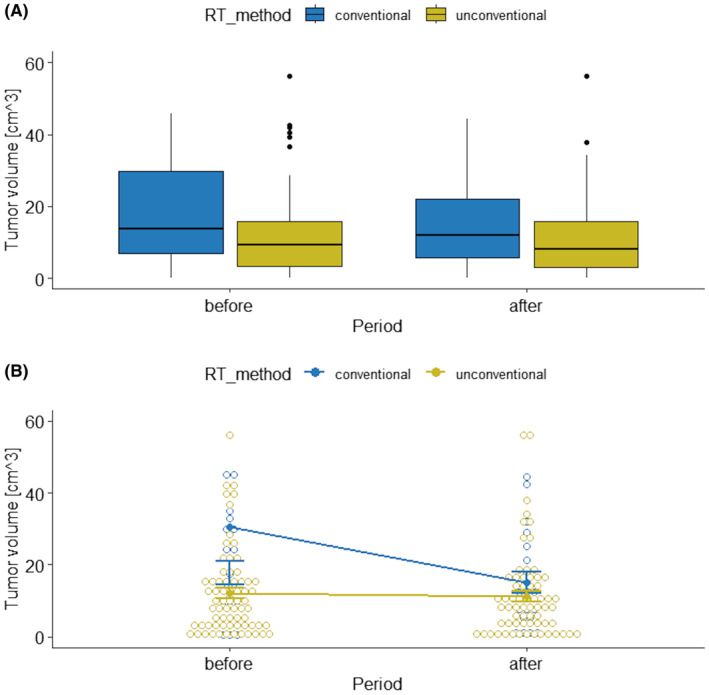
The reduction of the tumor's volume was reported after conventional and unconventional radiotherapy. The most significant depletion of the paraganglioma volume was noted after a factional dose ≤2 Gy and a total dose >40 Gy.
本研究旨在比较立体定向、低分割和常规放疗在头颈部副神经节瘤中的疗效,根据肿瘤体积变化评估不同分次剂量和总剂量的疗效。
我们分析了 76 例因副神经节瘤接受放疗的患者,根据分次剂量(≤2Gy、3-5.5Gy、≥6Gy)和总剂量(≤20Gy、21-40Gy、>40Gy)将患者分为 3 组。根据治疗前后的诊断图像测量并比较照射肿瘤的体积。
接受最低分次剂量(≤2Gy)治疗的患者,治疗后肿瘤平均体积缩小 14.4cm。接受高分次剂量(>2Gy)治疗的患者,立体定向和低分割放疗的肿瘤平均体积缩小不到 1cm。接受最高总剂量(>40Gy)治疗的患者,肿瘤平均体积缩小 15.9cm。接受总剂量≤20Gy 和 21-40Gy 治疗的患者,肿瘤平均体积稳定,分别缩小 1.15cm。分析表明,最低分次剂量和最高总剂量治疗的患者具有统计学显著优势(p<0.05)。
常规和非常规放疗后肿瘤体积均有缩小。分次剂量≤2Gy 和总剂量>40Gy 时,副神经节瘤体积缩小最明显。