El-Sharkawy Mahmoud, Alotaibi Modhi O, Li Jian, Mahmoud Esawy, Ghoneim Adel M, Ramadan Mohamed S, Shabana Mahmoud
School of the Environment and Safety Engineering, School of Emergency Management, Jiangsu University, Zhenjiang 212013, China.
Soil and Water Department, Faculty of Agriculture, Tanta University, Tanta P.O. Box 31527, Egypt.
Nanomaterials (Basel). 2024 Sep 5;14(17):1450. doi: 10.3390/nano14171450.
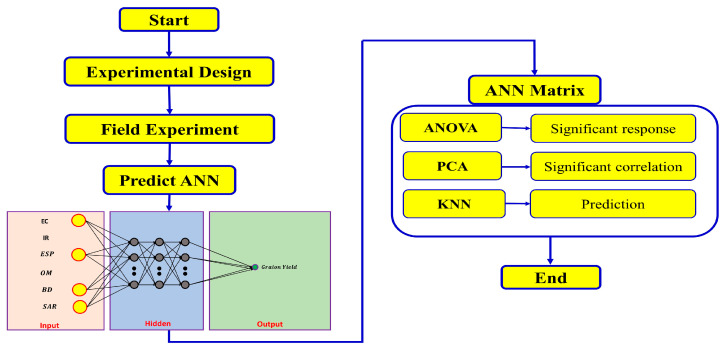
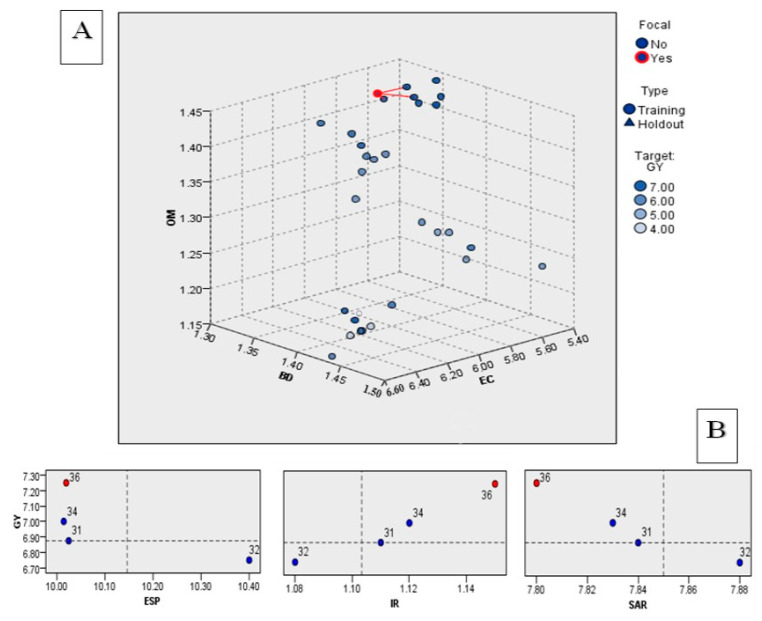
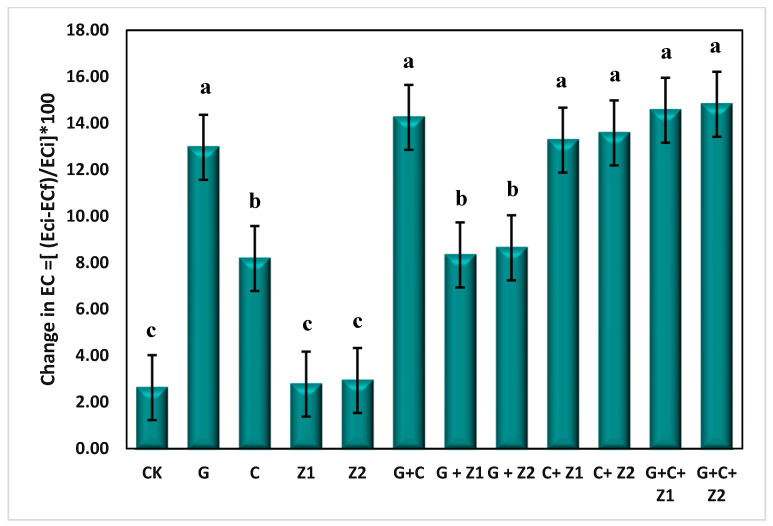
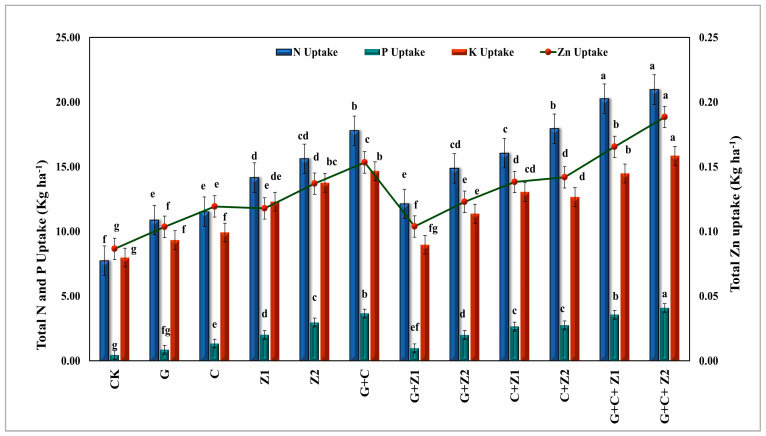
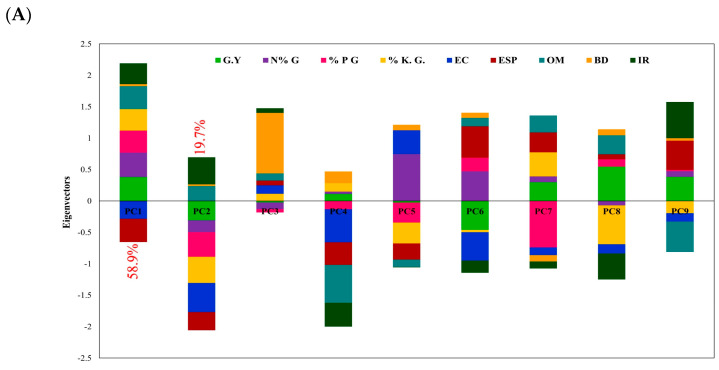
The salinity and alkalinity of soils are two fundamental factors that limit plant growth and productivity. For that reason, a field study conducted at Sakha Agric. Res. Station in Egypt during the 2022-2023 winter season aimed to assess the impact of gypsum (G), compost (C), and zinc foliar application in two images, traditional (Z as ZnSO) and nanoform (Z as N-ZnO), on alleviating the saline-sodic conditions of the soil and its impact on wheat productivity. The results showed that the combination of gypsum, compost, and N-ZnO foliar spray (G + C + Z) decreased the soil electrical conductivity (EC), sodium adsorption ratio (SAR), and exchangeable sodium percentage (ESP) by 14.81%, 40.60%, and 35.10%, respectively. Additionally, compared to the control, the G + C + Z treatment showed improved nutrient content and uptake as well as superior wheat biomass parameters, such as the highest grain yield (7.07 Mg ha), plant height (98.0 cm), 1000-grain weight (57.03 g), and straw yield (9.93 Mg ha). Interestingly, foliar application of N-ZnO was more effective than ZnSO in promoting wheat productivity. Principal component analysis highlighted a negative correlation between increased grain yield and the soil EC and SAR, whereas the soil organic matter (OM), infiltration rate (IR), and plant nutrient content were found to be positively correlated. Furthermore, employing the k-nearest neighbors technique, it was predicted that the wheat grain yield would rise to 7.25 t ha under certain soil parameters, such as EC (5.54 dS m), ESP (10.02%), OM (1.41%), bulk density (1.30 g cm), infiltration rate (1.15 cm h), and SAR (7.80%). These results demonstrate how adding compost and gypsum to foliar N-ZnO can improve the soil quality, increase the wheat yield, and improve the nutrient uptake, all of which can support sustainable agriculture.
土壤的盐分和碱度是限制植物生长和生产力的两个基本因素。因此,2022 - 2023年冬季在埃及萨卡农业研究站进行的一项田间研究旨在评估石膏(G)、堆肥(C)以及两种形态锌叶面喷施,即传统形态(硫酸锌形式的锌,Z)和纳米形态(纳米氧化锌形式的锌,Z),对缓解土壤盐碱化状况及其对小麦生产力影响的作用。结果表明,石膏、堆肥和纳米氧化锌叶面喷施(G + C + Z)的组合分别使土壤电导率(EC)、钠吸附比(SAR)和交换性钠百分比(ESP)降低了14.81%、40.60%和35.10%。此外,与对照相比,G + C + Z处理显示出养分含量和吸收的改善以及优异的小麦生物量参数,如最高的籽粒产量(7.07 Mg/ha)、株高(98.0厘米)、千粒重(57.03克)和秸秆产量(9.93 Mg/ha)。有趣的是,纳米氧化锌叶面喷施在促进小麦生产力方面比硫酸锌更有效。主成分分析突出了籽粒产量增加与土壤EC和SAR之间的负相关关系,而土壤有机质(OM)、渗透率(IR)和植物养分含量则呈正相关。此外,采用k近邻技术预测,在某些土壤参数下,如EC(5.54 dS/m)、ESP(10.02%)、OM(1.41%)、容重(1.30 g/cm)、渗透率(1.15 cm/h)和SAR(7.80%),小麦籽粒产量将增至7.25 t/ha。这些结果表明,在叶面喷施纳米氧化锌中添加堆肥和石膏可如何改善土壤质量、提高小麦产量并改善养分吸收,所有这些都有助于可持续农业发展。