Khaddour Karam, Murakami Naoka, Ruiz Emily S, Silk Ann W
Department of Medical Oncology, Dana-Farber Cancer Institute, Boston, MA 02215, USA.
Center for Cutaneous Oncology, Dana-Farber Cancer Institute, Boston, MA 02115, USA.
Cancers (Basel). 2024 Sep 4;16(17):3083. doi: 10.3390/cancers16173083.
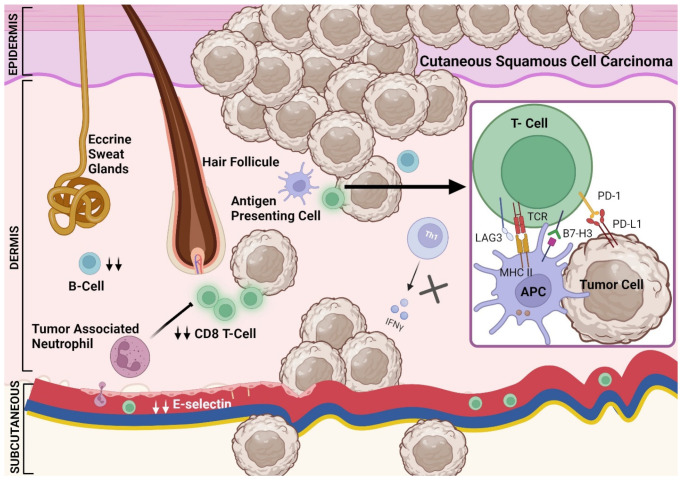
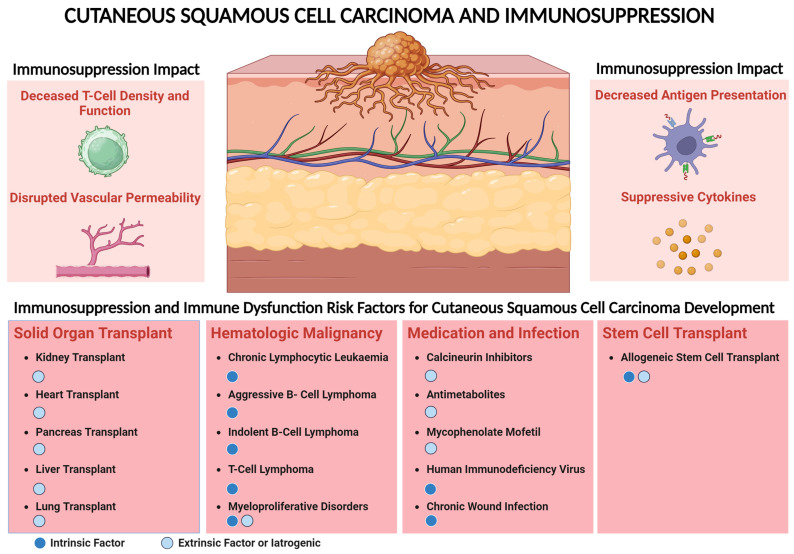
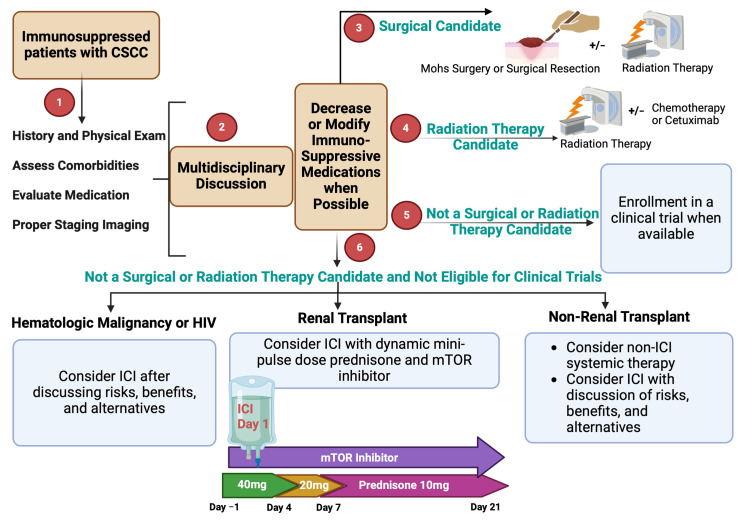
The management of advanced cutaneous squamous cell carcinoma (CSCC) has been revolutionized by the introduction of immunotherapy. Yet, successful treatment with immunotherapy relies on an adequate antitumor immune response. Patients who are solid-organ transplant recipients (SOTRs) have a higher incidence of CSCC compared to the general population. This review discusses the current knowledge of epidemiology, pathophysiology, and management of patients with CSCC who are immunocompromised because of their chronic exposure to immunosuppressive medications to prevent allograft rejection. First, we discuss the prognostic impact of immunosuppression in patients with CSCC. Next, we review the risk of CSCC development in immunosuppressed patients due to SOT. In addition, we provide an overview of the biological immune disruption present in transplanted immunosuppressed CSCC patients. We discuss the available evidence on the use of immunotherapy and provide a framework for the management approach with SOTRs with CSCC. Finally, we discuss potential novel approaches that are being investigated for the management of immunosuppressed patients with CSCC.
免疫疗法的引入彻底改变了晚期皮肤鳞状细胞癌(CSCC)的治疗方式。然而,免疫疗法的成功治疗依赖于充分的抗肿瘤免疫反应。与普通人群相比,实体器官移植受者(SOTR)患CSCC的发生率更高。本综述讨论了因长期暴露于免疫抑制药物以预防同种异体移植排斥而免疫功能低下的CSCC患者的流行病学、病理生理学和治疗的现有知识。首先,我们讨论免疫抑制对CSCC患者的预后影响。接下来,我们回顾了SOT导致免疫抑制患者发生CSCC的风险。此外,我们概述了移植免疫抑制CSCC患者中存在的生物免疫破坏情况。我们讨论了使用免疫疗法的现有证据,并为CSCC的SOTR管理方法提供了一个框架。最后,我们讨论了正在研究的用于治疗免疫抑制CSCC患者的潜在新方法。