Elvrum Ann-Kristin G, Kårstad Silja Berg, Hansen Gry, Bjørkøy Ingrid Randby, Lydersen Stian, Grunewaldt Kristine Hermansen, Eliasson Ann-Christin
Department of Neuromedicine and Movement Science, Faculty of Medicine and Health Sciences, Norwegian University of Science and Technology, 7491 Trondheim, Norway.
Department of Clinical and Molecular Medicine, Faculty of Medicine and Health Sciences, Norwegian University of Science and Technology, 7491 Trondheim, Norway.
J Clin Med. 2024 Sep 6;13(17):5287. doi: 10.3390/jcm13175287.
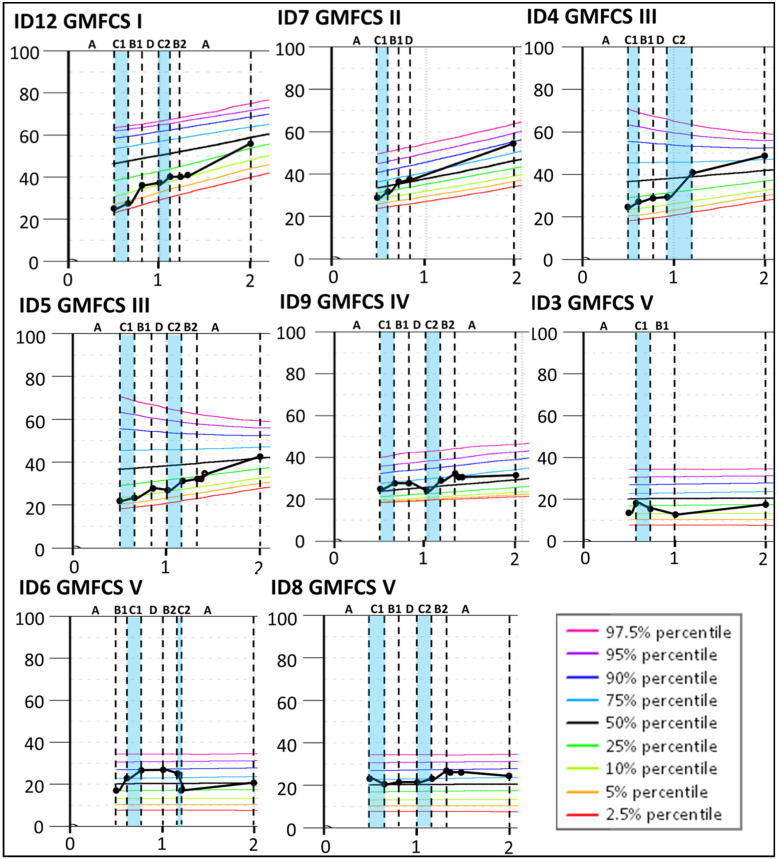
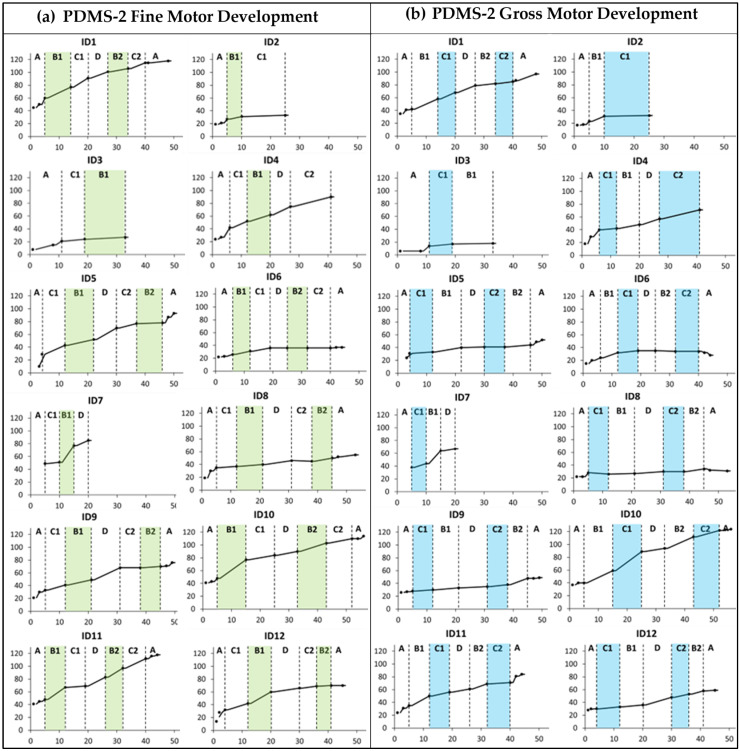
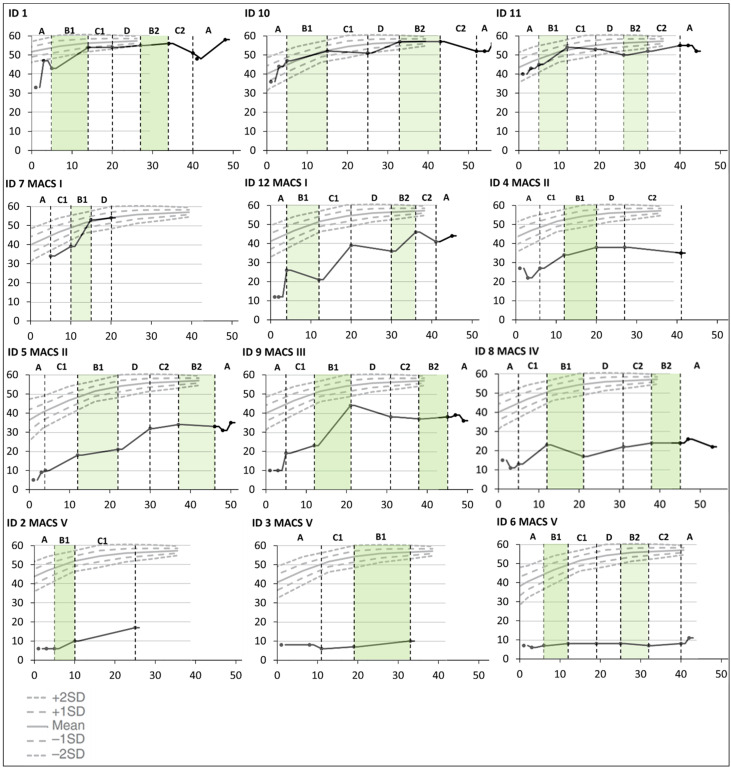
: Early interventions for infants at high risk of cerebral palsy (CP) are recommended, but limited evidence exists. Our objective was, therefore, to evaluate the effects of the family-centered and interprofessional Small Step early intervention program on motor development in infants at high risk of CP (ClinicalTrials.gov: NCT03264339). : A single-subject research design was employed to investigate participant characteristics (motor dysfunction severity measured using the Hammersmith Infant Neurological Examination (HINE) and Alberta Infant Motor Scale (AIMS) at three months of corrected age (3mCA) related to intervention response. The repeated measures Peabody Developmental Motor Scales-2 fine and gross motor composite (PDMS2-FMC and -GMC) and Hand Assessment for Infants (HAI) were analyzed visually by cumulative line graphs, while the Gross Motor Function Measure-66 (GMFM-66) was plotted against reference percentiles for various Gross Motor Function Classification System (GMFCS) levels. : All infants ( = 12) received the Small Step program, and eight completed all five training steps. At two years of corrected age (2yCA), nine children were diagnosed with CP. The children with the lowest HINE < 25 and/or AIMS ≤ 6 at 3mCA ( = 4) showed minor improvements during the program and were classified at GMFCS V 2yCA. Children with HINE = 25-40 ( = 5) improved their fine motor skills during the program, and four children had larger GMFM-66 improvements than expected according to the reference curves but that did not always happen during the mobility training steps. Three children with HINE = 41-50 and AIMS > 7 showed the largest improvements and were not diagnosed with CP 2yCA. : Our results indicate that the Small Step program contributed to the children's motor development, with better results for those with an initial higher HINE (>25). The specificity of training could not be confirmed.
推荐对脑瘫(CP)高危婴儿进行早期干预,但相关证据有限。因此,我们的目标是评估以家庭为中心的跨专业“小步”早期干预项目对CP高危婴儿运动发育的影响(ClinicalTrials.gov:NCT03264339)。
采用单受试者研究设计来调查参与者特征(在矫正年龄3个月(3mCA)时使用哈默史密斯婴儿神经学检查(HINE)和艾伯塔婴儿运动量表(AIMS)测量的运动功能障碍严重程度)与干预反应的关系。通过累积折线图直观分析重复测量的皮博迪发育运动量表-2精细和粗大运动综合得分(PDMS2-FMC和-GMC)以及婴儿手部评估(HAI),同时将粗大运动功能测量-66(GMFM-66)与不同粗大运动功能分类系统(GMFCS)水平的参考百分位数进行对比绘制。
所有婴儿(n = 12)均接受了“小步”项目,其中8名完成了全部五个训练步骤。在矫正年龄2岁(2yCA)时,9名儿童被诊断为CP。在3mCA时HINE最低<25且/或AIMS≤6的儿童(n = 4)在项目期间有轻微改善,在2yCA时被归类为GMFCS V级。HINE = 25 - 40的儿童(n = 5)在项目期间精细运动技能有所提高,4名儿童的GMFM-66改善幅度比参考曲线预期的更大,但在移动训练步骤中并非总是如此。3名HINE = 41 - 50且AIMS>7的儿童改善最大,在2yCA时未被诊断为CP。
我们的结果表明,“小步”项目有助于儿童的运动发育,对于初始HINE较高(>25)的儿童效果更好。训练的特异性无法得到证实。