Chuang Chang-Han, Chuang Hao-Chun, Wang Jou-Hua, Yang Jui-Ming, Wu Po-Ting, Hu Ming-Hsien, Su Hong-Lin, Lee Pei-Yuan
Department of Life Sciences, National Chung Hsing University, 402 Taichung, Taiwan.
Doctor Program in Translational Medicine, National Chung Hsing University, 402 Taichung, Taiwan.
J Clin Med. 2024 Sep 9;13(17):5341. doi: 10.3390/jcm13175341.
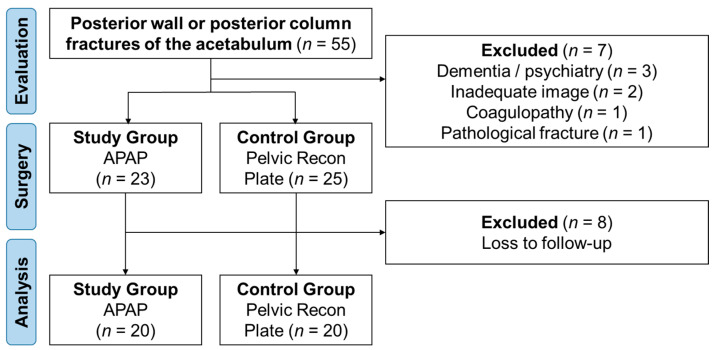
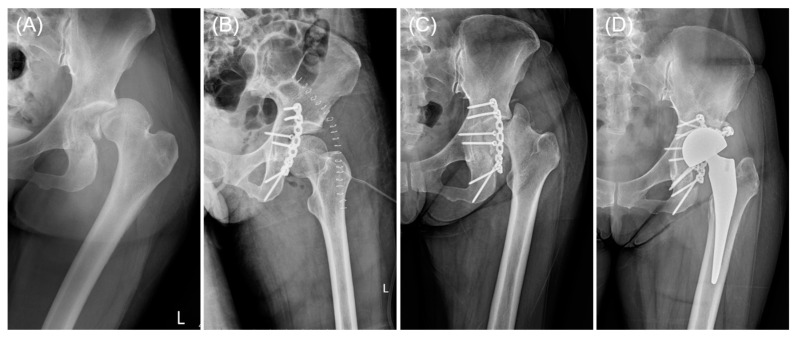
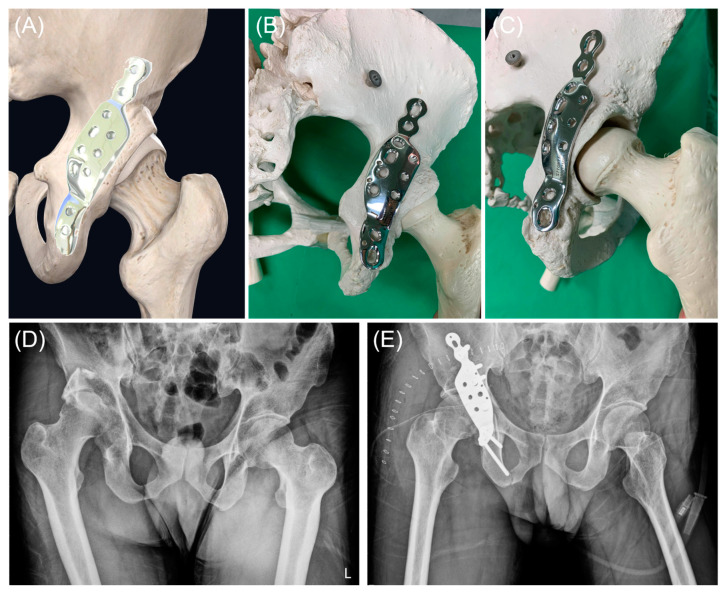
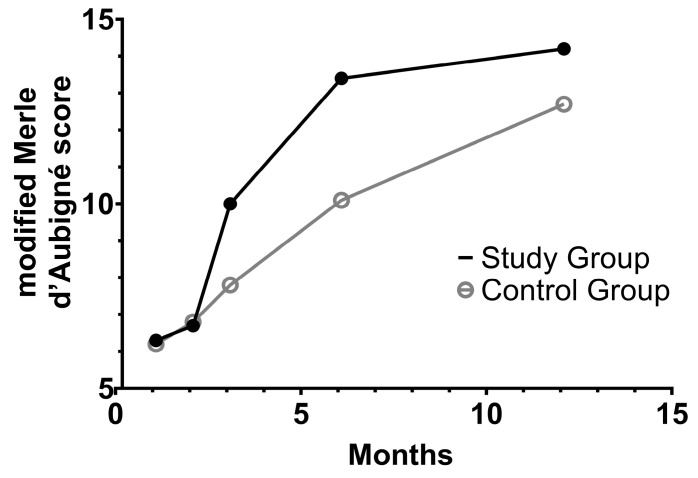
Functional recovery following the surgical fixation of acetabular posterior wall fractures remains a challenge. This study compares outcomes of posterior wall fracture reconstruction using an anatomical posterior acetabular plate (APAP) versus conventional reconstruction plates. Forty patients with acetabular fractures involving the posterior wall or column underwent surgery, with 20 treated using APAPs (APAP group) and 20 with conventional pelvic reconstruction plates (control group). Baseline patient characteristics, intraoperative blood loss and time, reduction quality, postoperative function, and postoperative complications were compared using appropriate non-parametric statistical tests. A general linear model for repeated measures analysis of variance was employed to analyze trends in functional recovery. No significant differences were observed in baseline characteristics. APAP significantly reduced surgical time by 40 min (186.5 ± 51.0 versus 225.0 ± 47.7, =0.004) and blood loss (695 ± 393 versus 930 ± 609, = 0.049) compared to conventional plates. At 3 and 6 months following surgery, the APAP group exhibited higher functional scores (modified Merle d'Aubigné scores 10 ± 1.8 versus 7.8 ± 1.4, < 0.001; 13.4 ± 2.8 versus 10.1 ± 2.1, = 0.001), converging with the control group by 12 months (modified Merle d'Aubigné scores 14.2 ± 2.6 versus 12.7 ± 2.6, = 0.072; OHS 31.6 ± 12.3 versus 30.3 ± 10.1, = 0.398). Radiologically, the APAP group demonstrated superior outcomes ( = 0.047). Complication and conversion rates to hip arthroplasty did not significantly differ between groups (10% versus 15%, = 0.633). : The use of an APAP in reconstructing the posterior acetabulum significantly reduces surgical time, decreases intraoperative blood loss, and leads to earlier functional recovery compared to conventional reconstruction plates. The APAP provides stable fixation of the posterior wall and ensures the durable maintenance of reduction, ultimately yielding favorable surgical outcomes.
髋臼后壁骨折手术固定后的功能恢复仍然是一项挑战。本研究比较了使用解剖型髋臼后钢板(APAP)与传统重建钢板进行后壁骨折重建的效果。40例髋臼骨折累及后壁或柱的患者接受了手术,其中20例使用APAP治疗(APAP组),20例使用传统骨盆重建钢板治疗(对照组)。使用适当的非参数统计检验比较患者的基线特征、术中失血量和时间、复位质量、术后功能及术后并发症。采用重复测量方差分析的一般线性模型分析功能恢复趋势。两组患者的基线特征无显著差异。与传统钢板相比,APAP显著缩短手术时间40分钟(186.5±51.0对225.0±47.7,P=0.004),减少失血量(695±393对930±609,P=0.049)。术后3个月和6个月时,APAP组的功能评分更高(改良Merle d'Aubigné评分10±1.8对7.8±1.4,P<0.001;13.4±2.8对10.1±2.1,P=0.001),到12个月时与对照组趋于一致(改良Merle d'Aubigné评分14.2±2.6对12.7±2.6,P=0.072;OHS 31.6±12.3对30.3±10.1,P=0.398)。影像学检查显示,APAP组效果更佳(P=0.047)。两组的并发症发生率及髋关节置换转化率无显著差异(10%对15%,P=0.633)。结论:与传统重建钢板相比,使用APAP重建髋臼后壁可显著缩短手术时间,减少术中失血量,并能更早实现功能恢复。APAP可提供后壁的稳定固定,确保复位的持久维持,最终取得良好的手术效果。