
基于激光熔覆的AlCoCrFeNi高熵合金涂层工艺参数优化与数值模拟
Process Parameters Optimization and Numerical Simulation of AlCoCrFeNi High-Entropy Alloy Coating via Laser Cladding.
作者信息
Chen Bin, Zhao Yang, Yang Hui, Zhao Jingjing
机构信息
School of Materials Science and Engineering, Anhui University of Technology, Maanshan 243032, China.
School of Management Science and Engineering, Anhui University of Technology, Maanshan 243032, China.
出版信息
Materials (Basel). 2024 Aug 27;17(17):4243. doi: 10.3390/ma17174243.
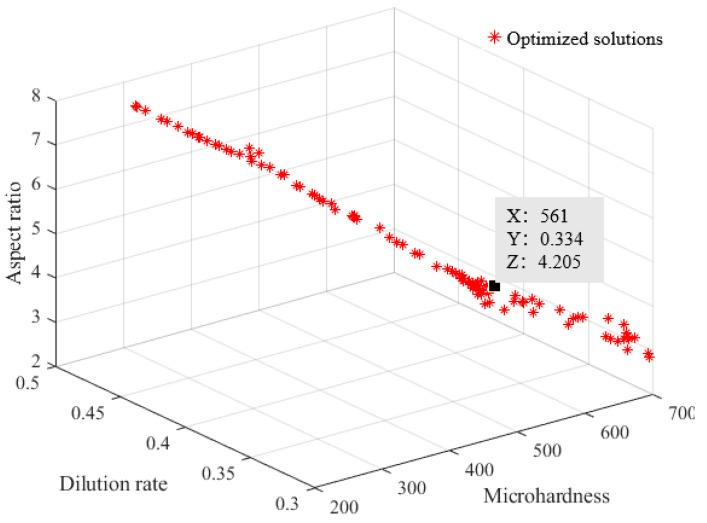
The use of laser cladding technology to prepare coatings of AlCoCrFeNi high-entropy alloy holds enormous potential for application. However, the cladding quality will have a considerable effect on the properties of the coatings. In this study, considering the complex coupling relationship between cladding quality and the process parameters, an orthogonal experimental design was employed, with laser power, scanning speed, and powder feed rate as correlation factor variables, and microhardness, dilution rate, and aspect ratio as characteristic variables. The experimental data underwent gray correlation analysis to determine the effect of various process parameters on the quality of cladding. Then, the NSGA-II algorithm was used to establish a multi-objective optimization model of process parameters. Finally, the ANSYS Workbench simulation model was employed to conduct numerical simulations on a group of optimized process parameters and analyze the change rule of the temperature field. The results demonstrate that the laser cladding coating of AlCoCrFeNi high-entropy alloy with the single pass is of high quality within the determined orthogonal experimental parameters. The powder feed rate exerts the most significant influence on microhardness, while laser power has the greatest impact on dilution rate, and scanning speed predominantly affects aspect ratio. The designed third-order polynomial nonlinear regression model exhibits a high fitting accuracy, and the NSGA-II algorithm can be used for multi-objective optimization to obtain the Pareto front solution set. The numerical simulation results demonstrate that the temperature field of AlCoCrFeNi high-entropy alloy laser cladding exhibits a "comet tail" phenomenon, where the highest temperature of the molten pool is close to 3000 °C. The temperature variations in the molten pool align with the features of laser cladding technology. This study lays the groundwork for the widespread application of laser cladding AlCoCrFeNi high-entropy alloy in surface engineering, additive manufacturing, and remanufacturing. Researchers and engineering practitioners can utilize the findings from this research to judiciously manage processing parameters based on the results of gray correlation analysis. Furthermore, the outcomes of multi-objective optimization can assist in the selection of appropriate process parameters aligned with specific application requirements. Additionally, the methodological approach adopted in this study offers valuable insights applicable to the exploration of various materials and diverse additive manufacturing techniques.
利用激光熔覆技术制备AlCoCrFeNi高熵合金涂层具有巨大的应用潜力。然而,熔覆质量会对涂层性能产生相当大的影响。在本研究中,考虑到熔覆质量与工艺参数之间复杂的耦合关系,采用了正交试验设计,将激光功率、扫描速度和送粉速率作为相关因子变量,将显微硬度、稀释率和长宽比作为特征变量。对实验数据进行灰色关联分析,以确定各种工艺参数对熔覆质量的影响。然后,使用NSGA-II算法建立工艺参数的多目标优化模型。最后,采用ANSYS Workbench模拟模型对一组优化后的工艺参数进行数值模拟,并分析温度场的变化规律。结果表明,在确定的正交试验参数范围内,单道次的AlCoCrFeNi高熵合金激光熔覆涂层质量较高。送粉速率对显微硬度的影响最为显著,而激光功率对稀释率的影响最大,扫描速度主要影响长宽比。所设计的三阶多项式非线性回归模型具有较高的拟合精度,NSGA-II算法可用于多目标优化以获得帕累托前沿解集。数值模拟结果表明,AlCoCrFeNi高熵合金激光熔覆的温度场呈现“彗尾”现象,熔池最高温度接近3000℃。熔池内的温度变化与激光熔覆技术的特点相符。本研究为激光熔覆AlCoCrFeNi高熵合金在表面工程、增材制造和再制造中的广泛应用奠定了基础。研究人员和工程技术人员可以利用本研究结果,根据灰色关联分析结果合理控制加工参数。此外,多目标优化的结果有助于根据特定应用需求选择合适的工艺参数。此外,本研究采用的方法为探索各种材料和不同的增材制造技术提供了有价值的见解。




 Zotero 插件