
空心下沉过程中微管内外表面粗糙度的变化
Change in Surface Roughness on the Inner and Outer Surfaces of the Microtube during Hollow Sinking.
作者信息
Sakaguchi Hayate, Kishimoto Takuma, Suematsu Saki, Tashima Kenichi, Kano Koichi, Kajino Satoshi, Gondo Shiori, Suzuki Shinsuke
机构信息
Department of Materials Science, Graduate School of Fundamental Science and Engineering, Waseda University, 3-4-1 Okubo, Shinjuku 169-8555, Japan.
Department of Applied Mechanics and Aerospace Engineering, Faculty of Fundamental Science and Engineering, Waseda University, 3-4-1 Okubo, Shinjuku 169-8555, Japan.
出版信息
Materials (Basel). 2024 Aug 30;17(17):4320. doi: 10.3390/ma17174320.
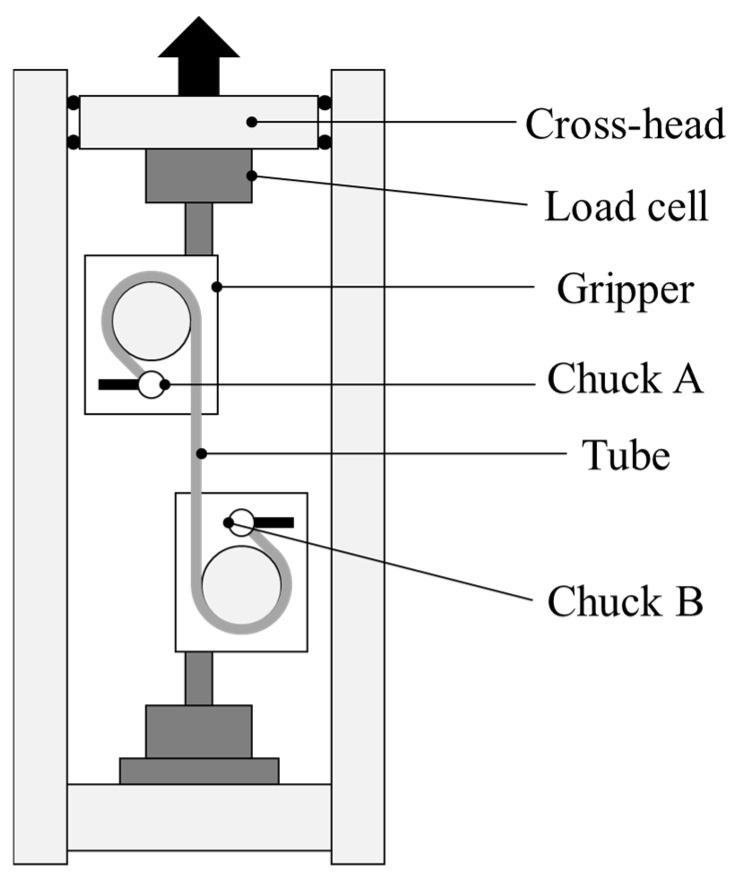
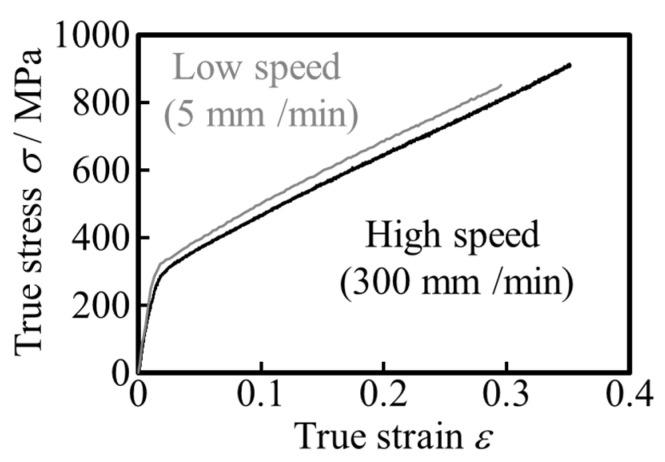
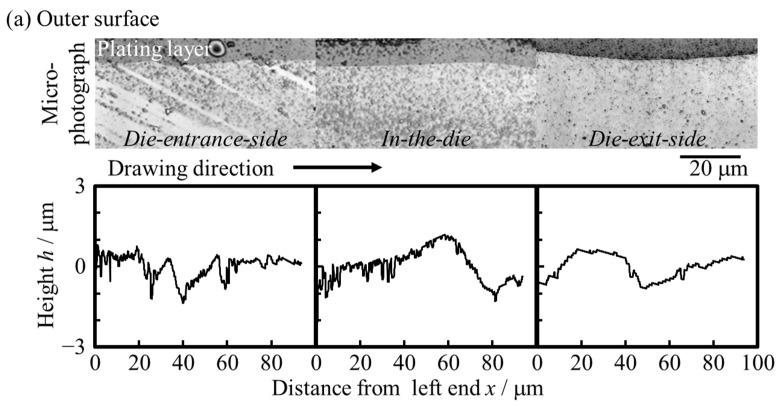
Hollow sinking experiments and tensile tests were conducted to clarify the evolution of surface roughness during hollow sinking. Stainless steel tubes (outer diameter: 1.5 mm; wall thickness: 0.045 mm) featuring a single grain spanning the wall thickness achieved via annealing as the starting material. The tube was drawn without an internal tool using a draw bench by controlling the tube drawing speed ratio of the die entrance and exit sides. The surface roughnesses of the inner and outer surfaces at the die entrance and exit sides of the drawn tube were compared with the surface roughnesses of the inner and outer surfaces under the uniaxial tensile deformation of the starting material. As a result, two major findings were revealed; the surface roughness formation behavior during the hollow sinking; the uniaxial tensile deformation exhibits a tube on both sides of the entrance and the exit of a die. Former uniaxial tensile deformation forms surface roughness of the tube at the die-entrance-side. However, hollow sinking reduces the roughness. The tube keeps its small roughness even though it is applied the later uniaxial tensile deformation behind the die exit. Furthermore, the conventional formula to predict the surface roughness of a metal sheet caused by the uniaxial tensile deformation can predict the surface roughness of a tube in the hollow sinking. At both die entrance and exit sides, the roughness of the inner surface was larger than that of the outer surface at the die entrance and exit side. The outer surface of the tube contacts the inside of a die when the tube passes through the die. The height of the convex parts decreased at that moment. Hollow sinking suppressed the increase in surface roughness of the inner surface as the outer surface was smoothed in the die. However, due to the formation of surface roughness after leaving the die, there is an overall increasing trend in inner surface roughness.
进行了空心拉拔实验和拉伸试验,以阐明空心拉拔过程中表面粗糙度的演变。以通过退火获得的壁厚上具有单个晶粒的不锈钢管(外径:1.5毫米;壁厚:0.045毫米)作为原材料。通过控制模具入口和出口侧的管材拉拔速度比,使用拉拔台在没有内部工具的情况下对管材进行拉拔。将拉拔管材模具入口和出口侧的内表面和外表面的粗糙度与原材料单轴拉伸变形下的内表面和外表面粗糙度进行比较。结果,揭示了两个主要发现;空心拉拔过程中的表面粗糙度形成行为;单轴拉伸变形在模具入口和出口两侧均表现出管材的情况。先前的单轴拉伸变形在模具入口侧形成管材的表面粗糙度。然而,空心拉拔降低了粗糙度。即使在模具出口后方施加后期单轴拉伸变形,管材仍保持其较小的粗糙度。此外,用于预测由单轴拉伸变形引起的金属板表面粗糙度的传统公式可以预测空心拉拔中管材的表面粗糙度。在模具入口和出口两侧,内表面的粗糙度均大于模具入口和出口侧外表面的粗糙度。当管材穿过模具时,管材的外表面与模具内部接触。此时凸部的高度降低。由于外表面在模具中被平滑,空心拉拔抑制了内表面表面粗糙度的增加。然而,由于离开模具后表面粗糙度的形成,内表面粗糙度总体上有增加的趋势。








 Zotero 插件