Sahli Agnès, Daeniker Laurent, Rossier Isaline, Caseiro Luciana, di Bella Enrico, Krejci Ivo, Bortolotto Tissiana
Division of Fixed Prosthodontics and Biomaterials, University Clinic of Dental Medicine (CUMD), University of Geneva, 1205 Geneva, Switzerland.
Division of Cariology and Endodontology, University Clinic of Dental Medicine (CUMD), University of Geneva, 1205 Geneva, Switzerland.
Materials (Basel). 2024 Sep 4;17(17):4373. doi: 10.3390/ma17174373.
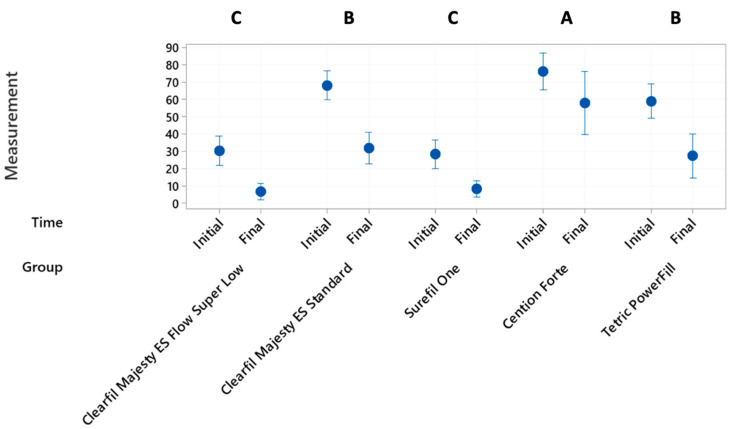
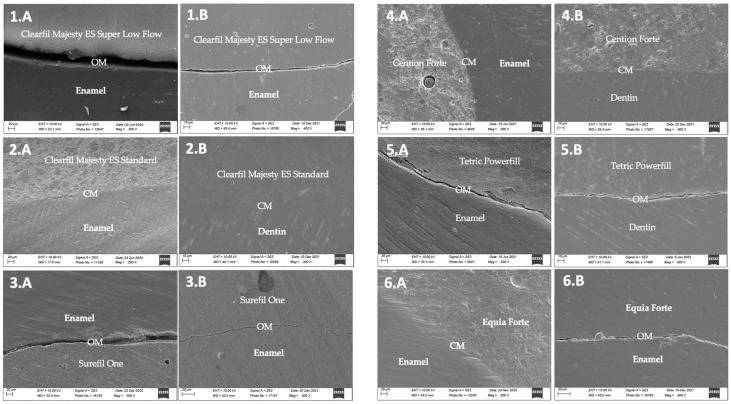
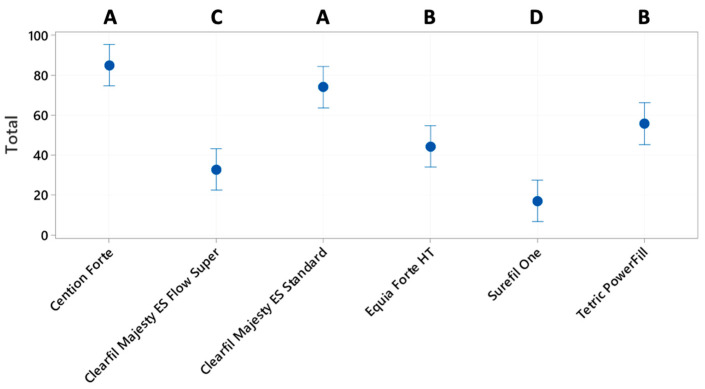
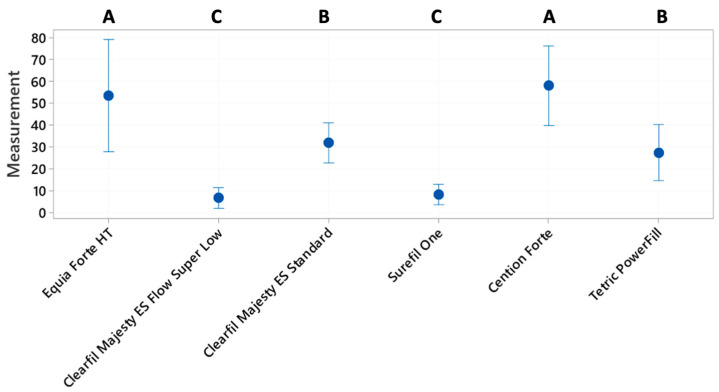
(1) Background: Restoring decayed teeth in young patients can be challenging. This calls for a simplification of the protocols through new biomaterials. Therefore, the aim of this study was to compare the marginal adaptation delivered by restorative materials applied on class II cavities by using a simplified protocol, before and after fatigue test, followed by the assessment of the internal adaptation. (2) Methods: Forty-eight human teeth were divided into six groups (n = 8). Dentinal fluid simulation was performed before restoring the class II cavities: Gr 1-adhesive (Clearfil Universal Bond Quick) and nanohybrid flowable composite (Clearfil Majesty ES Super Low Flow), Gr 2-adhesive (Clearfil Universal Bond Quick) and nanohybrid composite (Clearfil Majesty ES standard), Gr 3-bulk fill self-adhesive composite (Surefil One), Gr 4-bioactive powder-liquid filling material (Cention Forte), Gr 5-universal adhesive (Adhese Universal) and nanohybrid composite resin (Tetric Powerfill); and control group (CT)-high-viscosity glass ionomer (Equia Forte). Marginal adaptation was observed with scanning electron microscopy (SEM) and compared before and after a fatigue test consisting of repeated thermal and mechanical cycles. The specimens were then cut mesio-distally, and internal adaptation was undertaken using SEM again. Repeated measures and one way ANOVA followed by a Fisher's LSD test and Fisher's LSD post hoc test were used in order to compare the statistically significant differences among groups. (3) Results: As for the marginal adaptation after loading, Cention Forte (58%) and Equia Forte HT (53%) were statistically equivalent and presented the highest results, followed by Clearfil Majesty ES Standard (32%) and Tetric Powerfill (27%), with Surefil One (8%) and Clearfil Majesty ES Flow Super Low (7%) showing the worst results. In terms of internal adaptation, Cention Forte (85%) and Clearfil Majesty ES Standard (74%) had the highest percentages of continuous margins. Tetric powerfill (56%) and Equia Forte HT (44%) showed statistically significantly lower results, followed by Clearfil Majesty ES Flow Super Low (33%) and eventually Surefil One (17%). (4) Conclusions: This in vitro study showed promising results for the marginal and internal adaptation of alkasite dual cured Cention Forte in the restoration of class II cavities. This material could be considered an interesting restorative alternative for the restoration of deciduous teeth.
(1) 背景:修复年轻患者的龋坏牙齿可能具有挑战性。这就需要通过新型生物材料简化治疗方案。因此,本研究的目的是比较使用简化方案在II类洞上应用修复材料后,在疲劳试验前后的边缘适应性,随后评估内部适应性。(2) 方法:48颗人牙分为6组(n = 8)。在修复II类洞之前进行牙本质液模拟:第1组-粘结剂(Clearfil Universal Bond Quick)和纳米混合可流动复合树脂(Clearfil Majesty ES Super Low Flow),第2组-粘结剂(Clearfil Universal Bond Quick)和纳米混合复合树脂(Clearfil Majesty ES standard),第3组-大块充填自粘结复合树脂(Surefil One),第4组-生物活性粉液充填材料(Cention Forte),第5组-通用粘结剂(Adhese Universal)和纳米混合复合树脂(Tetric Powerfill);以及对照组(CT)-高粘度玻璃离子水门汀(Equia Forte)。通过扫描电子显微镜(SEM)观察边缘适应性,并在由重复热循环和机械循环组成的疲劳试验前后进行比较。然后将标本沿近远中方向切割,再次使用SEM评估内部适应性。为了比较各组之间的统计学显著差异,采用重复测量和单因素方差分析,随后进行Fisher最小显著差异检验和Fisher最小显著差异事后检验。(3) 结果:关于加载后的边缘适应性,Cention Forte(58%)和Equia Forte HT(53%)在统计学上相当,且结果最高,其次是Clearfil Majesty ES Standard(32%)和Tetric Powerfill(27%),Surefil One(8%)和Clearfil Majesty ES Flow Super Low(7%)显示最差结果。在内部适应性方面,Cention Forte(85%)和Clearfil Majesty ES Standard(74%)的连续边缘百分比最高。Tetric powerfill(56%)和Equia Forte HT(44%)显示统计学上显著较低的结果,其次是Clearfil Majesty ES Flow Super Low(33%),最终是Surefil One(17%)。(4) 结论:这项体外研究表明,碱式硅铝酸盐双固化Cention Forte在修复II类洞时,在边缘和内部适应性方面显示出有前景的结果。这种材料可被视为修复乳牙的一种有趣的修复替代材料。