Riddler Sharon A, Benson Constance A, Brinson Cynthia, Deeks Steven G, DeJesus Edwin, Mills Anthony, Para Michael F, Ramgopal Moti N, Cai Yanhui, Zheng Yanan, Zhang Liao, Jiang Wendy, Liu Xiaopeng, Verrill Donovan, Lim Daina, de Vries Christiaan R, Wallin Jeffrey J, Vendrame Elena, SenGupta Devi
Department of Medicine, University of Pittsburgh, Pittsburgh, PA, USA.
Department of Medicine, UC San Diego, San Diego, CA, USA.
Infect Dis Ther. 2024 Nov;13(11):2285-2299. doi: 10.1007/s40121-024-01034-w. Epub 2024 Sep 15.
Vesatolimod is a Toll-like receptor-7 (TLR7) agonist in clinical development as part of a combination regimen for human immunodeficiency virus (HIV) cure. Influenza-like symptoms associated with TLR7-mediated immune activation have been reported in clinical trials of vesatolimod. Therefore, a broader understanding of the safety profile of vesatolimod and association with dose and mechanism of action will help inform future clinical studies.
In this analysis, data on flu-like adverse events of interest (AEIs) were pooled from eight clinical studies in which 606 participants either received single or multiple doses of vesatolimod (0.3-12 mg; n = 505) or placebo (n = 101). Vesatolimod pharmacokinetics, inflammatory responses, and pharmacodynamics were assessed.
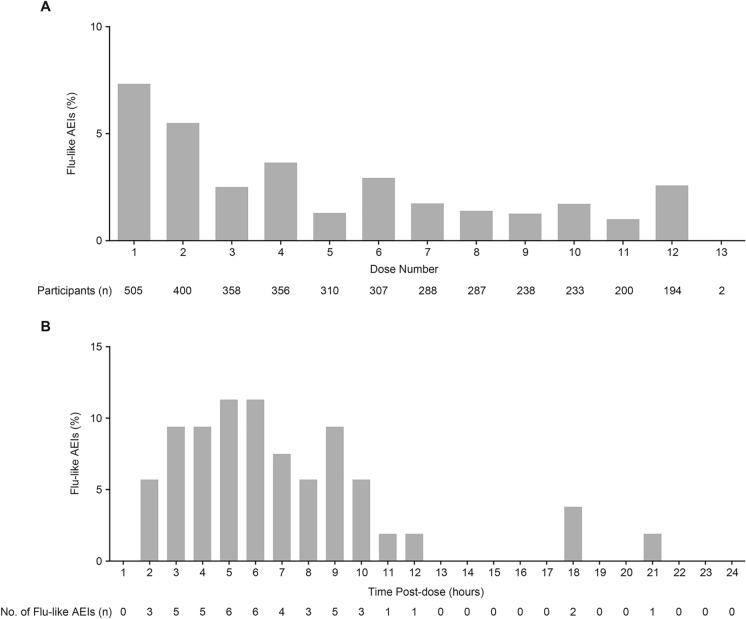
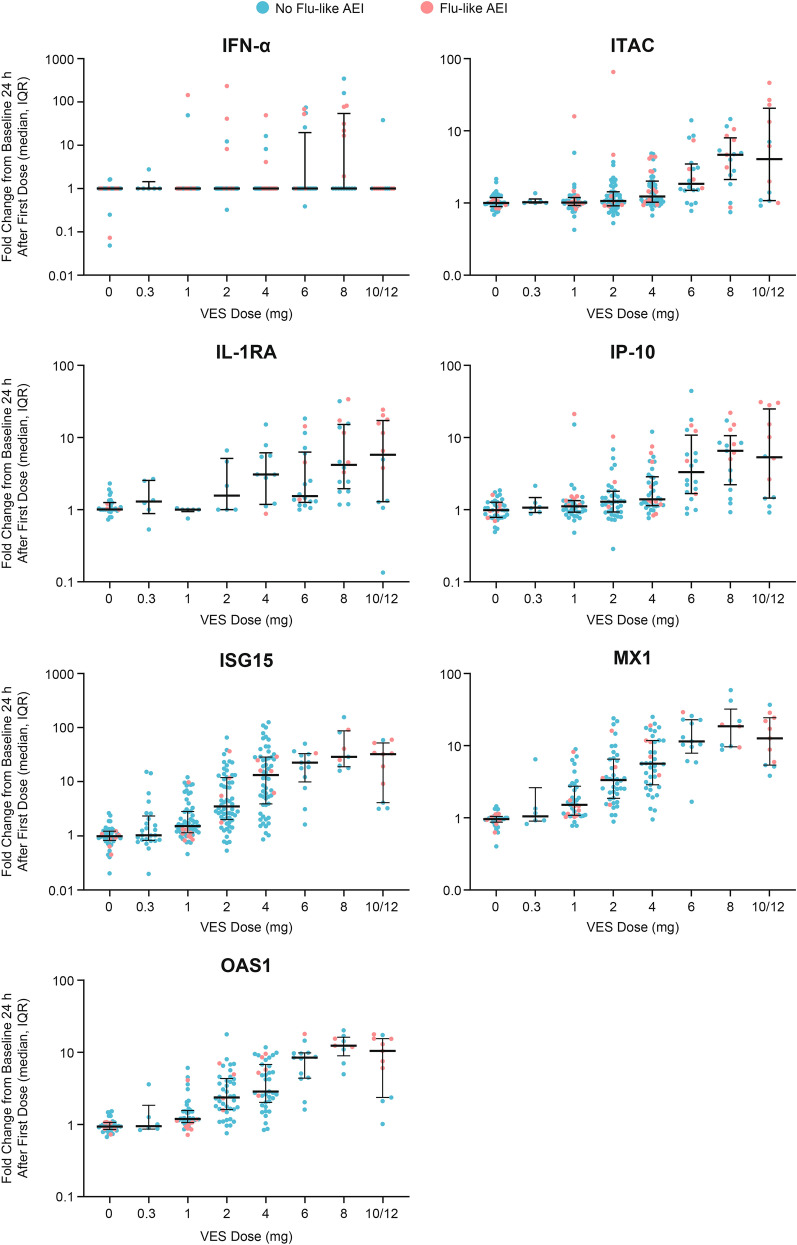
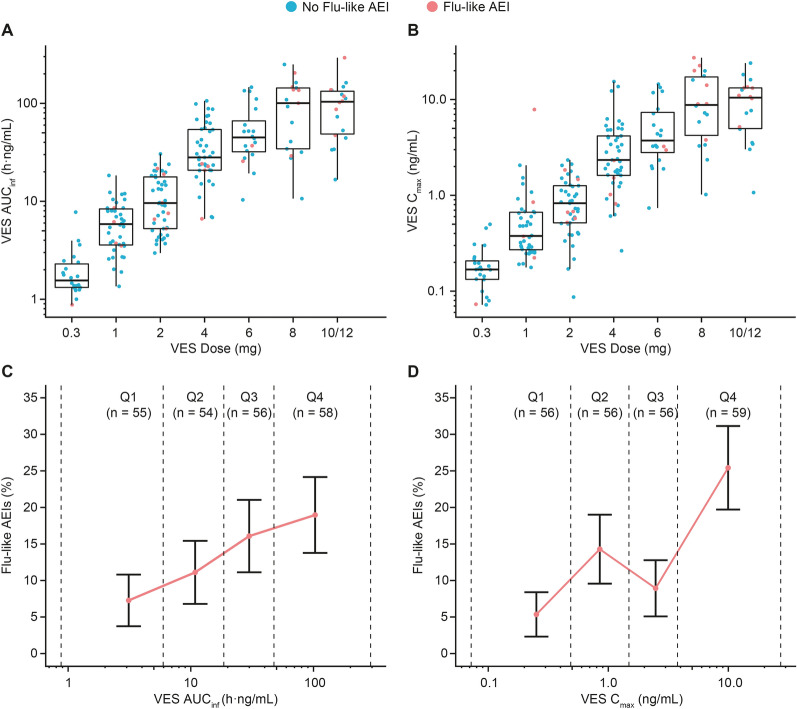
The incidence of flu-like AEIs was higher with vesatolimod versus placebo (19% [96/505] vs. 8% [8/101]) and increased with vesatolimod dose and exposure. Most flu-like AEIs with vesatolimod were grade 1 or 2 severity (55% [53 of 96] grade 1; 35% [34 of 96] grade 2) with onset primarily after the first and second dose. Occurrence of flu-like AEIs after doses 1-3 was predictive of reoccurrence after later doses. Dose-dependent elevations of pharmacodynamic biomarkers (interferon-stimulated gene 15, 2'-5'-oligoadenylate synthetase 1, myxovirus resistance-1, interferon-α, interleukin-1 receptor antagonist, interferon-γ-induced protein 10, interferon-inducible T-cell-α chemoattractant) observed in participants with flu-like AEIs suggest a link with vesatolimod mechanism of action.
Flu-like AEIs associated with vesatolimod administration were typically mild but increased with exposure, which may be predicted by the response to initial doses. The data suggest that adaptive clinical monitoring could help maximize pharmacodynamic responses and balance adverse events in future clinical trials of vesatolimod.
维萨特利莫德是一种Toll样受体7(TLR7)激动剂,目前正处于临床开发阶段,作为人类免疫缺陷病毒(HIV)治愈联合方案的一部分。在维萨特利莫德的临床试验中,已报告了与TLR7介导的免疫激活相关的流感样症状。因此,更全面地了解维萨特利莫德的安全性概况以及与剂量和作用机制的关联,将有助于为未来的临床研究提供信息。
在本分析中,从八项临床研究中汇总了有关感兴趣的流感样不良事件(AEIs)的数据,其中606名参与者接受了单剂量或多剂量的维萨特利莫德(0.3 - 12毫克;n = 505)或安慰剂(n = 101)。评估了维萨特利莫德的药代动力学、炎症反应和药效学。
与安慰剂相比,维萨特利莫德引起的流感样AEIs发生率更高(19% [96/505] 对8% [8/101]),且随维萨特利莫德剂量和暴露量增加而升高。维萨特利莫德引起的大多数流感样AEIs严重程度为1级或2级(55% [96例中的53例]为1级;35% [96例中的34例]为2级),主要在第一剂和第二剂后出现。第1 - 3剂后出现流感样AEIs可预测后续剂量后会再次出现。在出现流感样AEIs的参与者中观察到药效学生物标志物(干扰素刺激基因15、2'-5'-寡腺苷酸合成酶1、抗黏液病毒蛋白1、干扰素-α、白细胞介素-1受体拮抗剂、干扰素-γ诱导蛋白10、干扰素诱导的T细胞α趋化因子)的剂量依赖性升高,这表明与维萨特利莫德的作用机制有关。
与维萨特利莫德给药相关的流感样AEIs通常较轻,但随暴露量增加,这可能可通过对初始剂量的反应来预测。数据表明,适应性临床监测有助于在未来维萨特利莫德的临床试验中使药效学反应最大化并平衡不良事件。