Zhou Keyang, Peng Song, Yao Guang, Luo Yu, Li Quanji, Huang Yunchen, Zhang Qingxia, Deng Lingling, Song Zhi, Wang Wei, Liu Ding, Liu Yin
Department of Radiology, the Third Xiangya Hospital, Central South University, Changsha, China.
Department of Radiology, The Second Affiliated Hospital, Hengyang Medical School, University of South China, Hengyang, China.
Quant Imaging Med Surg. 2024 Sep 1;14(9):6745-6755. doi: 10.21037/qims-24-375. Epub 2024 Aug 28.
The glymphatic system is essential for the maintenance of brain homeostasis. It may be impaired in patients with epilepsy, but its association with neurocognitive function remains unknown. In this study, we aimed to elucidate the association between changes in the glymphatic system and neurocognitive function in individuals diagnosed with frontal lobe epilepsy (FLE).
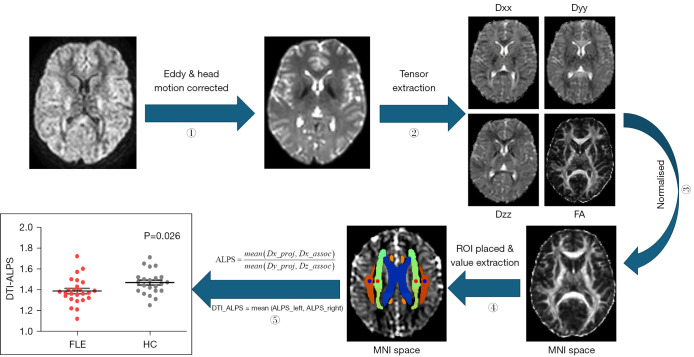
This retrospective case-control research engaged a group of patients with FLE and age-, sex-, and education-matched healthy volunteers. All participants were subjected to extensive neurocognitive assessments, complemented by structural and diffusion-weighted imaging. The "diffusion tensor imaging analysis along the perivascular space" (DTI-ALPS) index was computed to ascertain differences in glymphatic system function between the groups. Univariate and multivariate analyses were conducted to explore associations between DTI-ALPS, clinical characteristics in patients with FLE, and the neurocognitive test outcomes for both groups.
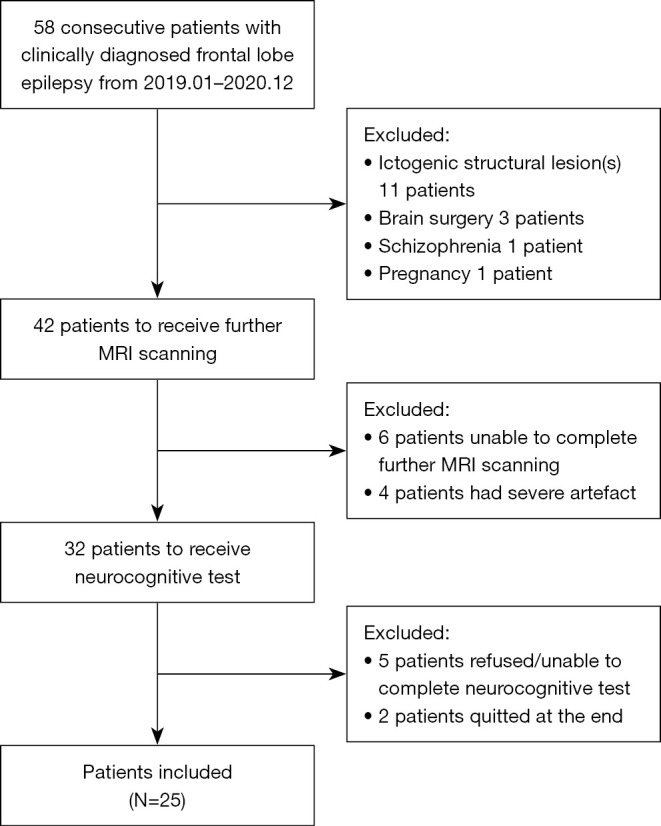
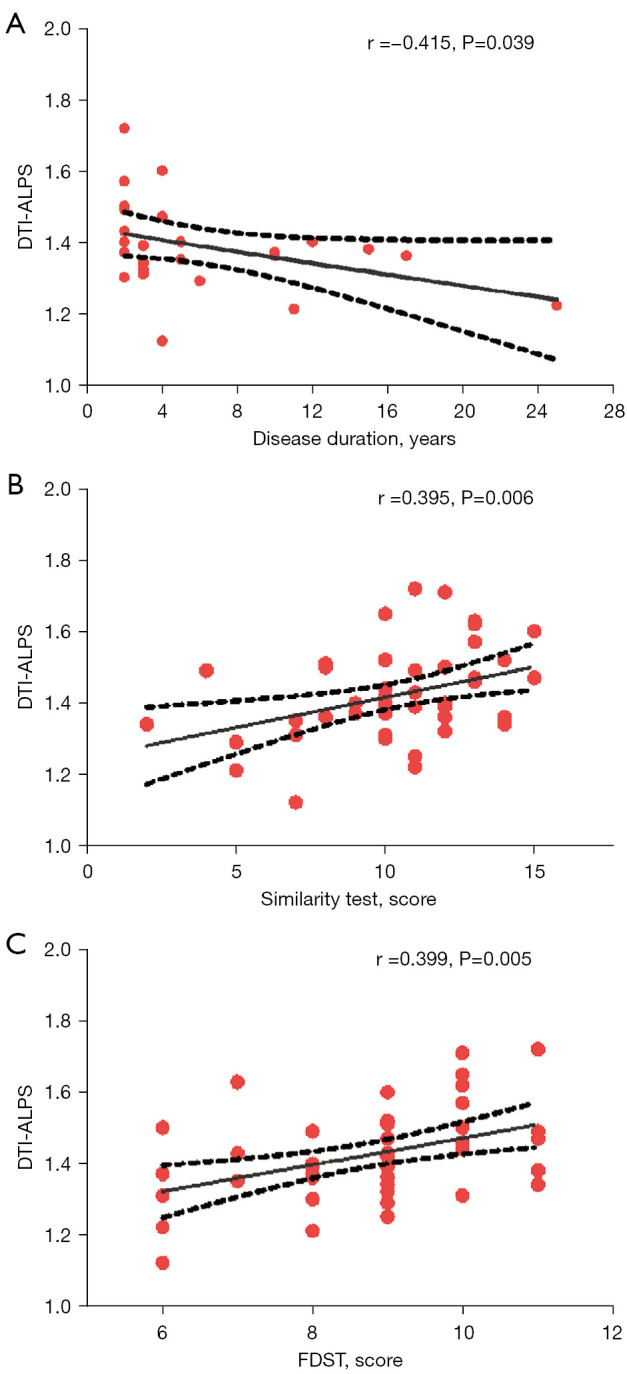
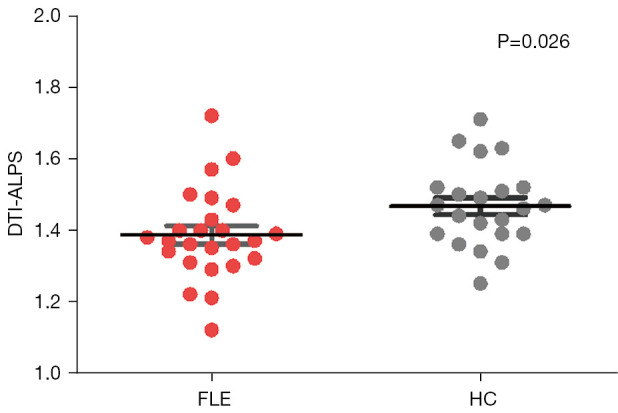
Twenty-five patients [mean age ± standard deviation (SD): 26.28±8.12 years, 10 females] with FLE and 22 healthy control (HC) participants (average age ± SD: 25.86±6.15 years, 11 females) were included. The average ALPS-index in FLE group was significantly lower than that in HC group (1.387±0.127 1.468±0.114, P=0.026). Further, significant neurocognitive difference was noted in Trail Making Test (TMT), Stroop Color and Word Test (SCWT), Digit Span Test (DST) and similarity test (ST) between the two groups. ALPS-index scores exhibited a negative correlation with disease duration in patients with FLE (r=-0.415, P=0.039), and positive correlations with the Forward Digit Span Test (FDST, r=0.399, P=0.005) and Similarity Test (ST, r=0.395, P=0.006) in both groups. After adjusting for potential confounders, DTI-ALPS maintained a significant independent association with FDST and ST.
The findings of the current study suggest a possible association between impairment in glymphatic function and FLE. Furthermore, results indicate that glymphatic dysfunction, as assessed via DTI-ALPS index, appears to be related to neurocognitive decline in FLE.
类淋巴系统对于维持脑内环境稳定至关重要。癫痫患者的类淋巴系统可能受损,但其与神经认知功能的关联尚不清楚。在本研究中,我们旨在阐明被诊断为额叶癫痫(FLE)的个体中类淋巴系统变化与神经认知功能之间的关联。
这项回顾性病例对照研究纳入了一组FLE患者以及年龄、性别和教育程度相匹配的健康志愿者。所有参与者均接受了广泛的神经认知评估,并辅以结构和扩散加权成像。计算“沿血管周围间隙的扩散张量成像分析”(DTI-ALPS)指数,以确定两组之间类淋巴系统功能的差异。进行单因素和多因素分析,以探讨DTI-ALPS、FLE患者的临床特征与两组神经认知测试结果之间的关联。
纳入了25例FLE患者[平均年龄±标准差(SD):26.28±8.12岁,10例女性]和22名健康对照(HC)参与者(平均年龄±SD:25.86±6.