
手术仪表盘对小儿扁桃体切除术结果的实施与影响:一项质量改进研究。
Implementation and impact of a surgical dashboard on pediatric tonsillectomy outcomes: A quality improvement study.
作者信息
Dang Quynh-Chi L, Román Emily, Donner Kimberly, Carsey Emily, Mitchell Ron F, Chorney Stephen R, Johnson Romaine F
机构信息
Department of Otolaryngology, Head and Neck Surgery University of Texas, Southwestern Medical Center at Dallas Dallas Texas USA.
出版信息
Laryngoscope Investig Otolaryngol. 2024 Sep 14;9(5):e1315. doi: 10.1002/lio2.1315. eCollection 2024 Oct.
INTRODUCTION
In pediatric tonsillectomy management, the consistent tracking of surgical outcomes and adherence to guidelines are vital. This study explores how a surgical dashboard can serve as a tool in research analysis, translating AAO-HNSF guidelines into measurable performance improvements.
METHODS
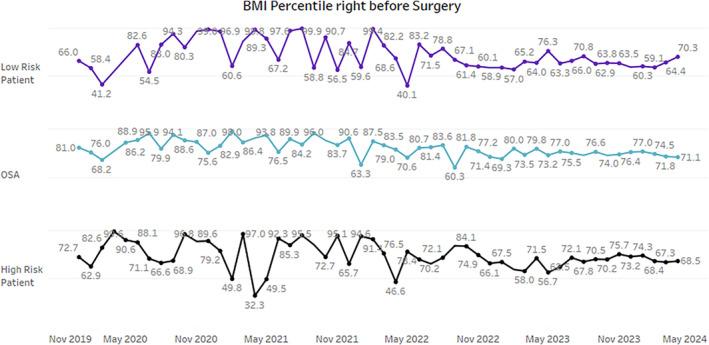
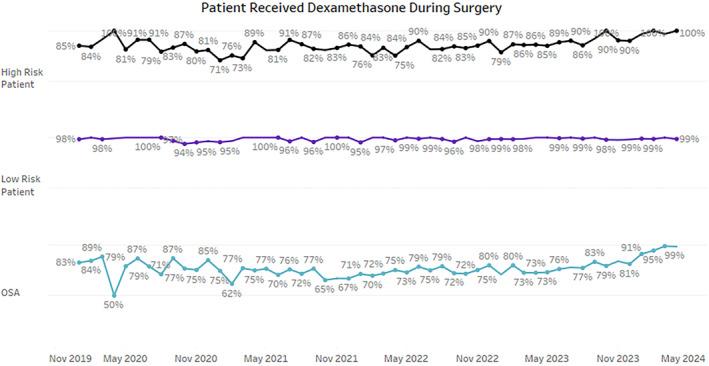
Using a prospective registry from three pediatric hospitals, a Tableau dashboard was constructed to graphically visualize key demographic and postoperative outcomes (including intensive care unit [ICU] utilization, 30-day emergency department (ED) visits, and postoperative bleed rates) in children undergoing tonsillectomy from 2020 to 2024. From the dashboard data, a retrospective cohort study analyzing 6767 tonsillectomies was conducted from January 2, 2020, to June 20, 2023. Patients were categorized into low-risk, OSA-only (by ICD-10 codes), and high-risk groups based on comorbidities. Logistic regression identified factors influencing ED revisits and unplanned nursing calls. Three quality initiatives were assessed: preoperative school absence notes, perioperative dexamethasone recording, and post-tonsillectomy parental education.
RESULTS
A total of 2122 (31%) were low-risk, 2648 (39%) were OSA-only, and 1997 (30%) high risk. Risk factors that increased the likelihood of ED visits were high-risk comorbidities (OR = 1.46; 95% CI = 1.24-1.74; < 0.001) and older age (OR = 1.05; 95% CI = 1.03-1.08; < 0.001). Risk factors that increased the likelihood of an unplanned nursing communication were high-risk comorbidities (OR = 1.53; 95% CI = 1.34-1.75; < 0.001), older age (OR = 1.03, 95% CI = 1.01-1.04; = 0.001), and Medicaid insurance (OR = 1.25; 95% CI = 1.09-1.43; = 0.002). Postoperative bleed control was generally comparable between the groups, at 2.8% (low risk), 2.7% (OSA), 3.2 (high risk) ( = 0.651).
CONCLUSION
The dashboard aided in data collection, data visualization, and data analysis of quality improvement initiatives, effectively translating guidelines into tangible measures to enhance care.
LEVEL OF EVIDENCE
NA.
引言
在小儿扁桃体切除术管理中,持续跟踪手术结果并遵循指南至关重要。本研究探讨了手术仪表盘如何作为研究分析工具,将美国耳鼻咽喉头颈外科学会基金会(AAO-HNSF)指南转化为可衡量的性能改进。
方法
利用来自三家儿科医院的前瞻性登记数据,构建了一个Tableau仪表盘,以图形方式直观呈现2020年至2024年接受扁桃体切除术儿童的关键人口统计学和术后结果(包括重症监护病房[ICU]使用率、30天内急诊就诊次数和术后出血率)。根据仪表盘数据,对2020年1月2日至2023年6月20日期间的6767例扁桃体切除术进行了回顾性队列研究。根据合并症将患者分为低风险、仅阻塞性睡眠呼吸暂停(按ICD-10编码)和高风险组。逻辑回归确定了影响急诊复诊和非计划护理呼叫的因素。评估了三项质量改进措施:术前缺课记录、围手术期地塞米松记录以及扁桃体切除术后家长教育。
结果
共有2122例(31%)为低风险,2648例(39%)为仅阻塞性睡眠呼吸暂停,1997例(30%)为高风险。增加急诊就诊可能性的风险因素为高风险合并症(OR = 1.46;95% CI = 1.24 - 1.74;P < 0.001)和年龄较大(OR = 1.05;95% CI = 1.03 - 1.08;P < 0.001)。增加非计划护理沟通可能性的风险因素为高风险合并症(OR = 1.53;95% CI = 1.34 - 1.75;P < 0.001)、年龄较大(OR = 1.03,95% CI = 1.01 - 1.04;P = 0.001)和医疗补助保险(OR = 1.25;95% CI = 1.09 - 1.43;P = 0.002)。术后出血控制在各组之间总体相当,低风险组为2.8%,阻塞性睡眠呼吸暂停组为2.7%,高风险组为3.2%(P = 0.651)。
结论
仪表盘有助于质量改进措施的数据收集、数据可视化和数据分析,有效地将指南转化为切实措施以改善护理。
证据级别
无。




 Zotero 插件