Palmeirim Ana Filipa, Araújo-Fernandes Ana Catarina, Castro-Fernandes Ana Sofia, Guedes Patricia, Cassari José, Mata Vanessa A, Yoh Natalie, Rocha Ricardo, Martínez-Arribas Javier, Alves-Martins Fernanda
CIBIO, Centro de Investigação em Biodiversidade e Recursos Genéticos, InBIO Laboratório Associado, Campus de Vairão, Universidade do Porto, Vairão, Portugal CIBIO, Centro de Investigação em Biodiversidade e Recursos Genéticos, InBIO Laboratório Associado, Campus de Vairão, Universidade do Porto Vairão Portugal.
BIOPOLIS Program in Genomics, Biodiversity and Land Planning, CIBIO, Campus de Vairão, Vairão, Portugal BIOPOLIS Program in Genomics, Biodiversity and Land Planning, CIBIO, Campus de Vairão Vairão Portugal.
Biodivers Data J. 2024 Sep 5;12:e131955. doi: 10.3897/BDJ.12.e131955. eCollection 2024.
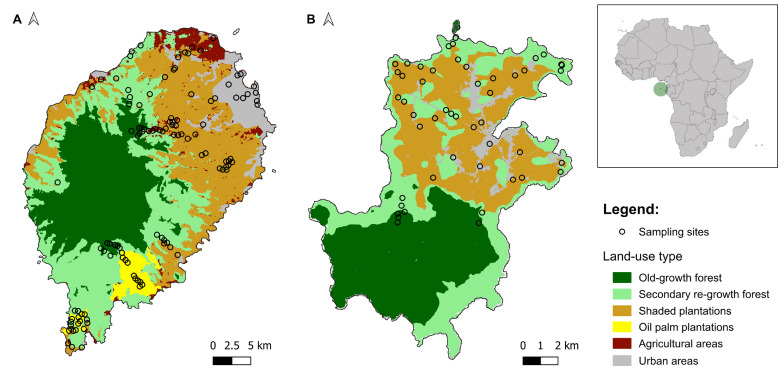
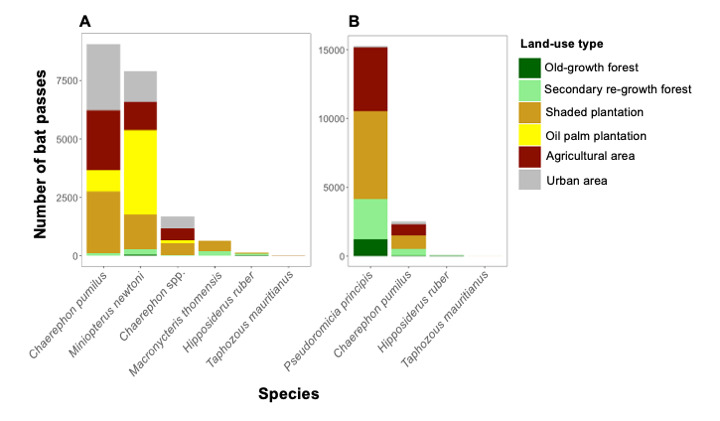
São Tomé and Príncipe oceanic islands, in Central West Africa, are characterised by exceptional levels of endemism. Since human colonisation in the mid-15 century, São Tomé and Príncipe have lost 74% and 67% of their native habitat, respectively. Today, these islands are mainly covered by remaining old-growth forests, secondary regrowth forests, shaded plantations (mostly of cocoa), oil palm plantations (in the case of São Tomé), small-scale agricultural areas and urban areas. Yet, little is known about how species on these islands are coping with land-use changes. Island ecosystems are particularly important for bats, with about 25% of the world's bat species being entirely restricted to island systems. São Tomé and Príncipe Islands comprise six and four native insectivorous bats, respectively. Two species, and , are island-endemics in São Tomé; is an island-endemic in Príncipe; and is endemic from both São Tomé and Príncipe. Here, we present a dataset comprising a comprehensive compilation of occurrence records derived from acoustic sampling of insectivorous bats across the predominant land-use types of both the São Tomé and Príncipe Islands. In each sampling site, standardised surveys consisted of deploying one Audio Moth device that recorded for 1 minute every 5 minutes over a 48-hour period. We identified a total of 19,437 bat-passes across the 115 sites surveyed in São Tomé Island and 17,837 bat-passes across the 50 sites surveyed in Príncipe Island.
Based on a sampling effort of 1,584 hours of recordings manually processed to identify all the contained bat passes, this dataset, publicly available on GBIF, provides comprehensive information on the activity of insectivorous bats across two endemic-rich oceanic islands in the Gulf of Guinea. For each bat pass identified, we report the identified species, geographic coordinates, land-use type, altitude, date and time. This is the first public dataset providing detailed information on species-level habitat use for insectivorous bats on oceanic islands in Africa.
位于非洲中西部的圣多美和普林西比海洋群岛具有极高的特有物种水平。自15世纪中叶人类殖民以来,圣多美和普林西比分别丧失了74%和67%的原生栖息地。如今,这些岛屿主要覆盖着残留的原始森林、次生再生林、遮荫种植园(主要是可可种植园)、油棕种植园(圣多美岛有)、小规模农业区和城市地区。然而,对于这些岛屿上的物种如何应对土地利用变化,人们知之甚少。岛屿生态系统对蝙蝠尤为重要,世界上约25%的蝙蝠物种完全局限于岛屿系统。圣多美和普林西比群岛分别有六种和四种本土食虫蝙蝠。两种物种, 和 ,是圣多美岛的岛屿特有物种; 是普林西比岛的岛屿特有物种; 是圣多美和普林西比两岛的特有物种。在此,我们展示了一个数据集,该数据集全面汇编了通过对圣多美和普林西比群岛主要土地利用类型中的食虫蝙蝠进行声学采样获得的出现记录。在每个采样点,标准化调查包括部署一个音频蛾设备,该设备在48小时内每5分钟记录1分钟。我们在圣多美岛调查的115个地点共识别出19437次蝙蝠飞过,在普林西比岛调查的50个地点共识别出17837次蝙蝠飞过。
基于对1584小时录音进行人工处理以识别所有包含的蝙蝠飞过的采样工作,这个在GBIF上公开可用的数据集提供了关于几内亚湾两个特有物种丰富的海洋岛屿上食虫蝙蝠活动的全面信息。对于识别出的每一次蝙蝠飞过,我们报告所识别的物种、地理坐标、土地利用类型、海拔、日期和时间。这是第一个提供非洲海洋岛屿上食虫蝙蝠物种水平栖息地利用详细信息的公共数据集。