Kurzion Ben, Shih Chia-Hao, Xie Hong, Wang Xin, Xu Kevin S
Case Western Reserve University, Cleveland, OH 44106, USA.
University of Toledo, Toledo, OH 43614, USA.
Artif Intell Med Conf Artif Intell Med (2005-). 2024 Jul;14844:90-100. doi: 10.1007/978-3-031-66538-7_11. Epub 2024 Jul 25.
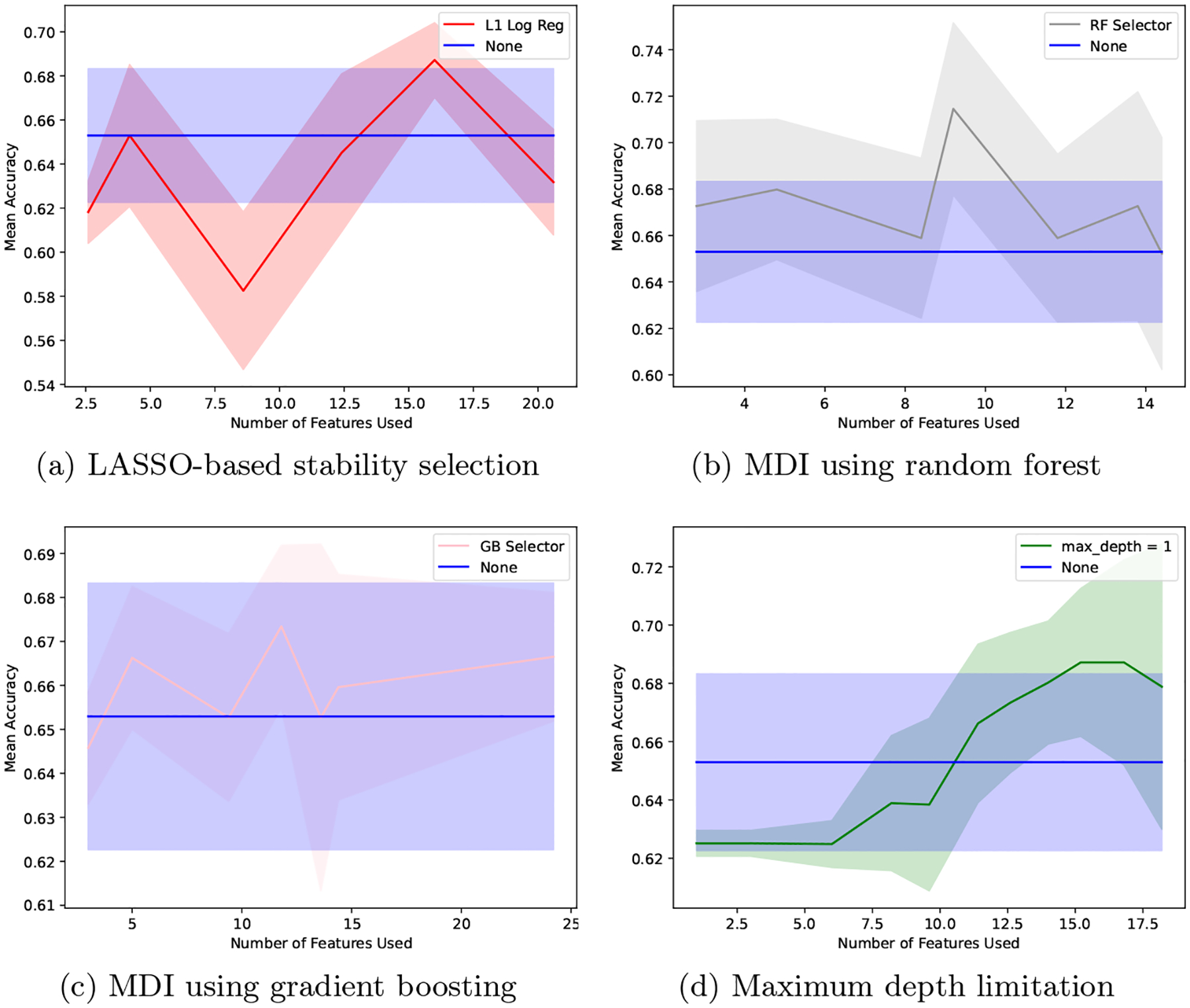
Traumatic experiences have the potential to give rise to post-traumatic stress disorder (PTSD), a debilitating psychiatric condition associated with impairments in both social and occupational functioning. There has been great interest in utilizing machine learning approaches to predict the development of PTSD in trauma patients from clinician assessment or survey-based psychological assessments. However, these assessments require a large number of questions, which is time consuming and not easy to administer. In this paper, we aim to predict PTSD development of patients 3 months post-trauma from multiple survey-based assessments taken within 2 weeks post-trauma. Our objective is to that patients need to answer while . We formulate this as a feature selection problem and consider 4 different feature selection approaches. We demonstrate that it is possible to achieve up to 72% accuracy for predicting the 3-month PTSD diagnosis from 10 survey questions using a mean decrease in impurity-based feature selector followed by a gradient boosting classifier.
创伤经历有可能引发创伤后应激障碍(PTSD),这是一种使人衰弱的精神疾病,与社交和职业功能受损有关。利用机器学习方法从临床评估或基于调查的心理评估中预测创伤患者PTSD的发展受到了极大关注。然而,这些评估需要大量问题,既耗时又不易实施。在本文中,我们旨在根据创伤后2周内进行的多次基于调查的评估来预测患者创伤后3个月PTSD的发展。我们的目标是在患者回答问题时……我们将此表述为一个特征选择问题,并考虑4种不同的特征选择方法。我们证明,使用基于杂质减少的特征选择器,然后是梯度提升分类器,从10个调查问题中预测3个月PTSD诊断的准确率可达72%。