Carroll Emma C, Yang Hyunjun, Jones Julia G, Oehler Abby, Charvat Annemarie F, Montgomery Kelly M, Yung Anthony, Millbern Zoe, Vinueza Nelson R, DeGrado William F, Mordes Daniel A, Condello Carlo, Gestwicki Jason E
Department of Chemistry, San José State University, San José, CA 95192.
Institute for Neurodegenerative Diseases, University of California, San Francisco, San Francisco, CA 94158.
bioRxiv. 2024 Sep 2:2024.09.02.610853. doi: 10.1101/2024.09.02.610853.
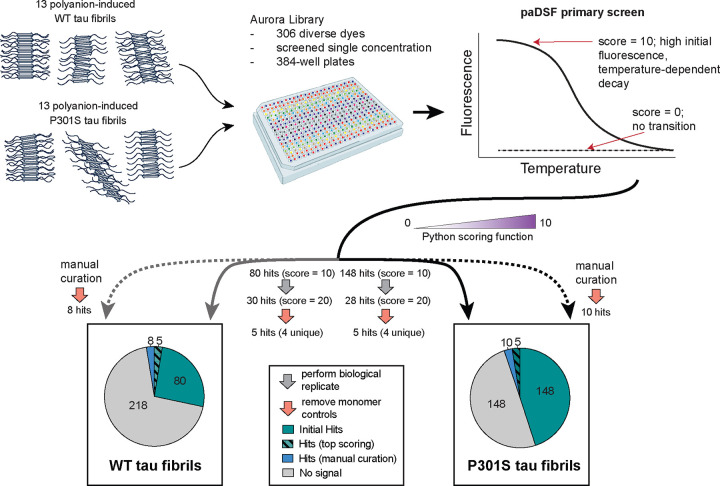
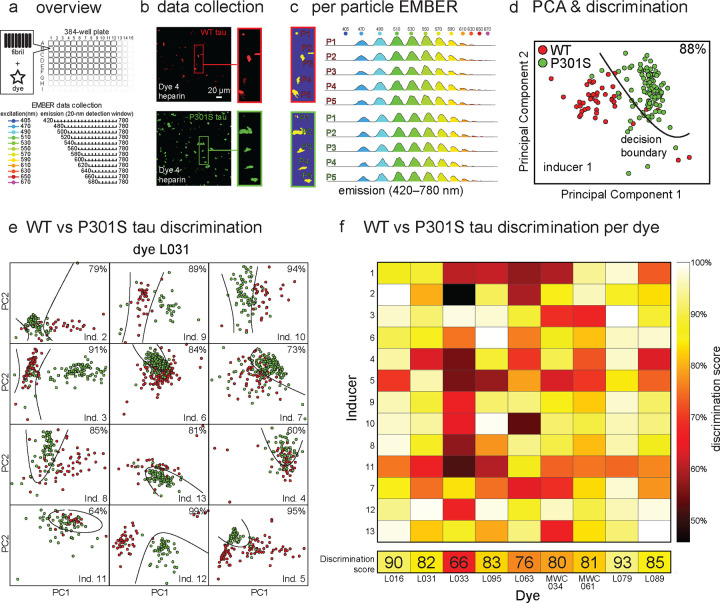
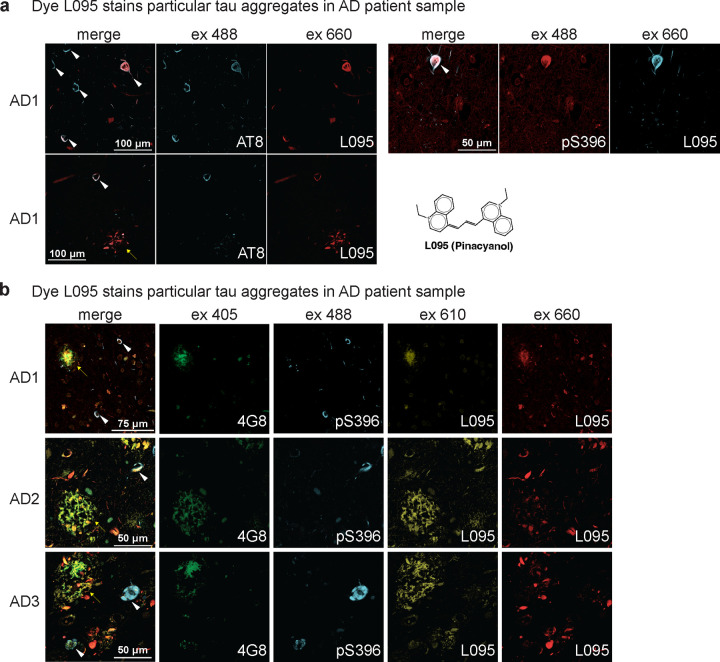
Aggregation of microtubule-associated protein tau (MAPT/tau) into conformationally distinct fibrils underpins neurodegenerative tauopathies. Fluorescent probes (fluoroprobes), such as thioflavin T (ThT), have been essential tools for studying tau aggregation; however, most of them do not discriminate between amyloid fibril conformations (polymorphs). This gap is due, in part, to a lack of high-throughput methods for screening large, diverse chemical collections. Here, we leverage advances in protein adaptive differential scanning fluorimetry (paDSF) to screen the Aurora collection of 300+ fluorescent dyes against multiple synthetic tau fibril polymorphs. This screen, coupled with orthogonal secondary assays, revealed pan-fibril binding chemotypes, as well as fluoroprobes selective for subsets of fibrils. One fluoroprobe recognized tau pathology in brain slices from Alzheimer's disease patients. We propose that these scaffolds represent entry points for development of selective fibril ligands and, more broadly, that high throughput, fluorescence-based dye screening is a platform for their discovery.
微管相关蛋白tau(MAPT/tau)聚集成构象不同的原纤维是神经退行性tau蛋白病的基础。荧光探针,如硫黄素T(ThT),一直是研究tau聚集的重要工具;然而,它们中的大多数无法区分淀粉样原纤维的构象(多晶型物)。这种差距部分是由于缺乏用于筛选大量、多样化学物质库的高通量方法。在这里,我们利用蛋白质适应性差示扫描荧光法(paDSF)的进展,针对多种合成tau原纤维多晶型物筛选了300多种荧光染料的Aurora库。该筛选与正交二级分析相结合,揭示了泛原纤维结合化学型以及对原纤维亚群具有选择性的荧光探针。一种荧光探针在阿尔茨海默病患者的脑切片中识别出tau病变。我们认为,这些支架代表了开发选择性原纤维配体的切入点,更广泛地说,基于荧光的高通量染料筛选是发现它们的一个平台。